











What are the key innovations shaping the future of precast concrete?
Texte Stef Pennemans et Tim Janssens | Photos Tine Brans, Jasmien Smets, Pixabay

From BIM, virtual and augmented reality and robotics to 3D printing, a range of innovations are becoming increasingly established in construction and gradually finding their place in precast concrete. What will concrete construction, including precast, look like in the future? In a podcast on architecture website architectura.be, three experts from the production, development and architecture sectors answer this fascinating question.
Digitalisation can no longer be ignored in today’s construction practice. This also applies to people and organisations working with precast concrete. The fact that the underlying principles of prefabrication and innovative collaboration models such as Design & Build overlap is already an advantage, says Dirk Engelen, managing director of BINST ARCHITECTS. “In conventional construction, a limited percentage of additional costs is due to failures. BIM can significantly optimise processes and minimise these risks, and this is where prefabrication can play a key role. In collaborative construction teams, added value is often sought by involving the contractor at a very early stage, resulting in greater efficiency. Precast fits perfectly into this approach.”
The main aim is to resolve critical issues at the preliminary design stage, reduce construction time on site and minimise construction errors. However, BIM is still in its infancy in precast concrete production, although progress seems to have accelerated recently. “A lot is still done manually and on site, and there is considerable scope for automating production. BIM offers significant added value, particularly in terms of quality assurance,” says Sonja Kuypers, CEO of Ebema.
Robotics and augmented reality
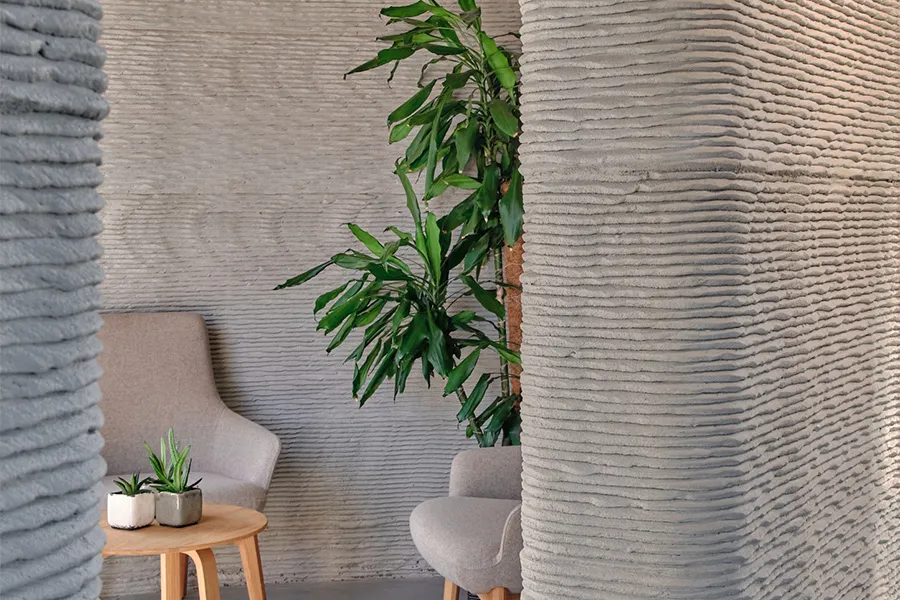
Robotics, laser technology, optical scanning, augmented reality … these innovations have also begun to make their way into the precast sector. “Augmented reality lets you overlay information on the real world, such as complex construction junctions and specific assembly instructions. This helps reduce execution errors and the resulting costs of failure,” explains Vincent Kerkstoel, director of the Kerkstoel Group and president of Febestral.
Augmented and virtual reality are also valuable tools for engaging with clients. For example, they can be used early in a project to show clients a detailed, realistic image of the intended end result, making it easier to explain the design and execution choices made. Dirk Engelen believes this development will lead to a new way of working with clients, design practices and contractors. “The virtual handover of the model, including the technical installations, finishes, colours … could be an important step in the construction process. Of course, this shifts much of the design work that is currently done during the execution phase to the preliminary phase, moving the construction process forward at TGV speed.”
Is 3D printing the future?
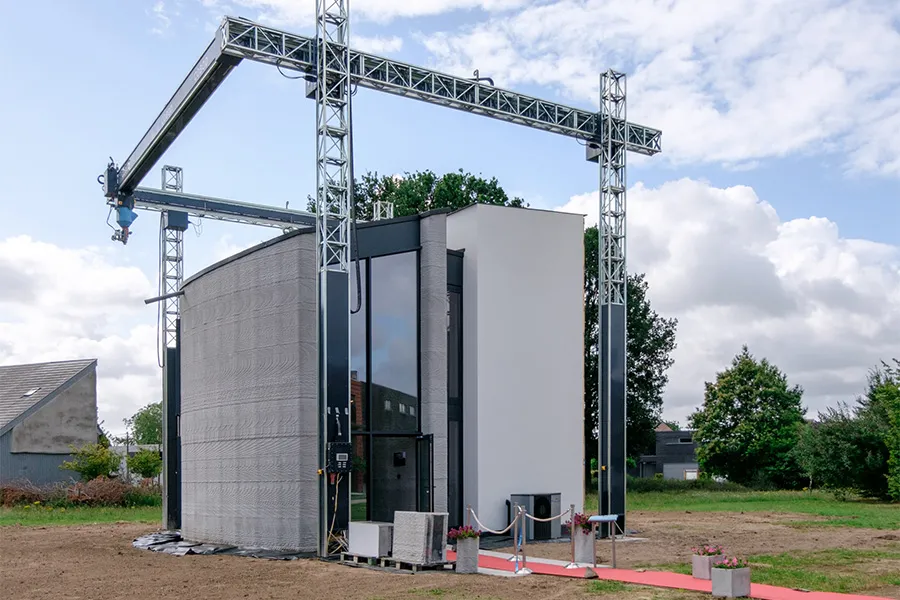
Another interesting innovation is 3D concrete printing. In the future, will more printing take place on site than production in precast manufacturers’ industrial halls? “This is a very interesting development, but I don’t think 3D printing will completely replace precast concrete. The technology is not yet ready for large-scale projects. What’s more, on-site printing is subject to weather, environmental and quality factors that are much easier to control in precast manufacturers’ halls. Finally, some elements are very difficult to print, such as large components for bridges or long spans. There is also no ready-made solution yet to the associated logistical challenges. I believe that specific printed elements could have a place in the overall picture. I also see opportunities in printing complex formwork for the production of precast concrete elements,” says Vincent Kerkstoel.
As an architect, Dirk Engelen sees no reason to adopt 3D printing on a large scale at this point. “It’s a valid alternative, but its scope is relatively limited for now. In any case, I haven’t yet seen many 3D-printed applications that couldn’t be produced in another way. I believe the pros and cons need to be carefully weighed against the context of each project. The fact that it is a fascinating technology is not enough in itself. It has to offer real added value. I see opportunities for creating complex forms that are more difficult to produce using formwork technology. But I also see 3D printing as a valuable complement to existing production and execution methods.”
Question about this story? Ask your question
Keep following this
Get an email when a new story is published. No account needed.
- ThemeNew ways of building
- SubjectConcrete







