Combining knowledge and experience for the first-ever tram project using a ‘ladder track’ system
Texte Niels Rouvrois Photos De Bonte Group
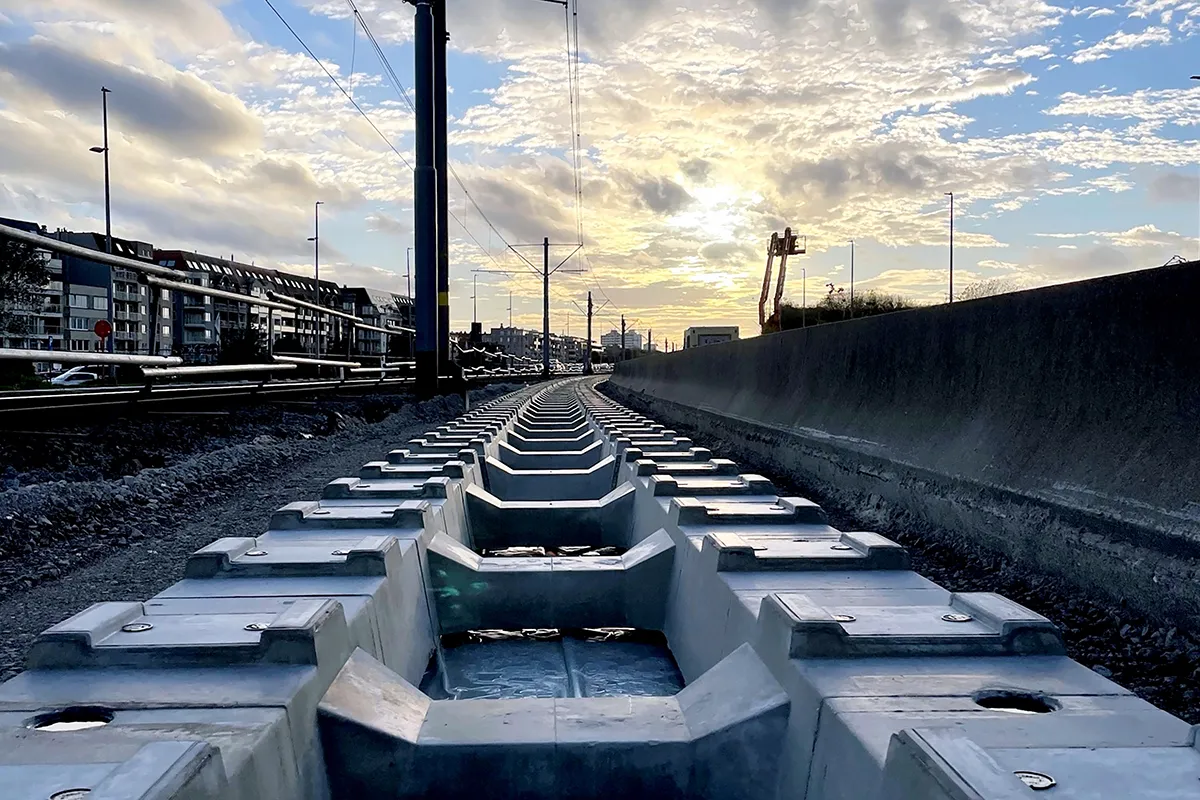
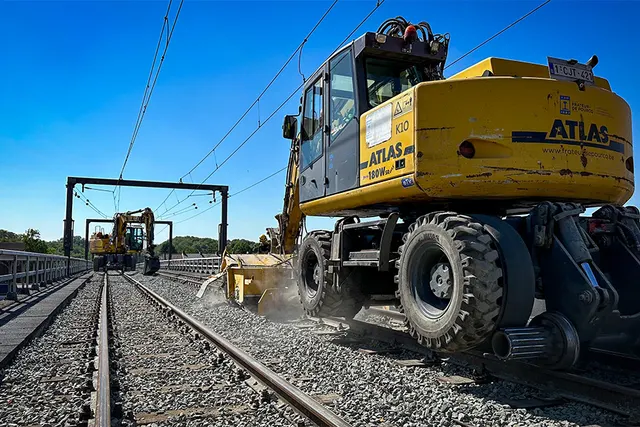
In September 2024, Taveirne began renewing the tram tracks in Bredene and Ostend at the request of De Lijn. The project is particularly notable as it marks the first use in Belgium of an innovative prefabricated curved ‘ladder track’ system. To manufacture this unique system, Taveirne turned to De Bonte Group. The two parties combined their considerable expertise to deliver an exceptional flagship project.
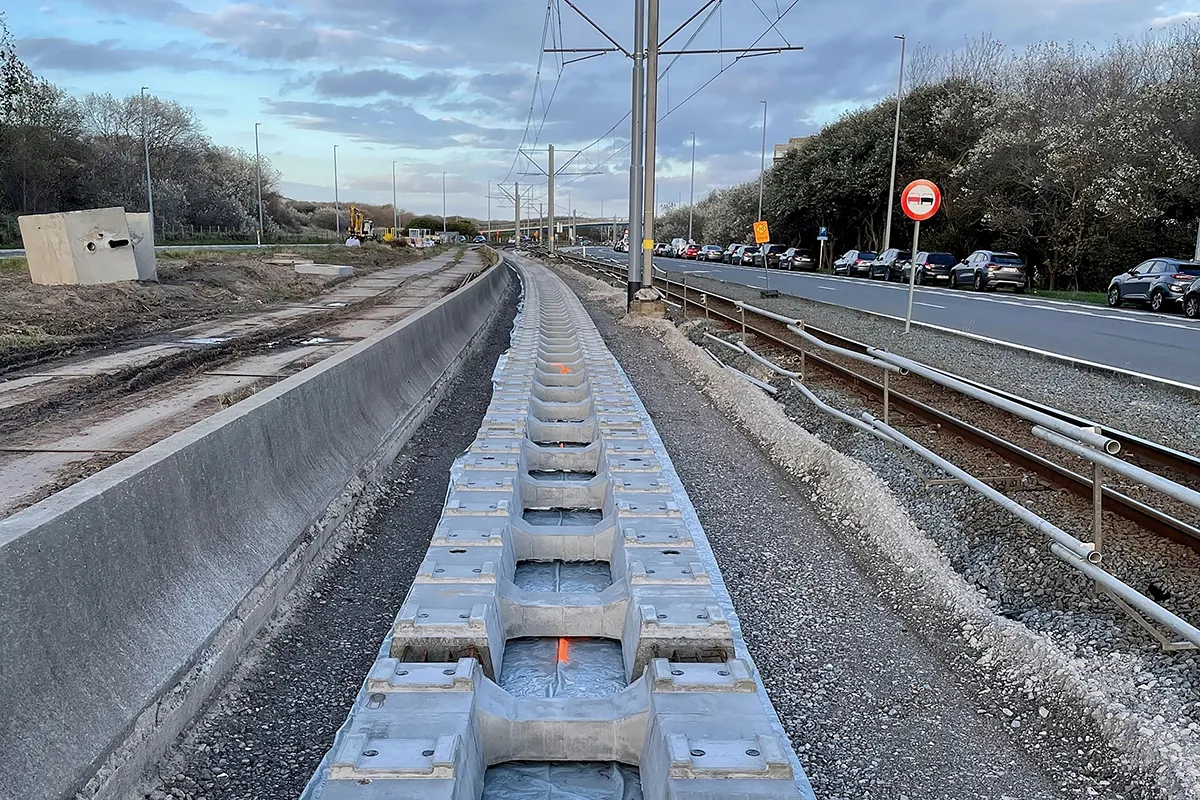
Urban space is evolving rapidly. Growing demand for mobility, the impact of climate change and the need for attractive public spaces call for integrated solutions. It is precisely at the interface between infrastructure and ecology that unexpected opportunities are emerging. Areas alongside tram and railway lines are proving particularly well suited to creating new connections. These are not only physical connections, but also links that support sustainability, biodiversity and climate adaptation. This green track, built in particular using prefabricated ‘ladder track’ elements, offers an innovative and robust solution.
Infranature
Bringing technical mobility infrastructure and nature together has become essential. Green tracks are a practical example of how to breathe new life into the urban landscape. Grass, sedum and other low-growing plants between tram tracks do more than make streets look better: they help reduce noise, allow water to infiltrate, purify the air and cool urban areas. The result is infrastructure that softens the landscape, benefits the environment and improves the urban microclimate. ‘We are hearing more and more about infranature,’ says Filip De Bonte, CEO of De Bonte Group. ‘Infrastructure stretches across towns and cities, which means concrete and vegetation have to coexist. We can embrace that idea and look for solutions, or oppose it, which is not viable in the long term. Through this project, we are demonstrating with Taveirne that we will be a reliable partner for De Lijn in this area in the future.’
Efficient construction
Up to 220 metres of ‘ladder track’ modules can be installed each day, significantly reducing construction time. Once in place, the open spaces are filled with topsoil, ensuring maximum water permeability.
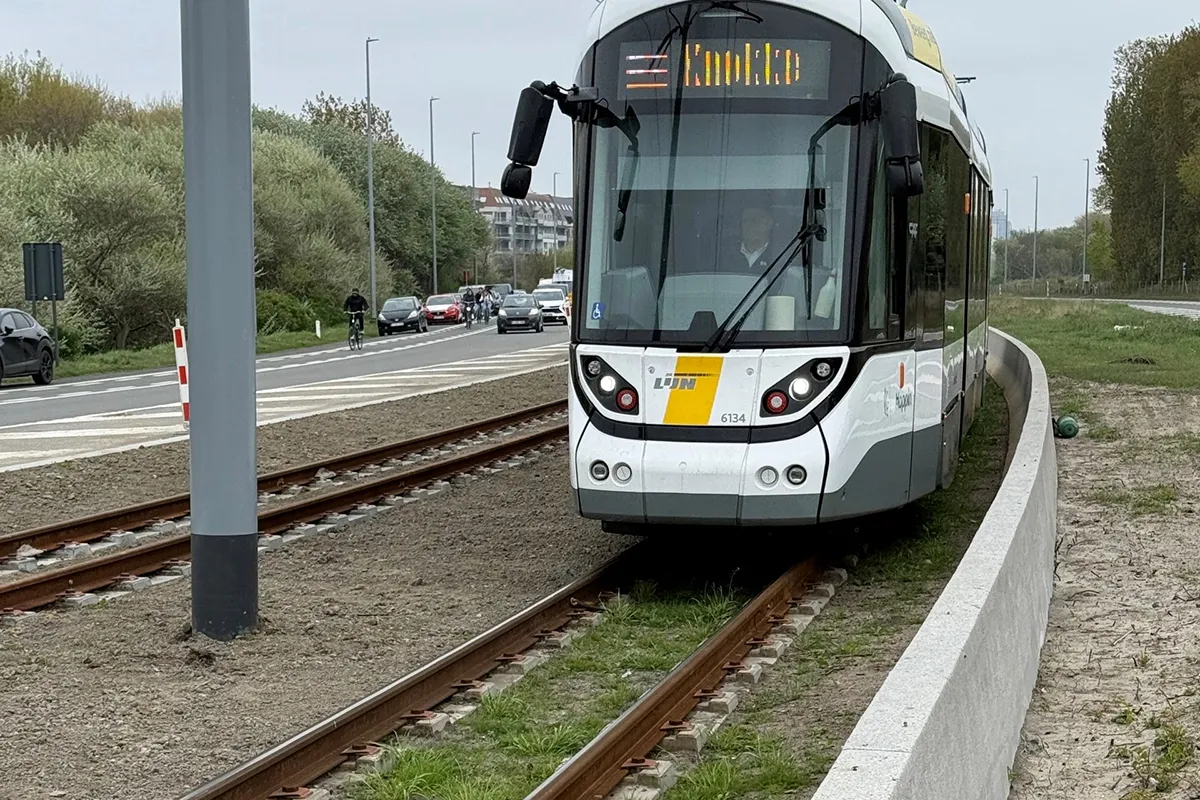
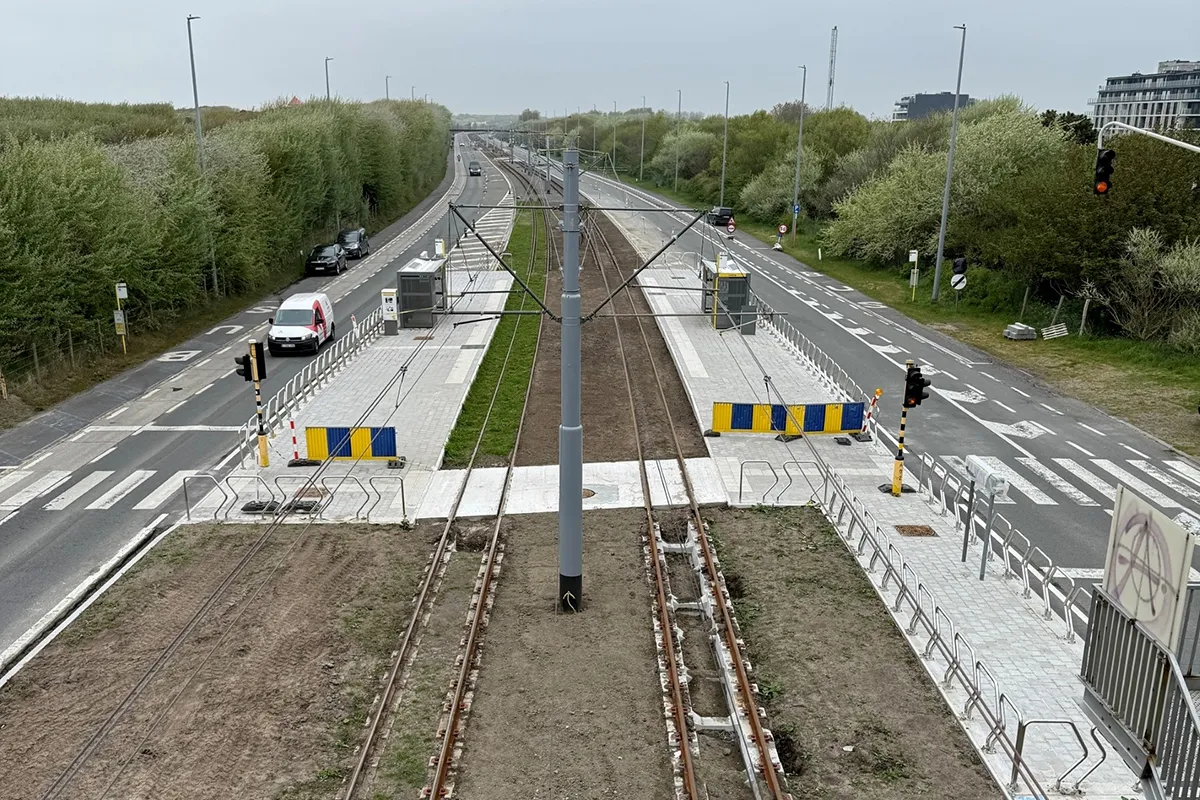
The area is then seeded with grass, which not only creates a greener, more attractive appearance, but also helps prevent sand building up between the rails. Green tracks with prefabricated ‘ladder track’ elements combine ecological benefits with technical robustness. Conventional maintenance, such as tamping, is not required thanks to the load-bearing substructure, which keeps the tracks stable. Even load distribution across the rails increases their service life and reduces maintenance costs. In addition, the green track design fully complies with rainwater regulations, making it much easier to incorporate into planning. ‘In theory, this system is excellent,’ says Lode Van Iseghem, technical director at Taveirne. ‘We are convinced of its potential, both technically and in terms of sustainability. The initial results are promising.’
Bredene project
From building new railway routes to renewing and maintaining existing tracks and overhead lines, Taveirne helps develop a safe, stable and reliable rail network. Kristof Vonck, project manager at Taveirne: ‘The project in Bredene involved renewing the tracks and overhead lines. We also renewed a crossing at Zeelaan. The rest of the project involved installing 2,200 metres of “ladder track” modules. The work is being carried out in several phases, as the route has to remain in service at certain times, including during the holidays.’ ∂
De Lijn had already used the ‘ladder track’ system in a pilot project. ‘But that was a fairly straightforward project, whereas Bredene involved installing more than two kilometres of track on a curved route,’ explains Kristof Vonck. ‘This project therefore presented significant logistical and technical challenges, requiring extremely precise planning, preliminary studies, and meticulous track installation and adjustment. The margin for error was particularly small, even more so than when installing traditional ballast.’
Tight tolerances
The elements have very tight tolerances for positioning and alignment, requiring the manufacturer to carry out thorough quality checks at the factory and take precise measurements to within 0.1 mm. This extreme precision was particularly important for ensuring that all sixteen bearing surfaces on each rigid element were coplanar. They were measured in 3D every day and then validated to ensure that the elements fitted together perfectly. Each element had its own dimensions and a unique positioning code to prevent it being incorrectly placed on site.
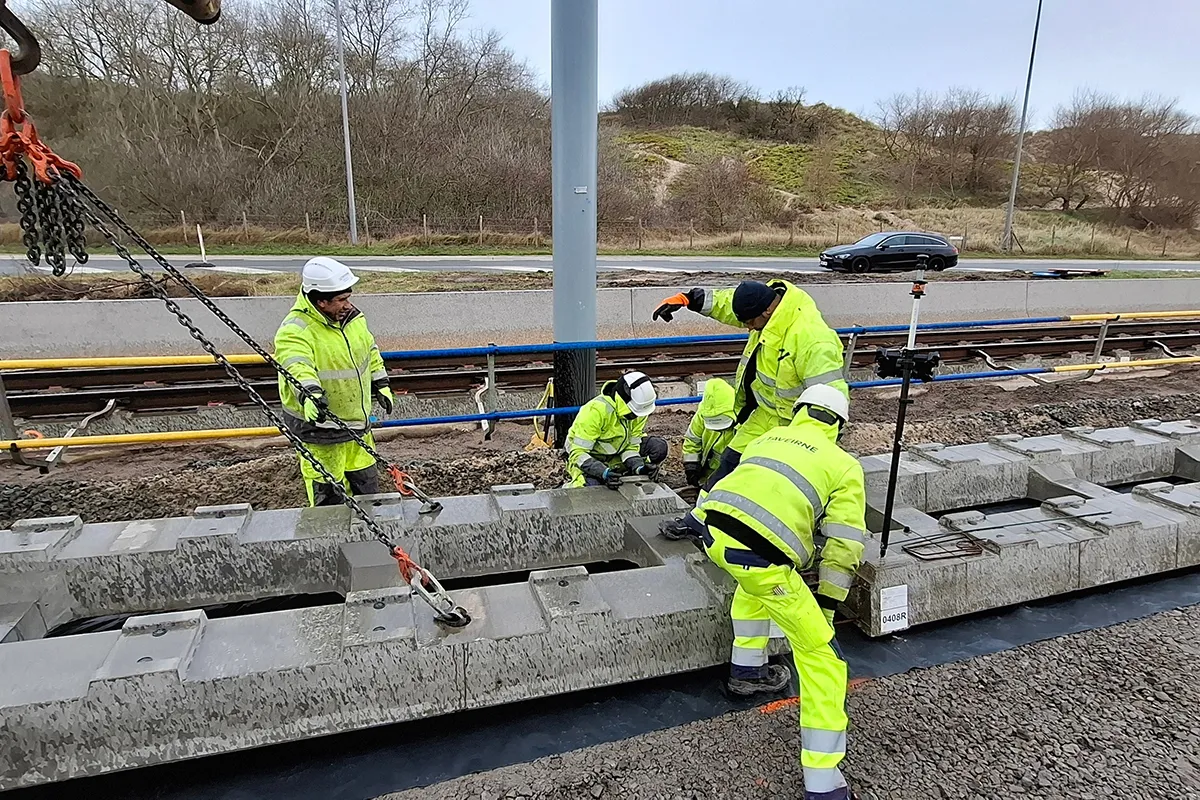
Before the tracks were installed, a trial was carried out, combining traditional techniques with advanced digital applications. The digital total station was a key tool. Each site team had one, enabling them to position the prefabricated elements entirely independently, without needing an external surveying team. Combining experience with technology took their expertise to the next level. And this was not a one-off, but standard practice for every team on site.
Experienced contractor
This method made installation easier and more systematic, with no demolition work needed to correct mistakes. The project was delivered flawlessly thanks to clearly defined technical requirements, a carefully designed production process and a detailed, well-thought-out installation plan. Kristof Vonck: ‘Each ladder track was assigned two fixed points using a total station, which helped us install them very accurately. These are 6-metre-long elements weighing 4 tonnes, lifted and installed by crane. The tracks were then laid. Marking these survey points on the prefabricated elements was therefore crucial.’ Lode Van Iseghem adds: ‘We are no strangers to innovative systems and techniques. We have already installed the first concrete turnouts and P turnouts for Infrabel, as well as the first direct fixings. We firmly believe in innovation, which is essential for moving forward.’
Filip De Bonte was impressed by Taveirne’s expertise: ‘I already knew the company, of course, and what it was capable of, but I was very impressed by the project team. This project is undoubtedly a benchmark for the entire sector. What impresses me most is that it did not rely solely on tried-and-tested techniques, but also on new approaches. For example, when it came to equipment, instead of using the latest machinery, we chose a machine that seemed perfectly suited to the project. We made the most of the flexibility allowed by the specifications, both in production and execution, and used it very professionally.’
Pioneering project
For public transport operators and cities, green tracks are more than just a technical solution. They are a way to make sustainability tangible in the urban landscape. The system brings mobility, climate adaptation, biodiversity and comfort together in a single integrated design. It therefore fits perfectly with current policy objectives. Contractor Taveirne and prefabricated element manufacturer De Bonte Group responded with a sophisticated concept, developed through extensive consultation. Moulds designed for curves, cant and even clothoid curves make it possible to meet every challenge posed by the route. ‘Thanks to the in-depth technical expertise, attention to detail and close consultation with the client, this project is a true pioneer. It not only meets the strictest quality standards, but can also serve as a benchmark for future projects. This collaboration demonstrates innovation, trust and a shared ambition to push boundaries and achieve sustainable results,’ concludes Benny De Bruyn, project manager at De Lijn.
Question about this story? Ask your question
Keep following this
Get an email when a new story is published. No account needed.
- ThemeNew ways of building
- SubjectRailway technology