











The revolutionary thermal break turns 40
Texte Wouter Polspoel | Photos Schöck
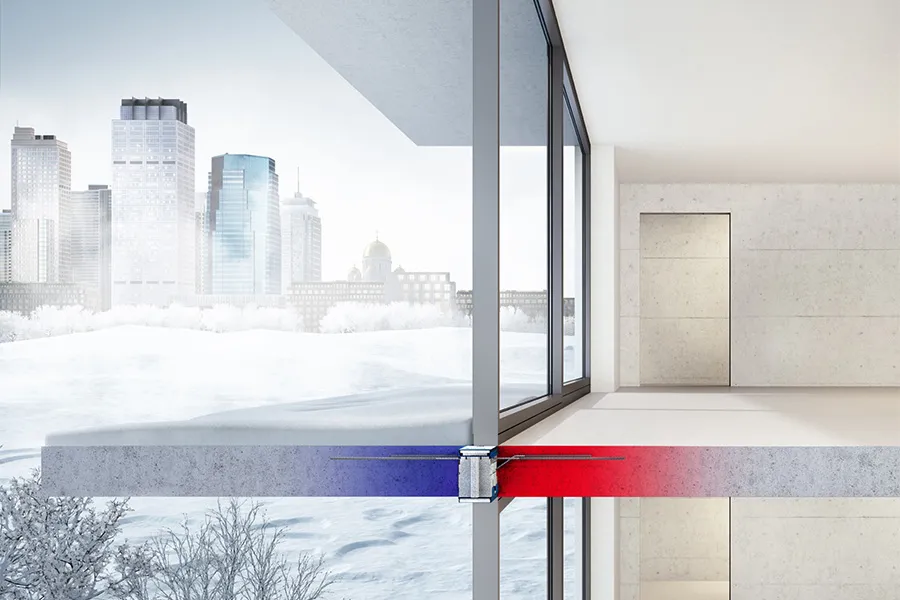
Isokorb® came onto the market 40 years ago. This innovative, straightforward solution from Schöck for preventing thermal bridges using thermal breaks revolutionised the construction industry at the time and is now indispensable. The inventor is said to have had the idea during a skiing holiday in the Swiss mountains…
A skiing holiday that changed everything. The late German engineer Eberhard Schöck would no doubt agree with us describing the week he spent on a winter holiday with his family in Zermatt, Switzerland, around Christmas 1979 in those terms. Here is what happened: in the holiday home, the man who had founded his own construction company, Schöck Bautrupp, in 1962, now known as Schöck, noticed mould on the ceiling. He soon realised that the uninsulated concrete balconies, which were at the same level as the building, were to blame. While still on holiday, he sketched out the first designs for a solution to prevent the problem. The following year, Eberhard Schöck patented his revolutionary idea, and in 1983, after four years of development, the solution was launched on the market with the necessary technical documentation: Isokorb®, an insulating element for minimising thermal bridges in cantilevered reinforced-concrete components. This solution revolutionised the construction industry.
Numerous innovations
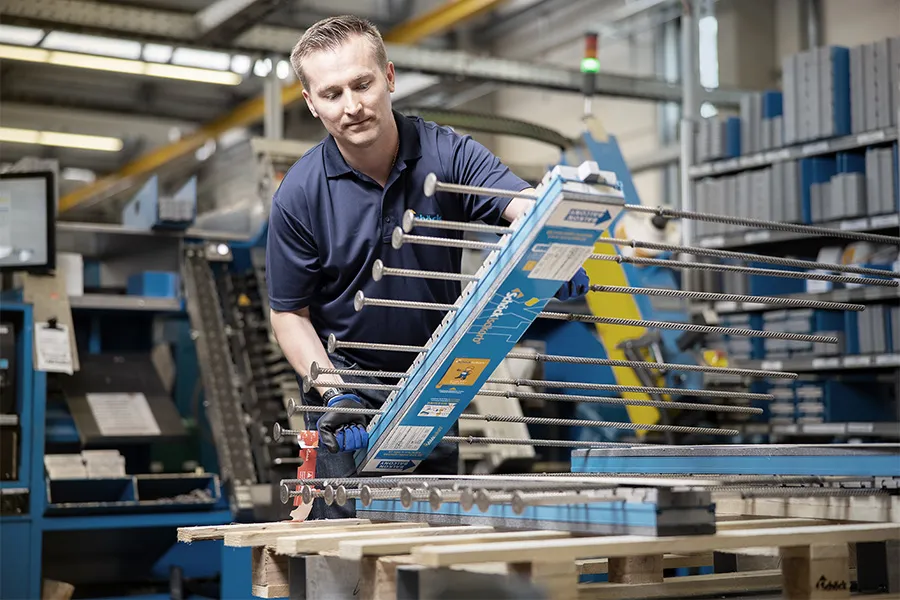
Many innovations followed over the years, including increasing the insulation thickness from 50 to 80 mm, replacing the steel compression bearing with an ultra-high-strength concrete compression bearing to increase load-bearing capacity and thermal insulation and make installation easier, and incorporating the high-performance Combar glass-fibre composite into Isokorb® as a thermally superior alternative to reinforcing steel and stainless steel. The development of useful digital tools was also important. These included CAD/BIM libraries for Isokorb® and simulation programmes that make it possible to select the right Isokorb® types or calculate the insulation performance of a balcony or roof cornice connection in just five steps. All these efforts have undoubtedly paid off: today, this structural anchoring system, which thermally separates building components, now including steel components, to prevent structural thermal bridges, is indispensable on construction sites.
Today, Isokorb® is sold in around 40 countries and used in the construction of free cantilevered or supported sections, balconies, loggias, galleries, canopies and parapets, for both new-build and renovation projects. In addition to standard applications, Isokorb® can also meet specific and complex requirements, such as unusual geometries, long cantilevers or hybrid building construction.
Durable, simple and cost-effective
“The invention of Isokorb® is one of the most important milestones in our company’s history,” says Mike Bucher, CEO of Schöck. “It is just as innovative today as it was then, and embodies the standards we set for the development of our entire product range: forward-looking, durable, safe, easy to install and cost-effective. Over the coming years, we want to make Isokorb® even better and more innovative, so that we can continue to respond effectively to market demand.”
Een zakelijke vraag aan Schöck Belgium BV? Get in touch
Companies in this story

Keep following this
Get an email when a new story is published. No account needed.
- SubjectConstruction
- CompanySchöck Belgium BV







