The benefits of geotextile certification
For more than twenty years, inspection body COPRO has issued BENOR certificates to manufacturers of permeable textile products. “The product’s application determines which tests it must undergo and which values it must meet,” explains Kris Vandenneucker, COPRO’s product manager for geotextiles, geogrids and metal road products.
For more than forty years, the voluntary BENOR quality mark has provided quality assurance for a wide range of construction products. COPRO has been appointed as the sectoral body for BENOR certification of a number of these products, including road restraint systems, hydraulically bound mixtures, road concrete, cast iron pipes and geotextiles.
“A geotextile is a woven or non-woven textile, mainly made from polypropylene, used in the construction sector,” explains Kris Vandenneucker. “Geotextiles have four essential functions: separation, reinforcement, filtration and drainage. There are various application standards for geotextiles, for example for roads, railways, foundation and earthworks, drainage systems, bank protection and so on.
Tests for tensile strength, puncture resistance, water permeability and characteristic opening size are some examples of the checks required when certifying geotextiles. For some applications, water permeability is more important than, for example, tensile strength. Combinations are also possible. A site with heavy lorry traffic requires a geotextile that is both strong and able to withstand a certain percentage of elongation.”
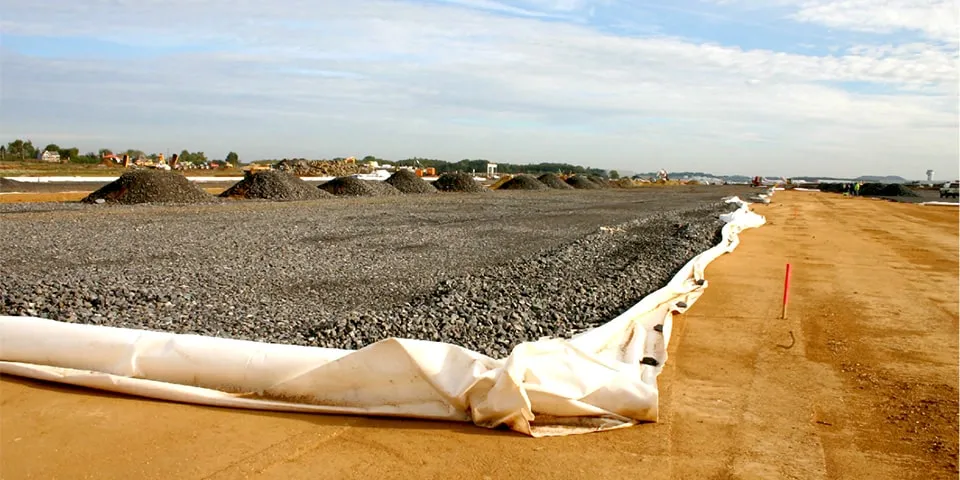
Installation of a BENOR-certified geotextile in Bierset.
BENOR
Kris Vandenneucker: “The BENOR mark is based on PTVs, which set out the technical requirements. Certification does not simply require tests to be carried out, it also specifies a minimum or maximum value that must be achieved. We visit manufacturers to witness tests and check their testing procedures, and also use accredited external laboratories to analyse samples. During tender procedures, public authorities set quality requirements for geotextiles. Compliance with these requirements is guaranteed by BENOR certification. In Flanders, the standard specification SB 250 refers directly to PTV 829 and BENOR certification. Things are a little different in the Brussels-Capital Region and Wallonia.”
The Brussels Region’s standard specification (CCT 2015), for example, states in the section on prior technical acceptance (Art. 42) that a BENOR-certified or equivalent product may be accepted, provided it meets the requirements of the specification, without the need for prior technical acceptance tests, which, it should be recalled, are at the contractor’s expense. In Wallonia, the Qualiroutes specification clearly refers to PTV 829, which sets out the technical specifications for the BENOR mark.
In practice, if a contractor presents a BENOR-certified geotextile (compliant with PTV 829) or an equivalent product, acceptance by the supervising officer will be facilitated on the basis of the technical data sheets, with no additional inspection costs. In other cases, if technical acceptance tests are required, the contractor may have to bear the costs, provided these costs are clearly stated in the tender documents. Although the approach differs from that in Flanders, it is clear that in both the Brussels Region and Wallonia, in addition to the obvious quality benefits, using voluntary marks simplifies and streamlines the technical acceptance process by making it possible to avoid the associated checks and costs.
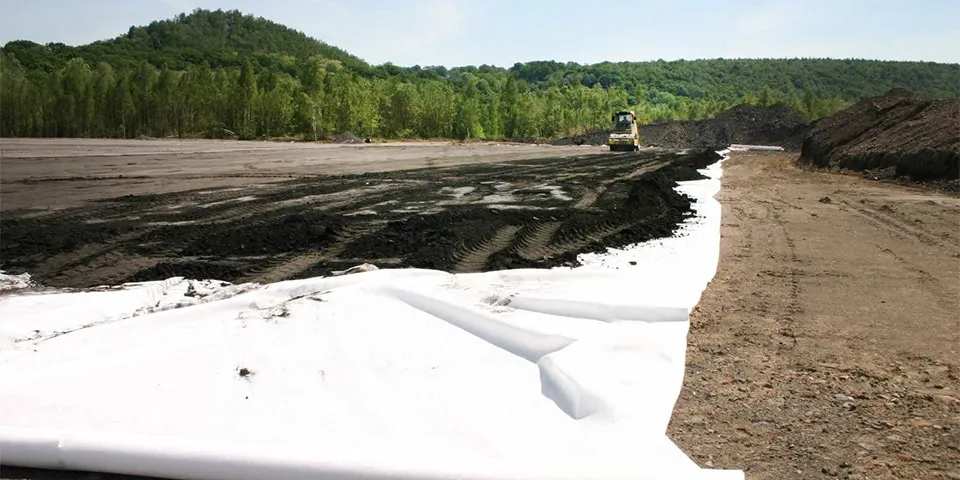
Each certified product has a technical data sheet approved by COPRO, available online.
Inspection
“Anyone holding a certificate is subject to regular inspections every year. For geotextiles, we use a points-based system,” explains Kris Vandenneucker. “It starts with a set number of points. When a manufacturer joins the scheme, eight inspections are scheduled per year. A manufacturer that receives few or no comments and therefore retains its points can request a lower inspection frequency. However, four inspections a year is the absolute minimum. If comments are raised, it is up to the manufacturer to take the necessary steps to address them.”
Extranet
To make the process even smoother, COPRO has launched its Extranet. “Every certified product has a technical data sheet approved by COPRO. Any supervising officer can consult the product sheet online and check that the product has the right certification, as well as view its characteristics and areas of application. The validity of a data sheet can also be checked using a QR code. A certificate on its own does not tell you everything. A manufacturer producing twenty different types of geotextile will not necessarily hold a certificate for all of them. This can lead to misunderstandings. The Extranet is there to prevent them. If the product sheet is not on our Extranet, the product is not certified,” concludes Kris Vandenneucker.
Question about this story? Ask your question
Companies in this story
Keep following this
Get an email when a new story is published. No account needed.
- ThemeManaging construction projects
- SubjectConstruction
- CompanyCOPRO