State-of-the-art fire protection for the Porte de Hal tunnel
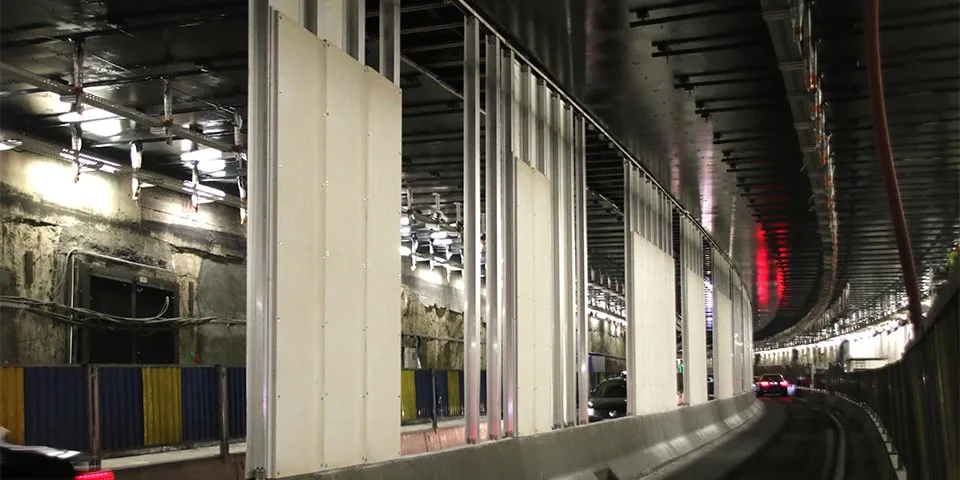
Opened 35 years ago, the Porte de Hal tunnel was one of the last Brussels tunnels without a barrier separating the two directions of traffic. A complete renovation had therefore become essential and urgent. This also involves bringing its fire protection up to current standards. GTA, a Luxembourg-based company, completed this mammoth task in record time.
GTA (General and Technical Applications) certainly knows its business. Specialising in passive fire protection and surface treatment for the tunnel, construction and civil engineering sectors, the company has an impressive portfolio of projects, including tunnels on the Mulhouse ring road and the Lyon northern ring road, as well as in Rouen and Besançon.
A 25-month project
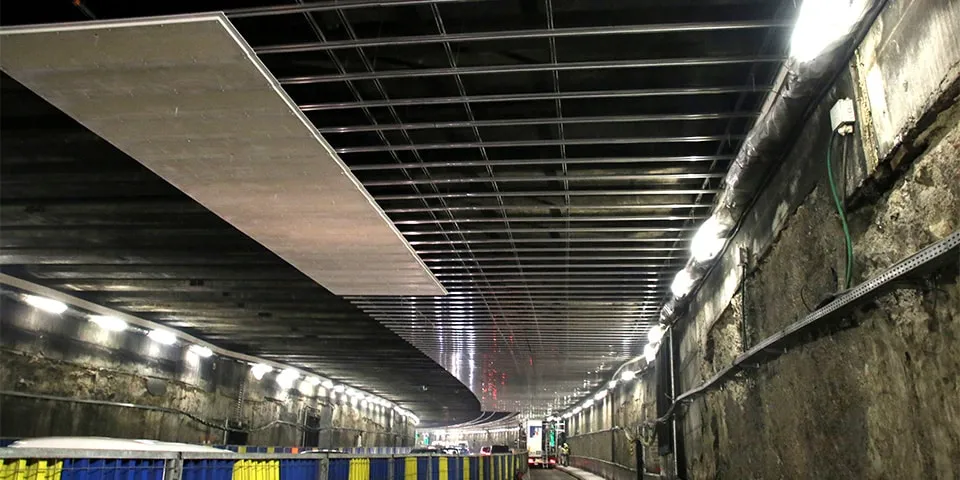
A lowered ceiling fitted with fire-resistant panels and installed on a double stainless steel frame gives the Porte de Hal tunnel excellent fire resistance.
A concrete barrier and a partition between the two directions of traffic, new emergency exits and alterations to existing exits, concrete repairs, road resurfacing, improved waterproofing between the tunnel and the metro directly beneath it, a new ventilation system, LED lighting, cabling and transmission equipment… the list of civil engineering works and equipment is long. The work is being carried out in several phases, with the aim of keeping full road closures to a minimum. Much of the work is also taking place at night.
From design to approval
GTA is taking a cross-disciplinary approach to the project, from design through to installation and approval, with the aim of ensuring resistance to some of the most demanding fire curves in the world: RWS120 (1350° after 2 hours of fire exposure) and ISO 240 (1100° after 4 hours of fire exposure). To bring the tunnel fully up to standard, GTA installed RF fire-resistant panels (AESTUVER) as a suspended ceiling on a double stainless steel frame, built the partition separating the two directions of traffic, provided thermal protection for cables and neoprene bearings, and applied a high-durability coating to the RF panels and concrete elements.
To ensure and guarantee the performance of the RF systems installed, GTA designed numerous calculation reports and thermal models in full, including to optimise the thickness of RF protection on the central partition. It also produced the construction and setting-out drawings for the entire project.
Challenges overcome!
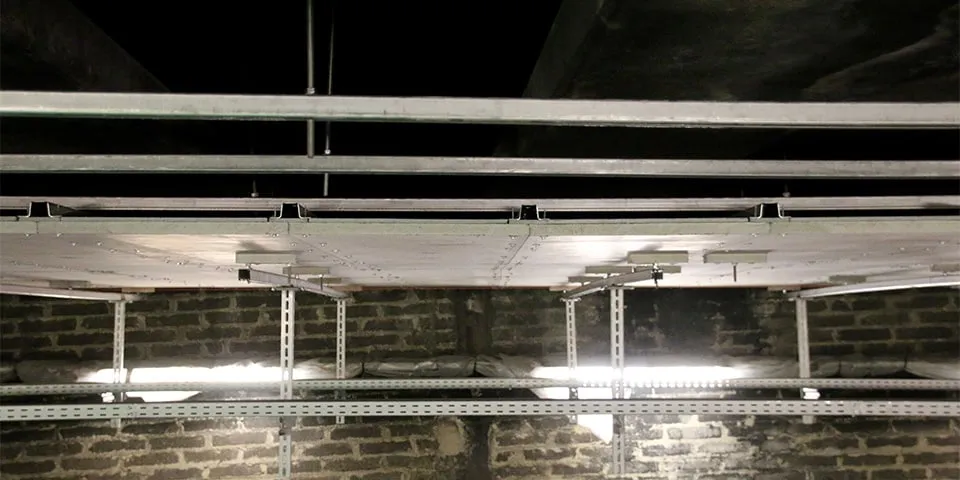
The fire protection was installed in record time.
Julien Feller, CEO of GTA Group: “Beyond the technical aspects, our main contribution was to share our expertise and working methods so that the work could be completed in record time. Various issues related to pollution in the tunnel delayed the start of the RF protection work. The original schedule allowed 12 months for installation of the RF ceiling and its stainless steel frame. In the end, the work was completed in 4 months, enabling AM Valens/VSE to meet its commitments to Bruxelles Mobilité.”
In addition to the very tight deadline, supply chain problems affecting stainless steel products, due to market pressures and the need for large volumes, forced the company to continually revise its methods and schedule. GTA Group’s in-house design office also had to make decisions on complex technical issues, as the time needed to obtain official opinions made it impossible to wait.
From now on, although motorists will have to wait a few more months to see the light at the end of the tunnel while equipment is installed and tests are carried out, the project will have benefited from GTA Group’s expertise in this highly specialised field, which is so important to mobility in Brussels.
Question about this story? Ask your question
Keep following this
Get an email when a new story is published. No account needed.
- ThemeBuilding and site safety and security
- SubjectConstruction