Better protection for people and property with precast concrete
The aim of fire safety is to limit harm to people and damage to property. An important part of fire safety is preventing buildings from collapsing. The structure must remain stable for long enough to allow people to evacuate and the fire brigade to intervene. The spread of fire must also be prevented. Concrete is known for its favourable behaviour in fire: it is non-combustible and non-flammable, releases no smoke or toxic gases, and has good fire resistance, allowing it to maintain its structural function in the event of a fire. All this makes it an ideal material for fire-resistant construction.
The point at which a building collapses after a fire starts is determined by the load and temperatures, together with the corresponding strength and stiffness. In concrete structures, reinforcing steel is the weak link. Because of its high thermal diffusivity, a measure of how quickly the temperature rises in a material, it heats up faster than concrete. Steel also loses strength more rapidly. The strategy for increasing the fire resistance of a load-bearing concrete structure is to slow the heating of the reinforcing steel.
Long-lasting fire resistance
By increasing the concrete cover, the concrete section, the reinforcement section and/or the effective depth, the fire resistance of a concrete structure can be significantly increased at the design stage. This applies to both reinforced and prestressed concrete. Precast elements leave the factory with their full fire resistance. This means that the fire resistance of the structure does not depend on installation and finishing on site. In fact, concrete requires no maintenance, even after years of service, ensuring fire resistance throughout the building’s service life.
Note that most concrete products have a standard fire resistance of 60 minutes or more. The additional cost of increasing fire resistance to 240 minutes or more is limited to a few euros for standard sections, and up to 20% for I-sections. Furthermore, repairing a concrete structure after a fire is technically feasible in many cases. However, economic considerations may lead to a different decision.
Stability
Concrete structures not only have high fire resistance, but also a high capacity to absorb loads thanks to their robustness and the possibility of redistributing loads. Fire-induced collapses are therefore rare. “
Nevertheless, designers must pay particular attention to overall stability in the event of a fire. Thermal expansion, deformations and restraint forces must be checked in particular. A building’s shape and dimensions, as well as its structural system, are important to how it behaves during a fire.
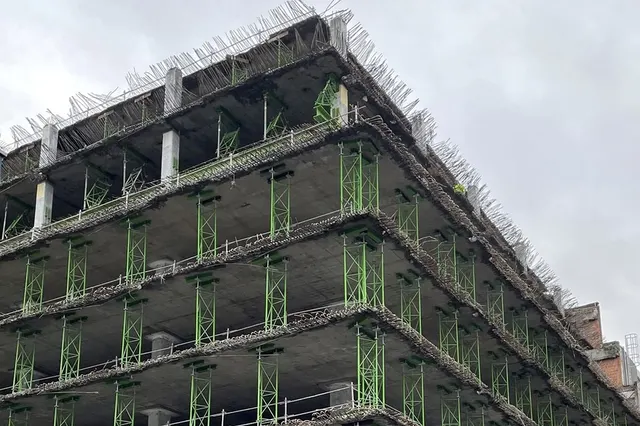
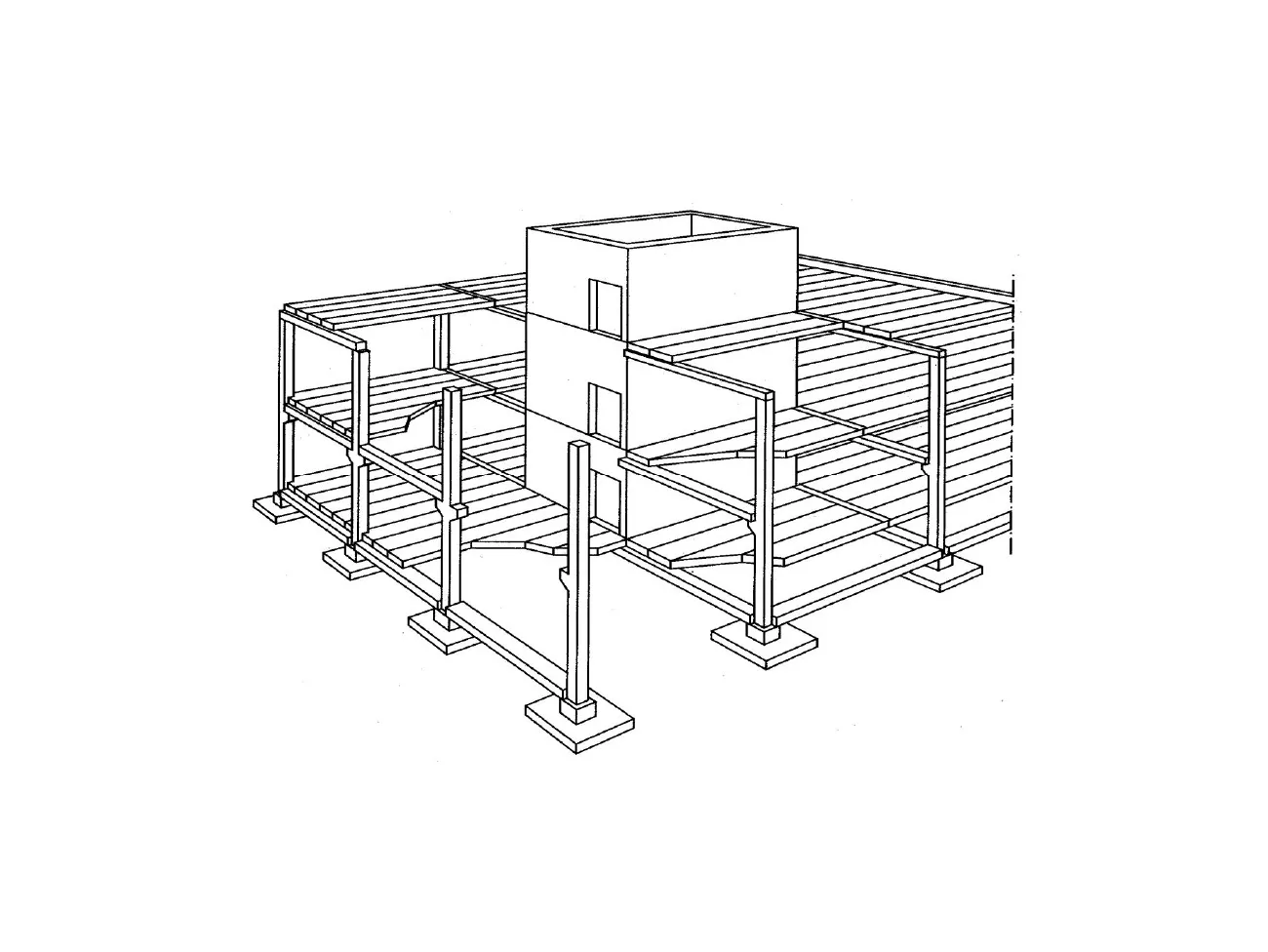
The best solution is to position the horizontal bracing in the centre and connect all the other elements to it with pinned joints. Precast concrete structures are particularly well suited to this approach. With this design, there is also no risk of columns breaking under lateral forces, as they are pinned. This also prevents the structure from collapsing outwards, allowing firefighters to approach the burning building safely. In addition, the structure will not collapse suddenly, as deformation will first cause visible cracks in the elements and connections.
Standard
NBN EN 1992-1-2 + ANB applies to the technical design of the fire resistance of reinforced or prestressed concrete elements. It also contains tabulated values. Specific provisions for certain concrete products, such as hollow-core slabs, are included in the relevant product standards.
Only a few cases are known in which a concrete structure has collapsed as a result of a fire. This shows that precast concrete structures are safe in the event of fire. If properly designed and constructed, precast concrete structures can withstand even extreme and prolonged fire conditions. Concrete makes it easy to meet fire safety requirements, and also allows recovery after a fire.
Question about this story? Ask your question
Keep following this
Get an email when a new story is published. No account needed.
- ThemeNew ways of building
- SubjectConcrete