











Belgium’s first ultra-high-performance concrete footbridge
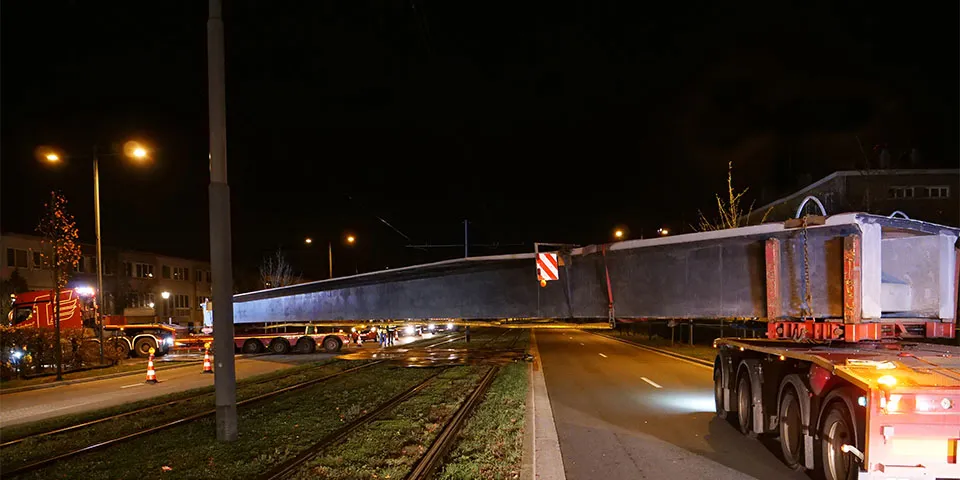
The new ‘Eenboom’ footbridge in Evere is Belgium’s first bridge made from ultra-high-performance concrete (UHPC). The footbridge crosses the Schaerbeek-Hal railway line and was installed in December 2018 on behalf of rail infrastructure manager Infrabel, replacing a structure dating from 1956. Infrabel appointed FEBE member Ergon, an entity of CRH Structural Concrete Belgium, to carry out the work.
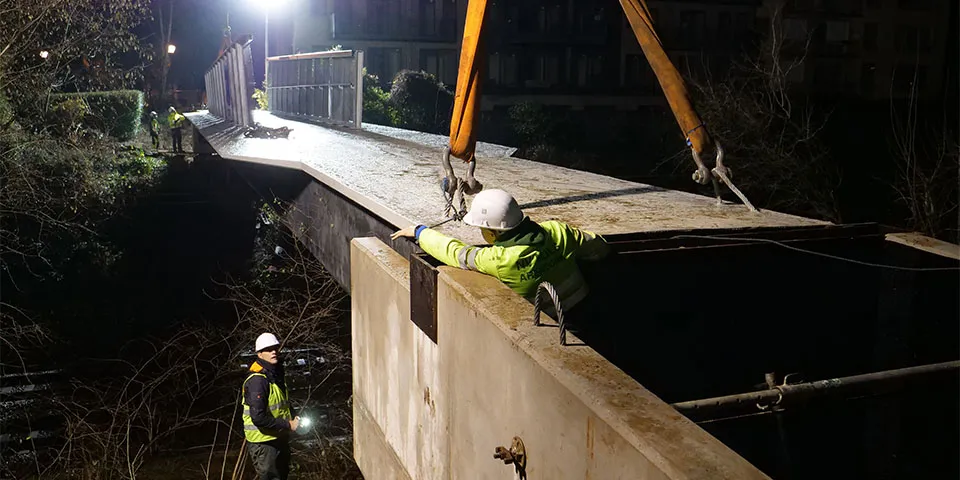
The ‘Eenboom’ footbridge in Evere is Belgium’s first bridge made from ultra-high-performance concrete (UHPC).
While designing the new footbridge, Infrabel identified the possibility of building it in UHPC. After exploring the market, the Belgian rail infrastructure manager turned to the expertise of the Belgian Building Research Institute (CSTC) and Ergon to carry out the work. This Belgian first is laden with symbolism, as the old footbridge was already one of the country’s first prestressed concrete bridges. UHPC made it possible to build a more slender structure, without a slab reinforcement, while making it stronger than a footbridge in conventional prestressed concrete. The structure consists of a 36-metre-long, 4-metre-wide slab, no more than 10 cm thick, supported by two beams barely ten centimetres thick.
The project was preceded by an extensive feasibility study. Pieter van der Zee, Technical Director at CRH/Ergon, was responsible for producing the UHPC test elements. “In 2012, CSTC launched a research project on UHPC,” says Pieter van der Zee. “The aim was not to use the mixes known in France at the time, but aggregates and additives that were readily available in Belgium. The idea was to make UHPC a local product wherever possible. Through FEBE, CSTC contacted prestressed concrete producers to manufacture test elements. At Ergon, we produced a few seven-metre-long I-beams and also made around forty prisms for CSTC. Small sections were sawn off and analysed.”
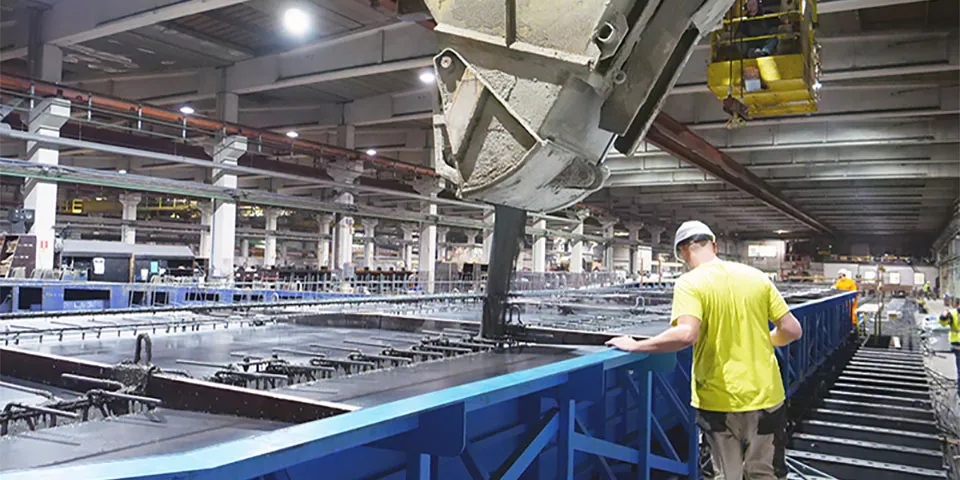
Concrete being poured into the elements.
Lighter element
CSTC produced a substantial report based on these tests. Pieter van der Zee says: “The tests opened up all kinds of possibilities. From time to time, I would suggest building a footbridge in UHPC at meetings. It is always exciting to imagine something that has never been done before. Infrabel was open to incorporating an exceptional element into one of its projects. A standard precast concrete footbridge would have required a gigantic crane at this very confined site. Alternatively, rail traffic would have had to be suspended for several days, which was unthinkable. The challenge, then, was to make the structure lighter. That meant using a higher-quality concrete.”
“That is how UHPC came into the picture,” continues Pieter van der Zee. “From a technical point of view, the footbridge is a remarkable achievement. In 2016, after extensive discussions and design work, we arrived at a solution in the form of a slightly sloping, double TT element, 36 metres long and 115 cm high. Casting a slope in UHPC is an achievement in itself. Self-compacting concrete is very fluid, with a flow of 800 mm. Casting it on a slope is particularly difficult, but not impossible.”
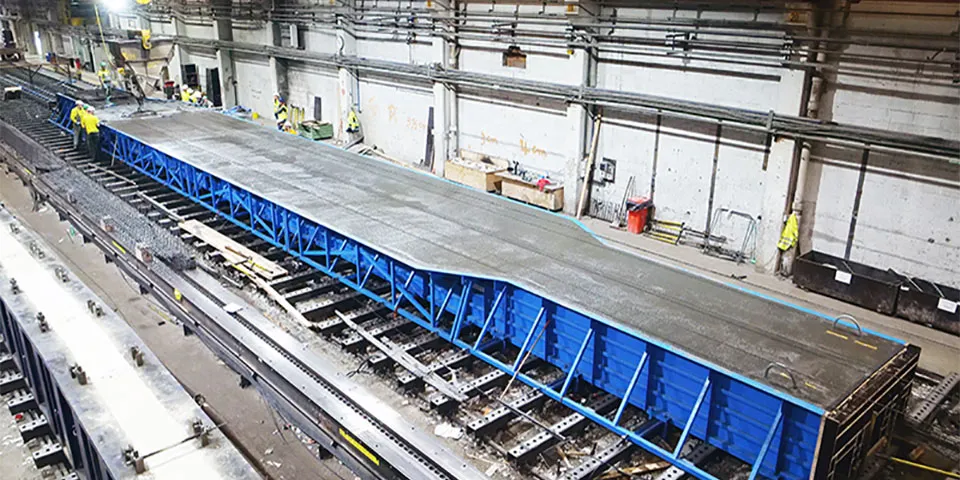
The formwork for the elements once filled.
A flagship project
Eenboom could be the first in a long series of UHPC bridges, but strict European regulations make it difficult to implement such new technologies. “There are currently no standardised requirements to follow. UHPC has been discussed in Europe for thirty years, but so far the number of projects can still be counted on the fingers of one hand. It is an inherently very durable, wear-resistant material. Using it makes it possible to create structures of incredible slenderness,” concludes Pieter van der Zee.
Eenboom, Evere
Completion: 2018
What? A footbridge for pedestrians and cyclists, the first in UHPC in Belgium
Where? Over the L26 railway line (Schaerbeek-Hal), between avenue Piérard and the Languedoc walking trails in Evere
Concrete strength: C120-150. After 24 h, the compressive strength
was ± 120 N/mm². After 28 days, it was ± 160 N/mm².
Construction: The bridge consists of a thin slab, 36 m long and 4 m wide, supported by two slender beams 10 cm thick.
Client: Infrabel
Design: Infrabel & Ergon
Contractor: Louis Mols Algemene Aannemingen nv
Engineering consultancy: Ergon
Precast concrete elements: Ergon
Question about this story? Ask your question
Keep following this
Get an email when a new story is published. No account needed.
- ThemeNew ways of building
- SubjectConcrete







