











A prefabricated concrete work of art for Beaufort 2021
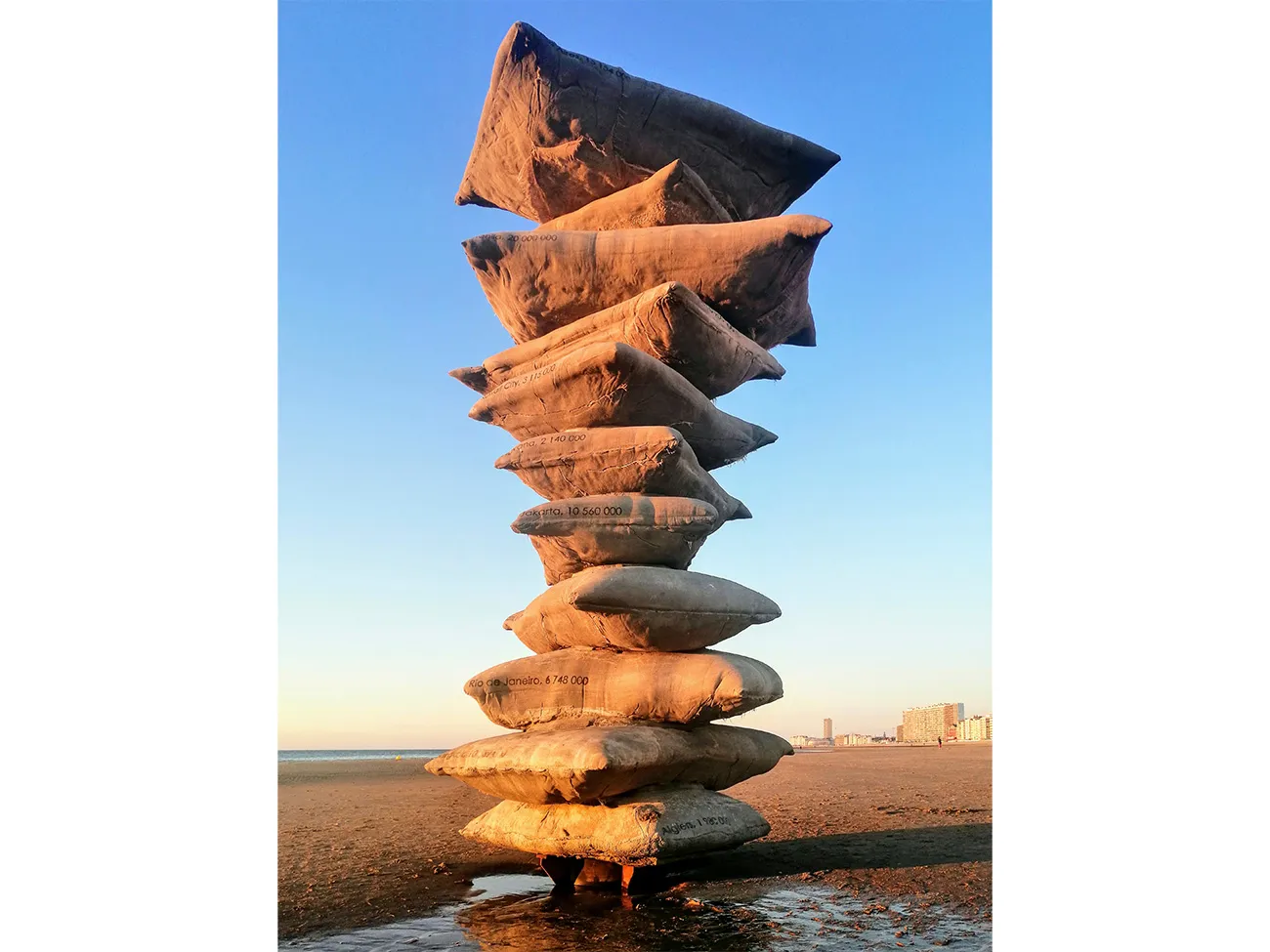
Last summer, visitors to the Belgian coast were able to admire the artworks featured in the Beaufort 2021 triennial. One of the most striking was ‘Pillage of the Sea’, built from precast concrete.
A small tower stood beside the Bredene breakwater, looking as though it had been made from stacked stones. It served as a landmark for walkers, but also evoked the spiritual significance of stacked stones in many ancient cultures. Here, the idea takes the form of a tower of sandbags, with climate change as its central theme. They form an imaginary barrier against rising sea levels. Each bag represents a city at risk of being flooded because of climate change, positioned at its altitude above sea level. The size of each bag represents the population of the city.
An eco-friendly material for a realistic result
The artist was looking for an eco-friendly material that would also withstand these extremely harsh marine conditions. For the production of ‘Pillage of the Sea’, artist Barbara Rosa worked with Enjoy Concrete. As a work of this kind falls outside the usual scope of production at the Veurne-based company, the creation of the elements was preceded by extensive research and testing. While the first trials produced a rather organic shape, the final result is a natural-looking, attractive pile of filled sandbags. The result was ultimately achieved using a fully natural formwork made from woven jute.
Trials with polymer concrete ultimately proved unfeasible. However, low CO2 emissions remain very important to the artist. This issue is becoming increasingly pressing, including for the public and the public sector. The formwork material is a custom-made bed of recycled sand and jute. The achievable formwork pressure was recorded empirically. This eco-friendly material is fantastic to work with, thanks to its tensile strength combined with its extensibility.
The elements were produced in alternating order to ensure a natural fit from one sandbag to the next. A 15 m-long steel tube serves as the foundation and central axis. 11 concrete elements, each with an eccentrically positioned opening, were slid onto it. As the site was accessible for only 6 hours a day, between low and high tide, the artwork had to be prefabricated.
An award nominee
It is no surprise that this work was nominated in the ‘Outstanding’ category of the FEBE Elements Awards, not only for its high level of technical achievement combined with its artistic character, but also for showing that concrete is an extremely suitable material for pushing boundaries. It also makes it possible to create unusual forms and structures while retaining a very familiar appearance.
The jury recognised this artwork as a highly original application of precast concrete, with considerable landscape value. The technical challenge was successfully met by using self-compacting concrete in a jute bag, making the whole structure suitable for the very harsh marine environment. Here, concrete provides an original way to convey a message to the viewer.
The technical challenge posed by this artwork was considerable: it had to withstand not only the impact of the sea and salt, but also be built between low and high tide.
The use of jute bags in combination with self-compacting concrete gives the whole structure a natural appearance, making it possible to achieve irregular shapes.
Question about this story? Ask your question
Keep following this
Get an email when a new story is published. No account needed.
- ThemeNew ways of building
- SubjectConcrete







