Underground infrastructure and sewerage
Belgian cisterns beneath the gilding of the Republic
Texte FEBE Photos O Beton
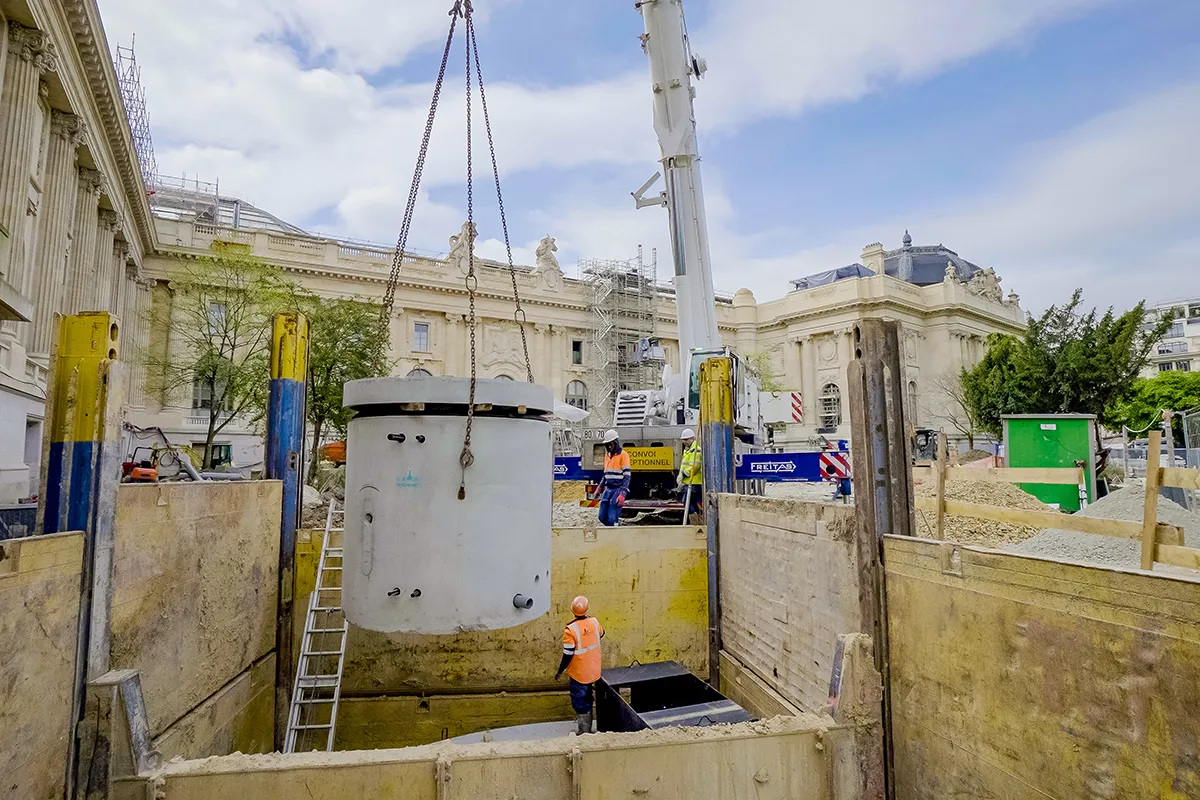
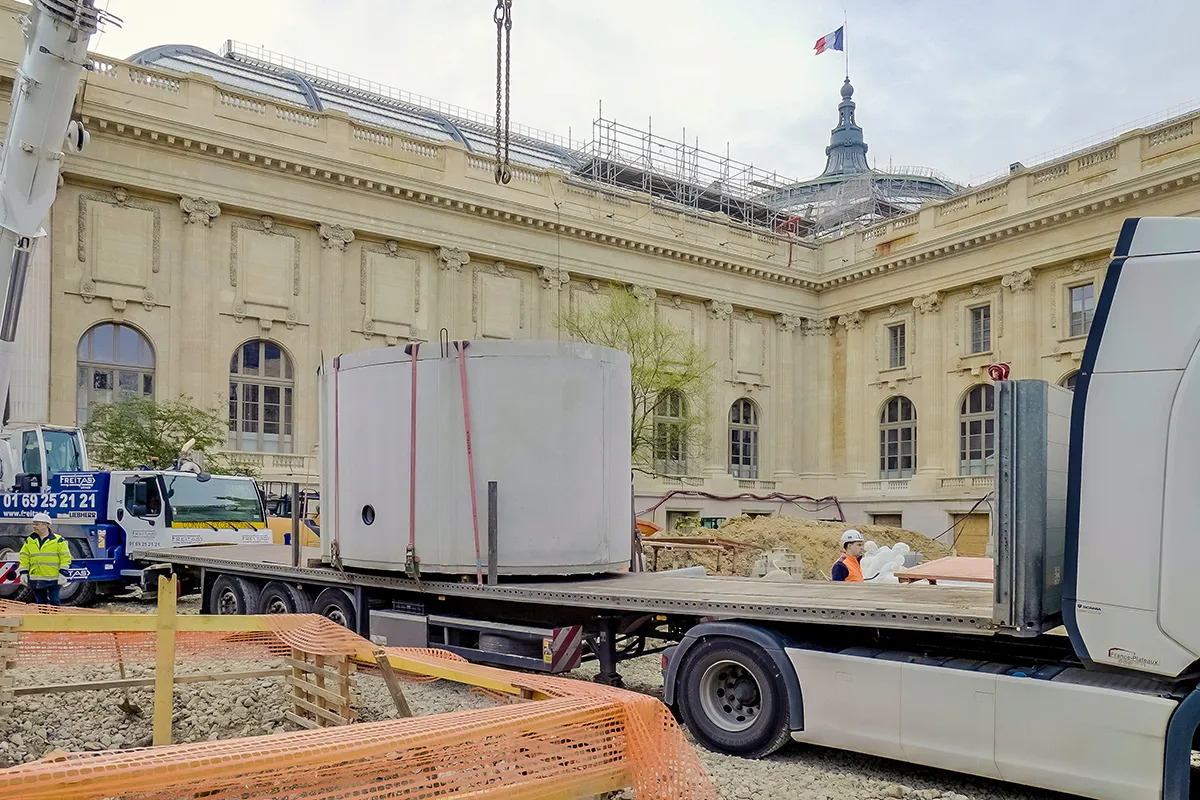
In March 2021, more than 120 years after it was built, the Grand Palais, with its 77 000 m2 of space hosting trade fairs and Parisian events, among other things, closed its doors for a major programme of works. This was completed in time for the Paris 2024 Olympic and Paralympic Games in the nave and surrounding galleries, while work on the rest of the building is continuing until spring 2025. The Grand Palais is due to reopen to the public on 6 June 2025.
As part of this exceptional renovation, environmental considerations led the client to explore the possibility of incorporating a rainwater harvesting system to irrigate the green spaces around the building.
Cross-border partnership
Founded in 2005, Aquae Environnement sa is one of the leading players in the design and supply of complete rainwater and greywater harvesting systems (slightly polluted domestic wastewater) in France. A designer and manufacturer of high-capacity filters and «plug & play» skids of all sizes, the company, based in Serris in Seine-et-Marne, has been using O Beton tanks for more than 15 years on all projects requiring underground external storage.
Jan Lauwers, Sales Manager at O Beton: «I have known Aquae Environnement for around twenty years. The company specialises in developing complete rainwater harvesting systems, including cisterns, pumps and filters, which it supplies to general contractors for projects of a certain scale. In turn, we supply them with our concrete cisterns, mainly single cisterns or pairs or groups of three tanks.»
Why does a company based in Île-de-France source its tanks from Roulers in Belgium? Jan Lauwers explains: «It is worth noting that France is less advanced than our country when it comes to rainwater harvesting. Here, rainwater harvesting is compulsory, at least in Flanders, whereas in France it is weighed against other investments in renewables, such as installing solar panels. We therefore have expertise and experience that may not necessarily be available across the border.»
Site-specific constraints
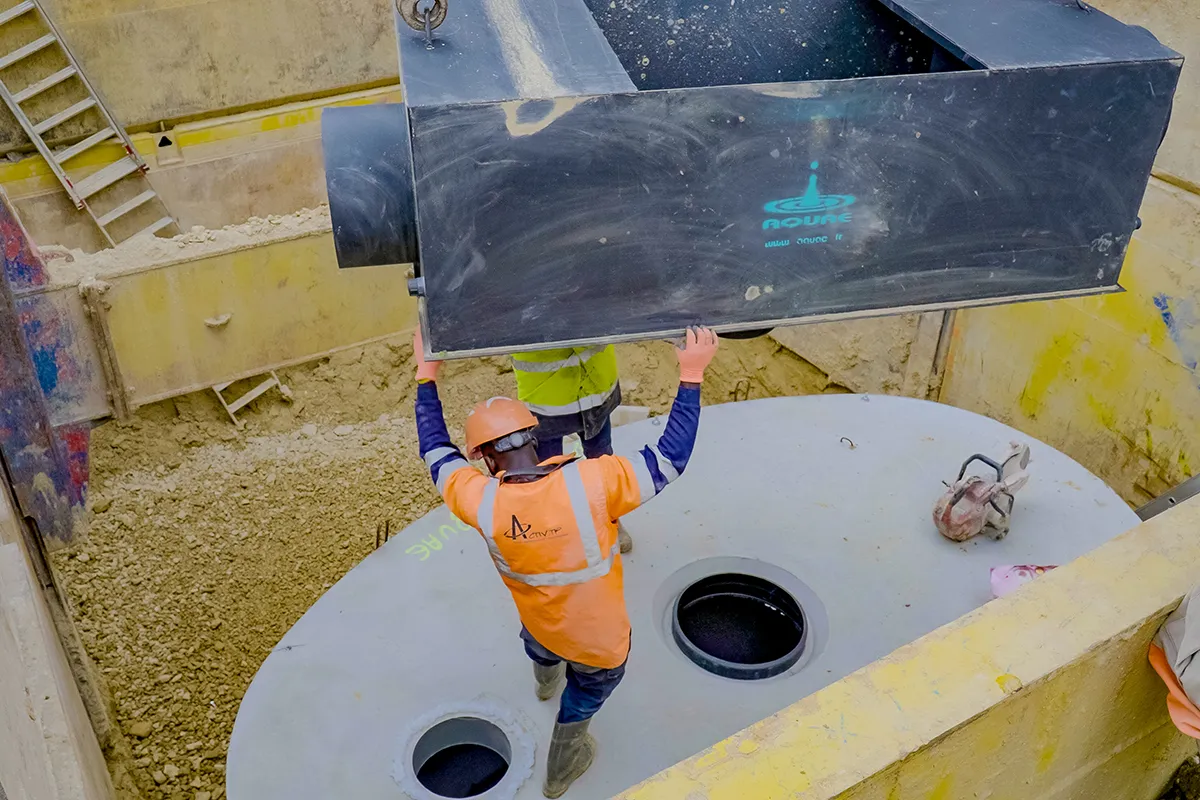
Given the constraints imposed by the existing drainage networks, the option of splitting the system into two separate, independent installations quickly emerged as the obvious choice. One was located to the north of the building and the other to the south, allowing the two existing networks to be diverted to underground storage. In view of the roof areas served, the storage capacity for each installation was set at 40 m3.
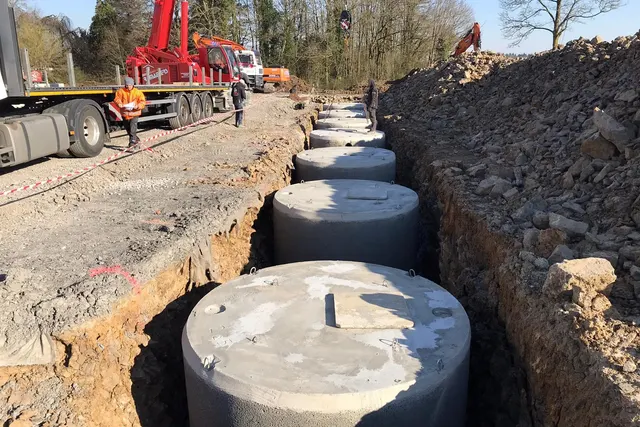
Constraints relating to the invert levels and the risk of groundwater rising led the Aquae Environnement team to approach O Beton to find the simplest and most effective solution. This involved connecting two 20 m3 tanks (D400 class), ballasted with a 20 cm concrete slab reinforced with a double 150/150/10/10 mesh.
Standard products, enhanced for the project
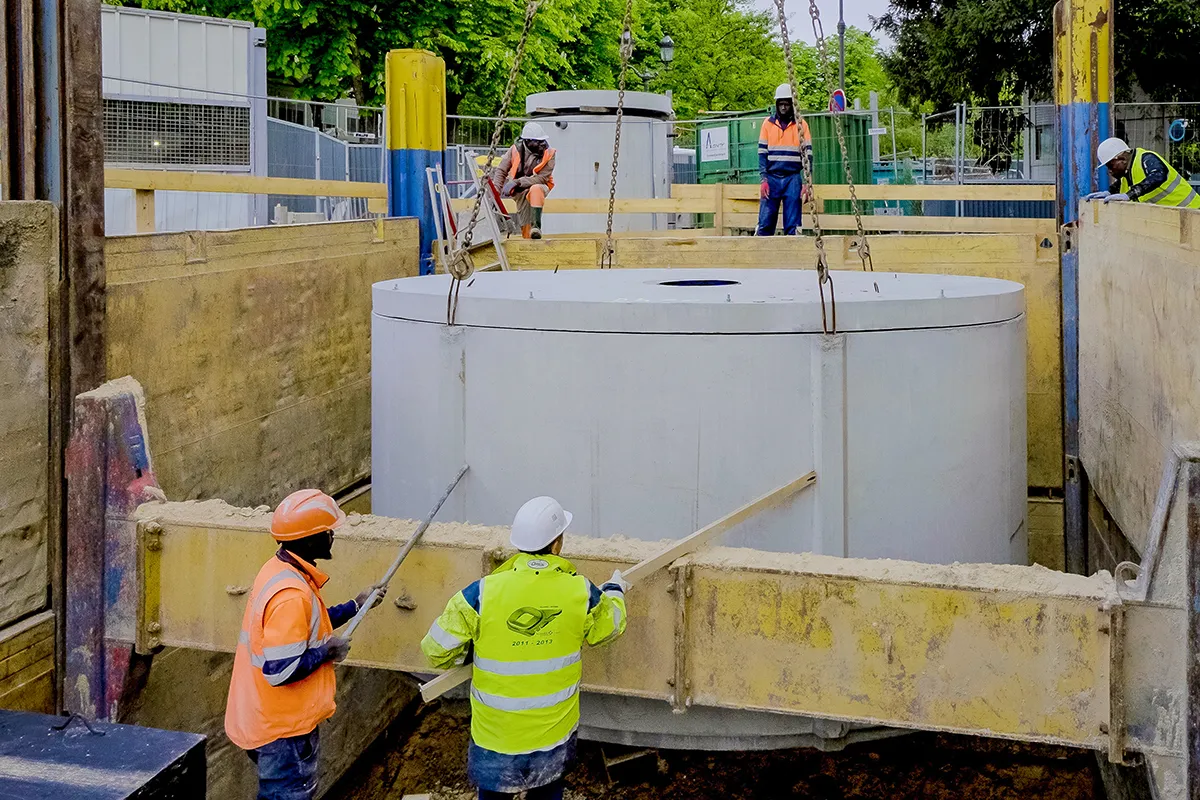
Jan Lauwers: «For this project, we supplied four 20 m3 OT VARIO D400 cisterns for rainwater storage, and two more with a capacity of 7500 litres, which were taller and 2 m in diameter. The Aquae teams converted these into underground plant rooms.
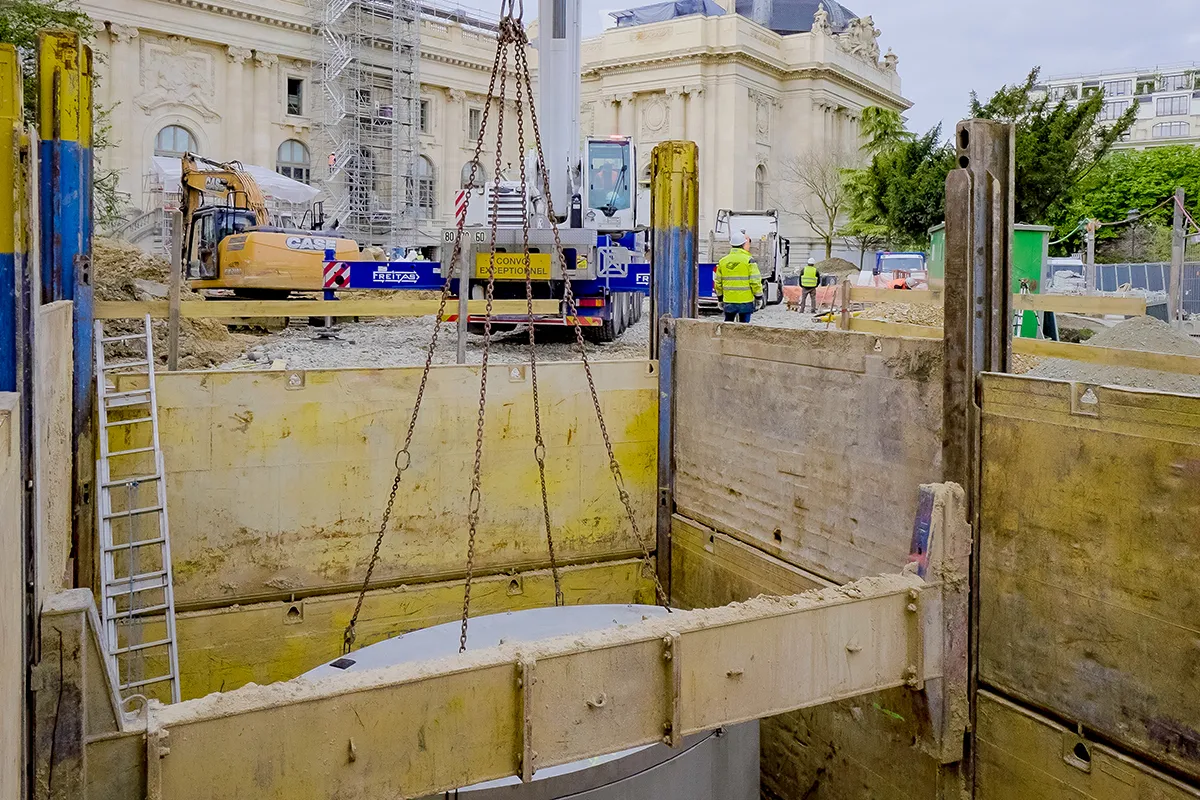
The four collection cisterns were buried under around 2.5 m to 3 m of backfill, more than in a typical installation, and ballasted by pouring concrete into the base to prevent them from floating due to groundwater pressure, which is directly affected by the proximity of the Seine. We drilled an additional hole in the cover so that Aquae could connect its filter.»
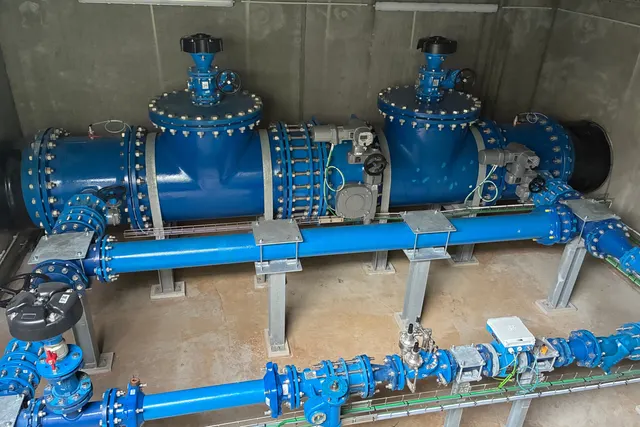
Each pair of tanks was then fitted with an Aquamat DN 500 epoxy-coated steel filter on the north side and a DN 300 filter on the south side. Designed by Aquae, these filters have two backwash nozzle manifolds, automatically controlled from the plant room.
Six cisterns, two converted into plant rooms
«The client wanted a solution for managing the supply and pressurisation of the collected water that was located outside the building and, moreover, out of sight. We therefore used an O Beton 7500-litre circular tank for each installation (OT VARIO, D400 class), which the company converted into a plant room,» Aquae Environnement explains. The two tanks were perforated in several places so that the plant rooms could be prepared in the workshop and delivered to site «plug & play».
O Beton carried out all the core drilling required for the equipment inlets and outlets. On site, the general contractor simply had to connect all the pipes. Aquae then commissioned the system.
More than just a supplier
This project demonstrates that O Beton is a valued partner that does more than supply standard cisterns. It works with its clients to develop customised solutions that meet specific requirements, such as more demanding conditions than those of a typical installation (burial depth, traffic loading, …). O Beton has also developed a separate range, the OT VARIO D400 used at the Grand Palais, which offers higher performance. Even for this premium range, O Beton is happy to provide customisation to meet particularly demanding operating conditions. Consulting engineers, contractors and end clients can all count on O Beton to contribute to the design process and add value wherever possible.
Technical details
Client: Réunion des Musées Nationaux, Grand palais (RMNGP)
Consulting engineer: Ingerop sa
Contractor: Activ TP sa
Rainwater management systems: Aquae Environnement sa
Precast concrete: O Beton nv
Question about this story? Ask your question
Keep following this
Get an email when a new story is published. No account needed.
- SubjectUnderground infrastructure and sewerage