











Safe, fast and simple: Daimler Truck and Linde launch a new standard for liquid hydrogen refuelling
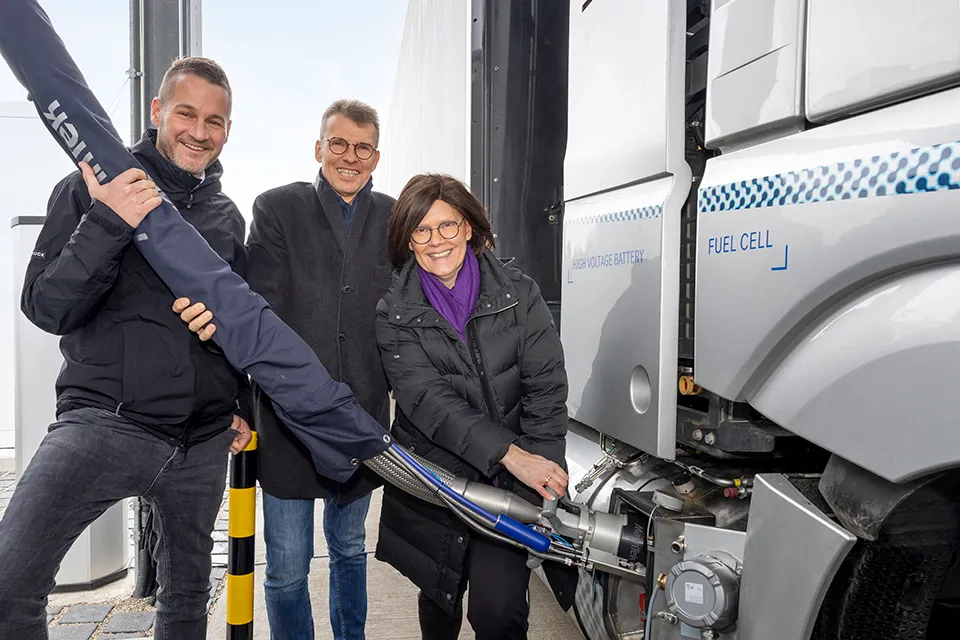
· Daimler Truck and Linde Engineering unveil sLH2, a jointly developed technology for refuelling with subcooled liquid hydrogen.
· Compared with gaseous hydrogen, subcooled liquid hydrogen (sLH2) offers greater storage density, longer range, faster refuelling, lower costs and higher energy efficiency.
· Daimler Truck and Linde Engineering aim to establish sLH2 as a shared refuelling standard for hydrogen trucks and make the technology available to all interested parties through an ISO standard.
· The first public sLH2 refuelling station has opened in Wörth-am-Rhein, Germany, and will also be used by selected logistics customers for initial trials with the Mercedes-Benz GenH2 Truck from mid-2024.
· Andreas Gorbach, Member of the Board of Management of Daimler Truck AG, responsible for Truck Technology: “Zero-emission transport requires three things: the right battery-electric and hydrogen vehicles, the necessary infrastructure network and cost parity between zero-emission vehicles and diesel trucks. We are taking an important step forward today on hydrogen infrastructure: with sLH2, refuelling with hydrogen becomes as convenient as refuelling with diesel. It takes around 10 to 15 minutes to refuel our Mercedes-Benz GenH2 Truck, giving it a range of more than 1,000 kilometres.”
· Juergen Nowicki, Executive Vice President of Linde plc and CEO of Linde Engineering: “Subcooled liquid hydrogen significantly increases the efficiency of hydrogen refuelling systems. This and other benefits make sLH2 a practical, CO2-neutral alternative to diesel in the heavy-duty vehicle sector. The technology we have developed with Daimler Truck will help pave the way for a robust refuelling network, which is essential to keeping vehicles moving and supply chains intact.”
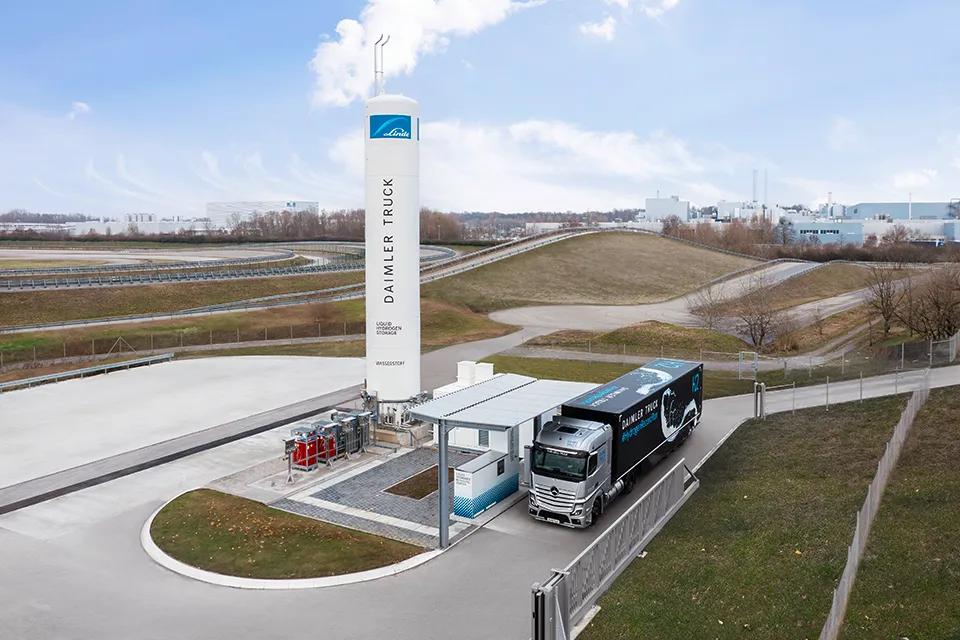
Daimler Truck and Linde Engineering, two leading industrial companies, have achieved a major infrastructure breakthrough on the road to decarbonising transport with hydrogen. Over the past few years, engineers from the two companies have jointly developed sLH2, a new process for handling subcooled liquid hydrogen. Compared with gaseous hydrogen, this innovative approach offers greater storage density, longer range, faster refuelling, lower costs and higher energy efficiency. Refuelling a 40-tonne heavy-duty truck carrying 80 kg of liquid hydrogen takes around ten to fifteen minutes and provides a range of 1,000 kilometres or more. At the same time, the new sLH2 technology reduces the investment required for a hydrogen refuelling station by a factor of two to three, while operating costs are five to six times lower. Liquid hydrogen can now be reliably supplied across Europe.
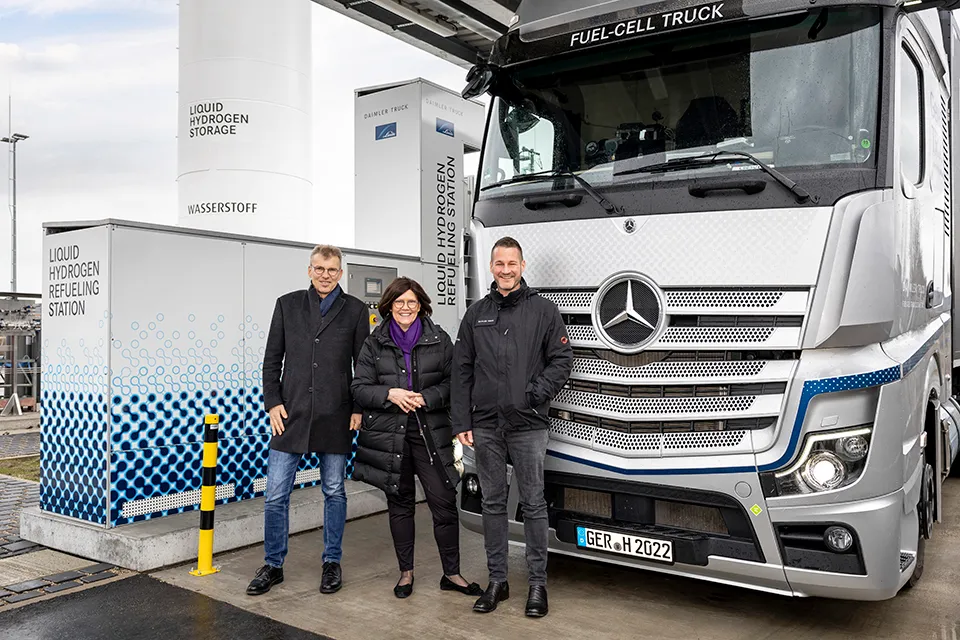
Compared with liquid hydrogen (LH2) refuelling technology, the new process uses an innovative sLH2 pump to raise the pressure of the liquid hydrogen slightly. This turns the hydrogen into subcooled liquid hydrogen (sLH2). In this state, hydrogen enables a highly robust refuelling process that minimises energy losses during refuelling. In addition, no data transmission is required between the refuelling station and the vehicle, further reducing the complexity of the solution. At the same time, refuelling capacity reaches new heights. The pilot refuelling station has a capacity of 400 kg of liquid hydrogen per hour. Compared with conventional liquid or gaseous hydrogen refuelling concepts, sLH2 is considerably simpler while delivering higher performance.
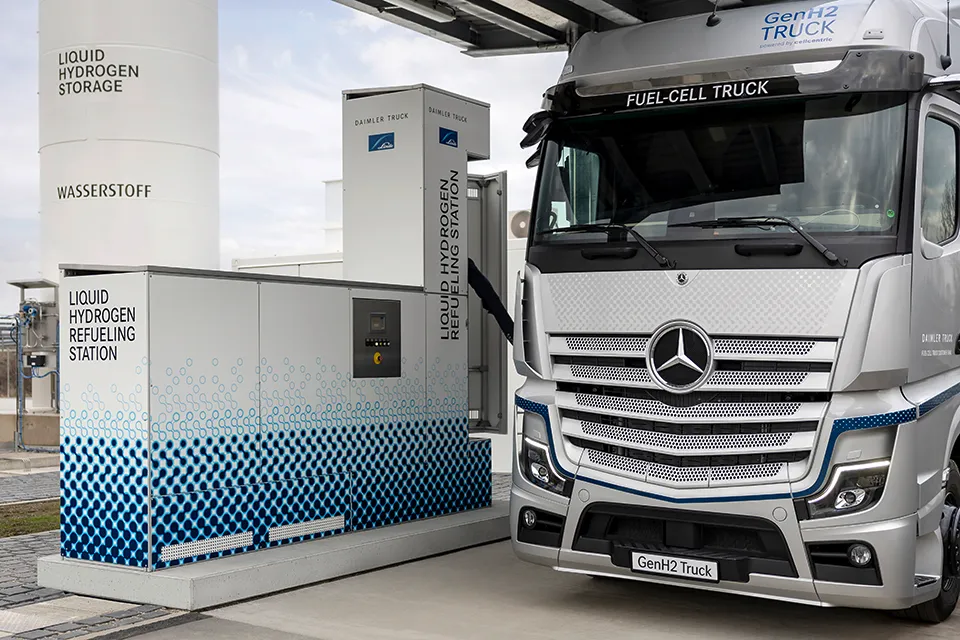
With the aim of establishing a shared refuelling standard for hydrogen trucks, the technology is being made available to all interested parties through an ISO standard. In the presence of Petra Dick-Walther, Rhineland-Palatinate’s Secretary of State for Economic Affairs, and international media, Andreas Gorbach, Member of the Board of Management of Daimler Truck, and Juergen Nowicki, CEO of Linde Engineering, today opened the first public sLH2 pilot station in Wörth am Rhein, refuelling a Mercedes-Benz GenH2 Truck prototype.
Andreas Gorbach, Member of the Board of Management of Daimler Truck AG, responsible for Truck Technology: “Zero-emission transport requires three things: the right battery-electric and hydrogen vehicles, the necessary infrastructure network and cost parity between zero-emission vehicles and diesel trucks. The transformation is already well under way when it comes to vehicles. We are taking an important step forward today on hydrogen infrastructure: with sLH2, refuelling with hydrogen becomes as convenient as refuelling with diesel today. It takes around 10 to 15 minutes to refuel our Mercedes-Benz GenH2 Truck, giving it a range of more than 1,000 kilometres. We now invite other OEMs and infrastructure companies to adopt our approach and make this technology an industry standard.”
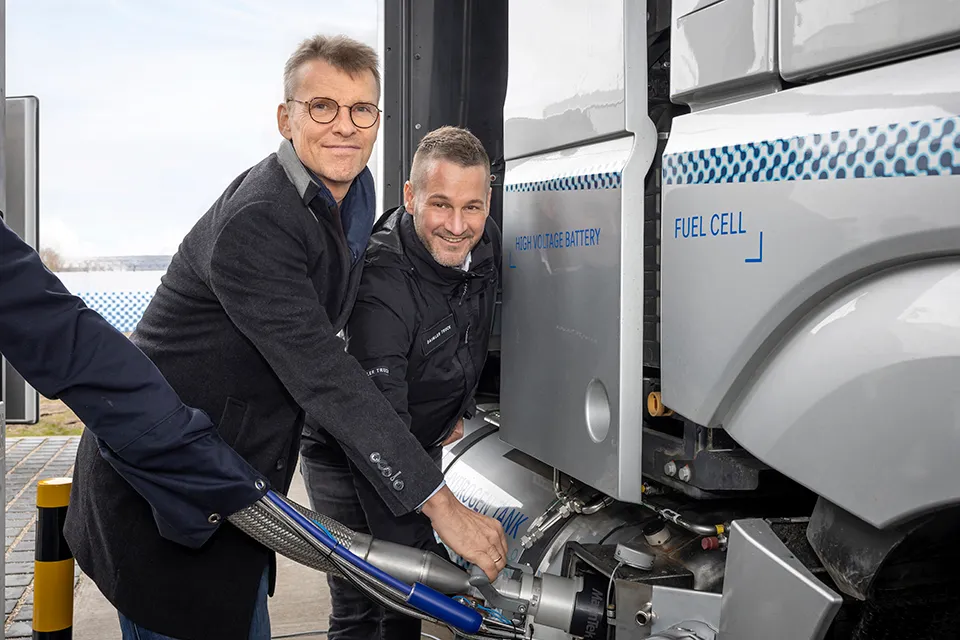
Juergen Nowicki, Executive Vice President of Linde plc and CEO of Linde Engineering: “Subcooled liquid hydrogen significantly increases the efficiency of hydrogen refuelling systems. The investment required is reduced by a factor of two to three, and operating costs are five to six times lower. These and other benefits make sLH2 a practical, CO2-neutral alternative to diesel in the heavy-duty vehicle sector. The technology we have developed with Daimler Truck will help pave the way for a robust refuelling network, which is essential to keeping vehicles moving and supply chains intact.”
Linde Engineering’s sLH2 refuelling station sets a benchmark for energy efficiency
The new public sLH2 refuelling station in Wörth-am-Rhein, Germany, sets a benchmark for energy efficiency and performance. With energy consumption of just 0.05 KWh/kg, it uses around 30 times less energy than conventional gaseous hydrogen refuelling. The refuelling station has a compact footprint of just 50 square metres, excluding the dispenser, and allows for configurations with multiple dispensers for parallel refuelling of trucks, as well as back-to-back refuelling. The liquid hydrogen storage tank has a capacity of four tonnes, enough for around ten hours of continuous refuelling. Meanwhile, the capacity of the sLH2 station can be increased to more than eight tonnes per day when replenished. The lower upfront investment and operating costs of sLH2 technology are expected to reduce the total cost of ownership over time.
Goal: set the industry standard for liquid hydrogen refuelling
Daimler Truck and Linde Engineering aim to make sLH2 the leading hydrogen refuelling technology for heavy-duty vehicles. That is why the two companies are providing a high level of transparency and openness around the relevant interfaces of the jointly developed sLH2 technology. The technology has been standardised through an open ISO process and is available to all interested parties. Daimler Truck and Linde Engineering are now calling on other OEMs, infrastructure companies and associations to adopt the new liquid hydrogen standard and thereby establish a global mass market for the process.
Safe, fast and simple hydrogen refuelling
Unlike current liquid hydrogen (LH2) refuelling, the sLH2 process is as convenient as today’s diesel refuelling technology. Thanks to robust insulation of the refuelling hose and the design of the interfaces between the nozzle and the fuel tank, the process is safe and spill-free. As a result, the safety measures required for sLH2 refuelling are comparable to those for diesel. During refuelling, cryogenic liquid hydrogen at minus 253 degrees Celsius can be dispensed into two 40 kg tanks mounted on either side of the truck chassis, without the need for special safety equipment. sLH2 technology enables a high flow rate of more than 400 kg of hydrogen per hour, and filling the tanks with 80 kg of liquid hydrogen takes ten to fifteen minutes. Finally, the new process avoids boil-off and “return gas” (gas from the vehicle tank flowing back to the refuelling station). This means only one nozzle is needed to fill the tanks, making sLH2 technology easier to use. Linde will supply liquid hydrogen to the new refuelling station in Wörth, drawing on the world’s largest liquid hydrogen production capacity and distribution system.
Liquid hydrogen delivers a range of 1,000 kilometres or more
Daimler Truck is prioritising liquid hydrogen in the development of its hydrogen-powered vehicles. In this aggregate state, the energy carrier has a much higher volumetric energy density than gaseous hydrogen. As a result, the tanks used in fuel-cell trucks running on liquid hydrogen are more cost-effective than the carbon-fibre tanks used for gaseous hydrogen. They are also significantly lighter because they operate at a lower pressure. This technology therefore makes it possible to increase payload while carrying more hydrogen, considerably extending the trucks’ range. The Mercedes-Benz GenH2 Truck is thus suited to flexible, demanding long-distance transport, just like conventional diesel trucks. This was demonstrated in September 2023, when a road-legal prototype of the Mercedes-Benz GenH2 Truck completed Daimler Truck’s #HydrogenRecordRun, covering 1,047 km on a single fill of 80 kg of liquid hydrogen. The company plans to introduce the production version of the fuel-cell truck in the second half of the decade.
sLH2 to be deployed in the Mercedes-Benz GenH2 truck trial fleet
From mid-2024, five companies are expected to take part in the first customer trials, gaining initial experience of CO2-free long-distance transport with the Mercedes-Benz GenH2 Trucks. The tractor units will be used for a range of long-distance transport applications on specific routes in Germany, and refuelled at the sLH2 refuelling station in Wörth-am-Rhein, which is now open to the public, and at a station in the Duisburg region. Daimler Truck and its partners are thus creating a flagship project to demonstrate that decarbonised transport using hydrogen trucks is already possible today. However, for the transition to succeed, an international refuelling infrastructure and an adequate supply of green liquid hydrogen will need to be established in the years ahead.
Question about this story? Ask your question
Keep following this
Get an email when a new story is published. No account needed.
- ThemeLow-carbon transport and mobility
- SubjectNews







