Diamonds are forever (well, maybe). But what about soil?
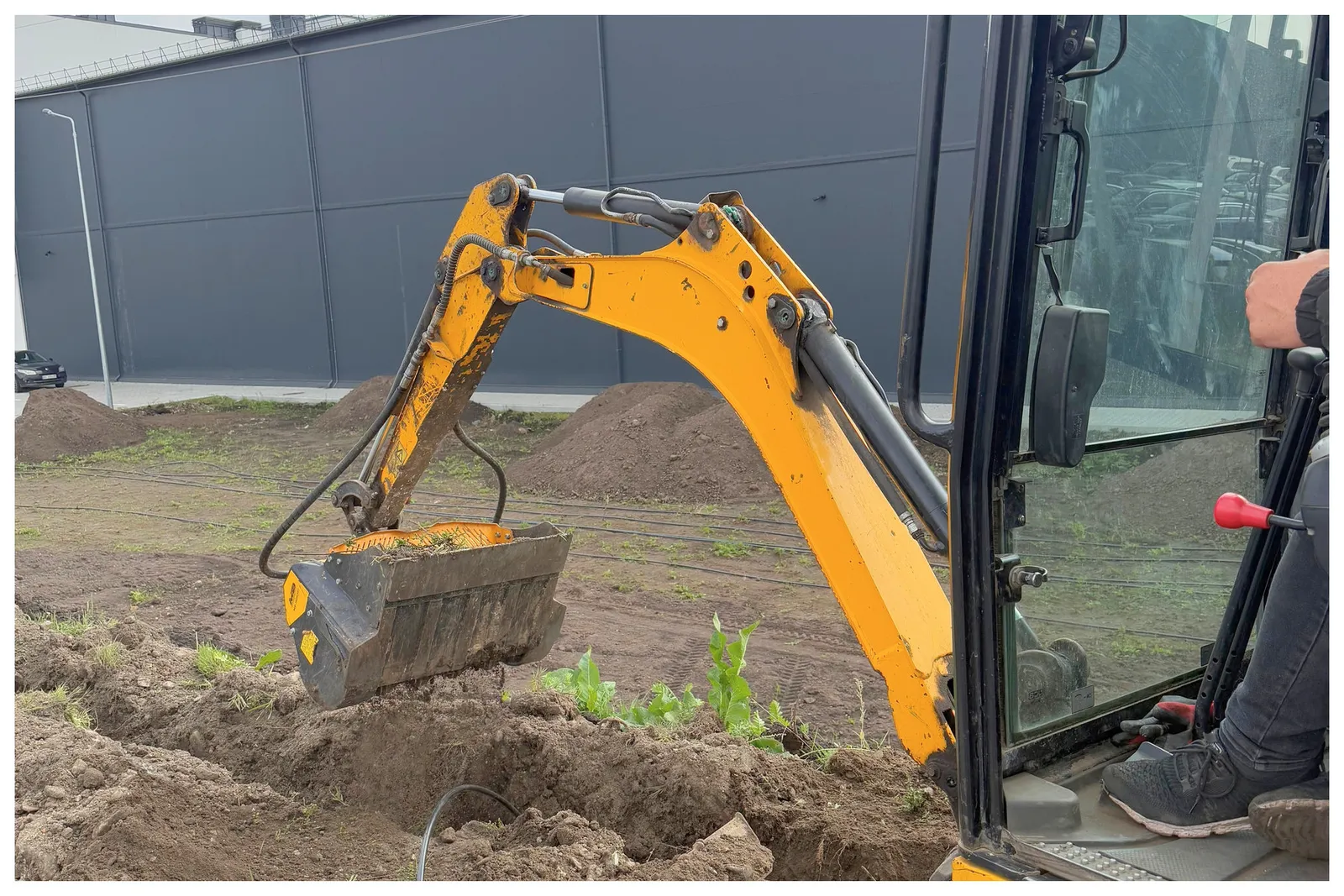
Excavated soil can travel many kilometres. Or it can stay on site and be used to grow something again. With the MB Crusher screening and crushing bucket, topsoil gets a second life right where it is needed.
Soil has a rather curious quality: it is worth a great deal when it is useful, but becomes a problem when it takes up space. In between come the lorries, journeys, transport costs, materials to buy and soil to manage.
Topsoil is a valuable resource. It contains organic matter, minerals and life. And when a project transforms an urban space into a park, garden, pedestrian area or green space, that soil can go back exactly where it is needed: to grow something.
More green space means more soil to put to good use
Cities are changing their look. Parks, pedestrian areas, urban greening and depaving projects are playing an increasingly important role in urban regeneration schemes.
The EU framework is also moving in this direction. The EU Nature Restoration Regulation sets targets for urban ecosystems: by 2030, Member States must ensure there is no net loss in the total area of urban green space and tree canopy cover, while from 2031 onwards, an increasing trend must be observed.
In construction terms, more green space also means more soil to move, prepare and put to good use.
And that raises a very practical question: why remove a resource, only to buy another one and bring it back to the site?
Topsoil created where it is needed
The MB Crusher MB-HDS rotary screening bucket makes it possible to screen material directly on the machine already working on site. Excavated soil, stones, roots and waste are fed into the attachment. Its rotors screen the materials, producing a soil fraction ready for the next operations. The result can be used as topsoil for a green space, material for seeding, a planting base or backfill. And the process does not stop at screening.
The MB Crusher MB-HDS range uses different types of rotors, selected according to the material and the desired result. The machine can therefore handle a range of operations, from screening soil and preparing growing media to mixing it with compost or sand.
When I grow up, I’ll be a gardener
Soil knows what to do when it finds the right place. Sometimes, all it needs is a helping hand.
Edil 2T S.n.c. di Todeschini Daniel & C. in Italy knows this well. The company uses an MB-HDS207 screening and crushing bucket fitted with an RQ8 screening kit for garden landscaping. Soil is fed in, passes through the rotors and is immediately ready for use on site. Fewer trips back and forth, less handling, and more material ready to contribute to the new project. The customer’s comment sums up the result: a job “fit for a real gardener”.
The case of a landscaping and gardening company in Lviv, Ukraine, is even more interesting. Here, the MB-HDS207 screening and crushing bucket is mounted on a mini excavator. The company previously used a skeleton bucket; now, with the MB Crusher attachment, work progresses around five times faster.
And this soil has plenty to do. Once screened, it becomes soil for lawns and flowers, supports new planting, goes into landscaping projects and is also used to backfill and cover water and irrigation pipes. That is what makes soil special: it changes location, form and purpose. But its value remains.
When soil also becomes a business
Others have approached the issue from a different angle.
In Lithuania, a company chose an MB-HDS220 star screen for its telescopic handler and turned the screening of sand, soil, compost and fertiliser into a fully fledged business. The materials are processed, screened and then packaged for sale to customers. Soil can therefore become a raw material, a product and an opportunity.
That is also the essence of circularity on site: making use of what is already available, reducing handling and transport, and producing new materials directly where they are needed.
This approach also aligns with the environmental objectives of public works. In Italy, for example, the CAM for green spaces provide for the preservation of the topsoil layer and its subsequent reuse in landscaping.
Diamonds remain a classic. Soil, on the other hand, reinvents itself. In the end, perhaps the real luxury is not having soil. It is knowing what to do with it.
Question about this story? Ask your question
Companies in this story
Keep following this
Get an email when a new story is published. No account needed.
- SubjectNews
- CompanyMB Crusher