











Round table on the future viability of the technical textiles industry
Texte Messe Frankfurt / Niels Rouvrois Photos Messe Frankfurt / Jean-Luc Valentin
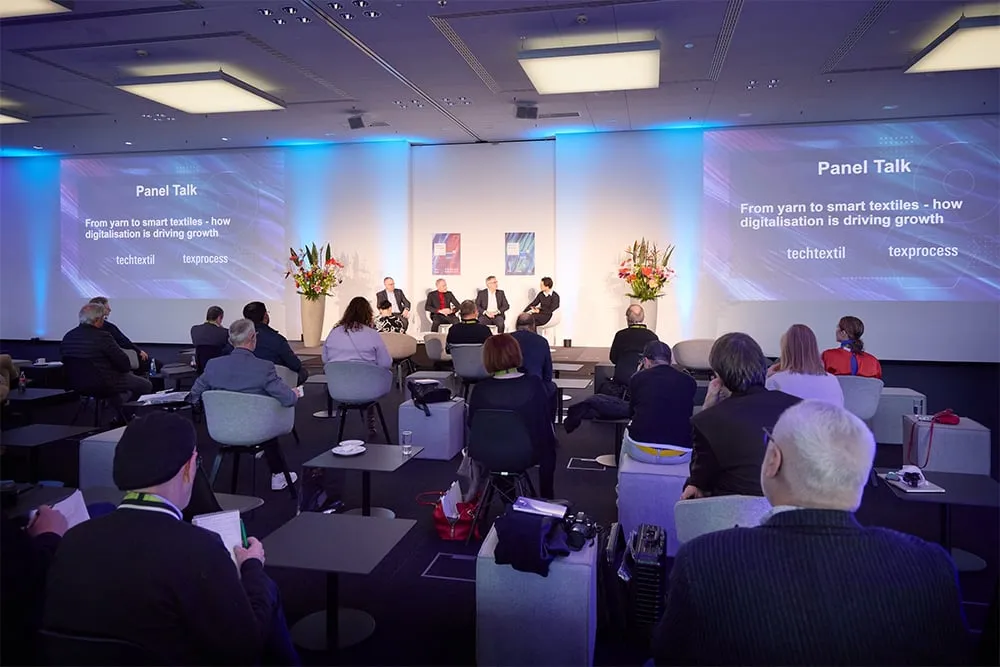
Technical textiles are being used more widely in the infrastructure sector. As in construction, what impact is digitalisation having on innovation in the textile industry? How can digitalisation help address the challenges facing the sector? What are the latest developments? What does the digital future of the technical textiles industry look like? At a round table held ahead of Techtextil and Texprocess (23 to 26 April), several experts discussed these and other questions, and previewed the two trade fairs.
Digitalisation is not yet firmly established across the board. A study carried out by the German Economic Research Institute in 2022 found that only 31% of companies in Germany are able to use data effectively. Yet it is essential for companies to improve their digital infrastructure, as legal requirements, such as the EU Strategy for Sustainable and Circular Textiles and the associated Digital Product Passport, call for a proportionate level of digitalisation. At the same time, digitalisation helps meet customers’ and partners’ sustainability requirements, particularly by improving supply chain transparency and resource calculations. Companies that want to remain competitive and produce efficiently and flexibly can no longer avoid digital technologies. Digitalisation offers solutions to the challenges facing the industry.
Techtextil and Texprocess are supporting companies on the path to a digital future. More than 1,600 exhibitors from around 50 countries will present their latest developments and technological innovations. Participants will find the right partners and digital solutions tailored to their needs. The extensive programme provides an ideal setting for meeting experts and industry representatives.
“The sectors have enormous innovation potential, particularly in digitalisation, but success is only possible through international information exchange. The global technical textiles industry will be at Techtextil and Texprocess. Dialogue, knowledge transfer, unique innovations and versatile solutions will strengthen companies in the future,” said Olaf Schmidt, Vice President Textiles & Textile Technologies at Messe Frankfurt.
Round table
At the round table, Prof. Thomas Gries, Director of the Institute of Textile Technology (ITA) at RWTH Aachen University, Elgar Straub, Managing Director of VDMA Textile Care, Fabric & Leather Technologies, and Olaf Schmidt assessed the state of digitalisation in the textile industry from several perspectives. Zackes Brustik moderated the discussion.
Digitalisation helps companies address challenges and remain competitive. Digital developments enable them to tackle shortages of raw materials and labour, energy costs and rising sustainability requirements, while producing more efficiently, quickly, flexibly, transparently and cost-effectively.
“The continuously changing demands of consumers and regulations, along with labour shortages and difficult business conditions caused by geopolitical shifts, present challenges for technical textile processors. Manufacturers of textile processing machinery, systems and processes provide solutions. Through digitalisation and automation, we help customers with their production and drive innovation, delivering greater flexibility, sustainability, quality and product potential,” added Elgar Straub.



Research and industry drive innovation
Although many companies have already digitalised some stages of their processes, it is essential to digitalise the entire value chain and close any gaps if the industry is to realise its full potential. “Resilient and sustainable value chains are essential to the future viability of the textile industry, and digitalising process stages is the foundation for them. To achieve this, researchers and industry must work closely together,” said Prof. Thomas Gries.
Digitalisation opens doors
The latest digital developments will be on show at Techtextil and Texprocess. They range from production technologies and textile processing machinery to fibres, yarns and nonwovens, as well as functional and smart textiles. The range of industries interested in technical textiles is unique. They are used in every field of application, from healthcare and mobility to construction. Digitalisation is also driving significant progress, making production and processing more efficient and enabling smart products to create new added value.
Question about this story? Ask your question
Keep following this
Get an email when a new story is published. No account needed.
- ThemeManaging construction projects
- SubjectNews







