











Handrail lighting provides comfort and safety for vulnerable road users
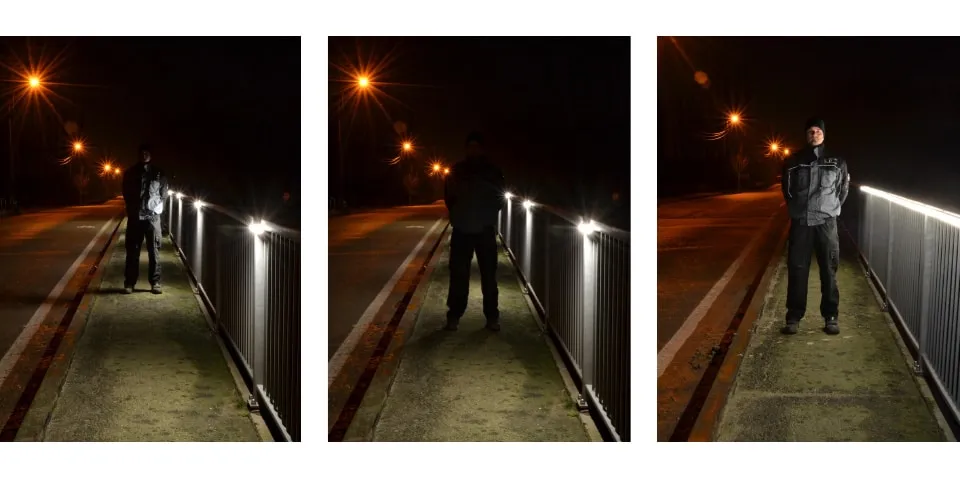
Designers of bridges and footbridges for pedestrians and cyclists most often choose not to mount lighting on poles, but to integrate it into the handrails. But how can safe and effective handrail lighting be achieved? “The principle is fairly new for this type of structure,” explains Piet Devriese of LEDtechnic, a company specialising in LED lighting systems, including handrail lighting.
To determine the lighting level on a bridge deck, designers generally refer to the S(4) or P(4) standards for pedestrian or cycle routes. “In practice, however, the provisions of these standards are unsuitable for implementing handrail lighting,” Piet Devriese continues. “These regulations were originally drawn up for lighting fittings mounted at the top of poles. But installing handrail lighting at a low level creates a very different situation. In many cases, handrail lighting is also the only lighting on the bridge, usually in dark surroundings where ambient light is very low or even non-existent.”
Facial recognition
At LEDtechnic, experience shows that the light levels specified in these standards are fairly high and can be achieved very easily using point lighting with wide spacing (> 4 m). Piet Devriese says: “But this type of installation is not ideal, especially for facial recognition. On a bridge or a footbridge for cyclists and pedestrians, the focus must be on people’s comfort and safety. In this context, recognising faces as clearly as possible is crucial, and this is achieved by using continuous lighting aimed as horizontally as possible.”
Continuous, diffuse and horizontal
When installing handrail lighting horizontally, particular attention must be paid to comfort, and passers-by must not be dazzled. “Experience has taught us that with lighting that is this continuous and diffuse, a luminous flux of around 60 lumen/m is the maximum if crossing the bridge is to remain comfortable,” says Piet Devriese. “For safety and facial recognition, the aim is to achieve a semi-cylindrical illuminance of 3 Lux, with a minimum of at least 2 Lux. And this applies not only at a height of 1.5 m, but also at a height of 1.8 m.” “The safest and most comfortable handrail lighting for bridges and footbridges for cyclists and pedestrians is therefore based not only on continuous, diffuse lighting, but also on a wide beam angle and lighting directed as horizontally as possible to achieve the semi-cylindrical values. All this is combined with an average illuminance on the bridge deck,” concludes Piet Devriese.
Question about this story? Ask your question
Keep following this
Get an email when a new story is published. No account needed.
- ThemeBuilding and site safety and security
- SubjectNews







