











Daimler Truck puts its new advanced safety assistance systems through intensive testing
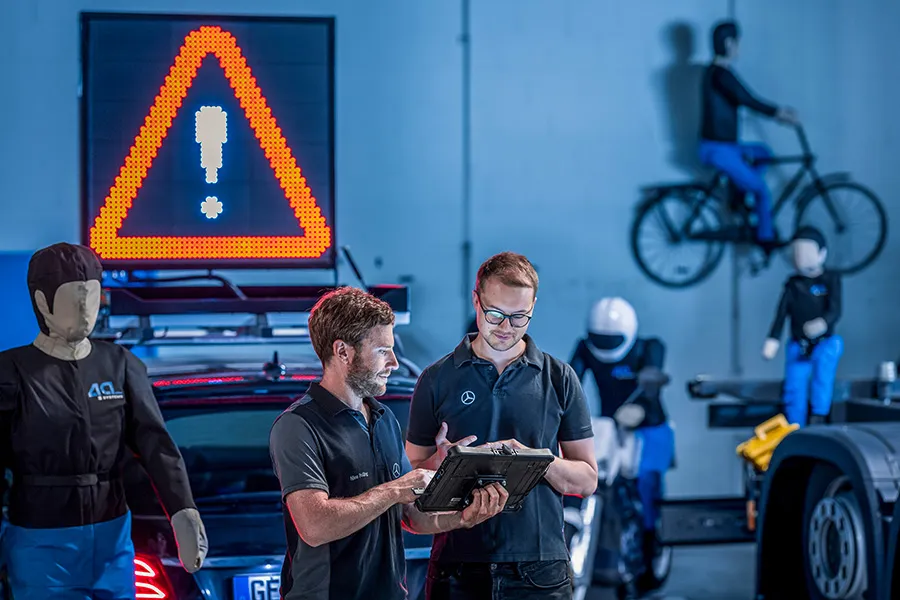
Whether it is emergency braking at the end of a traffic jam, greater safety when turning and changing lanes to the right, a reduced risk of skidding, for example on bends or during evasive manoeuvres, or many other use cases: thanks to safety assistance systems, professional drivers can better manage many potentially dangerous situations on the road and, ideally, prevent accidents or at least mitigate their consequences. Daimler Truck has always been an industry pioneer in this respect. For decades, the company’s development and testing engineers have worked to support drivers as effectively as possible in their work through appropriate features, thereby improving safety for all road users.
Daimler Truck had already fitted many systems across its different model ranges long before they became mandatory by law, as is currently the case, for example, under the European Commission’s General Safety Regulation (GSR) 2019/2144. Since 6 July 2022, the regulation has required additional systems to be fitted as standard on new vehicle types, and from July 2024, as part of a phased introduction of requirements for advanced systems, on all newly registered vehicles.
One thing is certain: before driver assistance systems can enter production, they must be thoroughly tested. At Daimler Truck, such tests take place throughout the year, in particular at the company’s development and testing centre (EVZ) in Wörth am Rhein, as well as in Finland, Spain and Japan, and at Daimler Truck North America’s test track in Madras, Oregon. More than 60 Daimler Truck vehicles worldwide undergo endurance testing throughout the year. The distance covered to validate the systems totals around five million kilometres from 2020 to the end of 2023.
Niyazi Mustafa Üstertuna, Head of Software & Electronics at Daimler Truck: “Tests such as those in Wörth are fundamentally important to us. They enable us to incorporate the resulting findings and insights into the systematic optimisation of existing driver assistance systems and the development of new safety functions, from the compact Atego to special-purpose trucks and buses. Our new systems, proven even in extreme conditions, are being improved significantly further.”
Setting new benchmarks
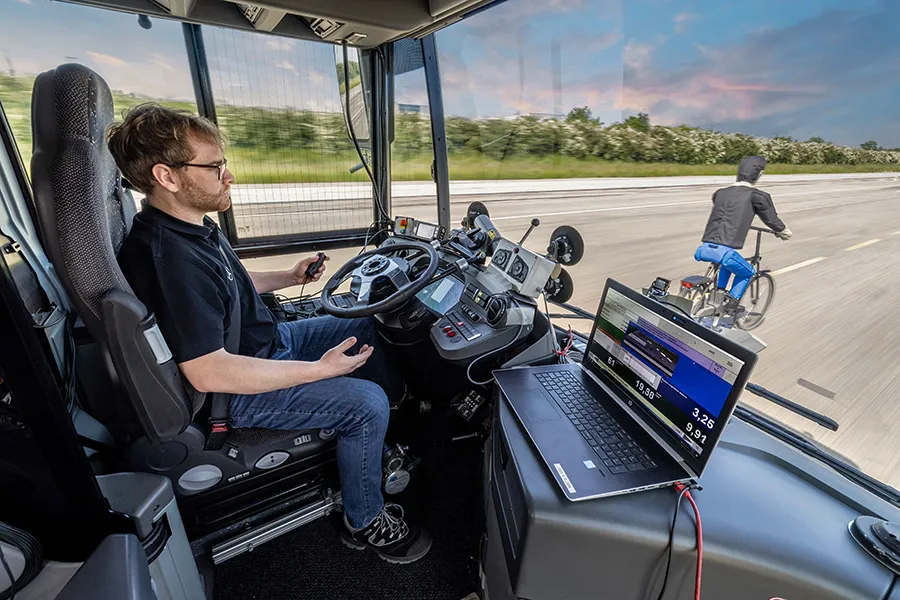
The recent in-depth tests at the electric development centre focused primarily on the driver assistance systems that will be used in Daimler Truck’s various trucks and buses from April 2024. These include Active Brake Assist (ABA) 6, the new Frontguard Assist, Active Sideguard Assist (ASGA) 2, Active Drive Assist (ADA) 3 and the Traffic Sign Assist. With these systems, Daimler Truck is once again underlining its pioneering role in this field and setting new benchmarks for safety. Alongside the Mercedes-Benz Trucks Actros, eActros and Atego, the test vehicles also include buses from Mercedes-Benz and Setra, as well as special-purpose trucks such as the Econic and Unimog. Tests include how and when ABA 6 gives a warning if a cyclist or motorcyclist suddenly crosses the lane or appears in front of the vehicle, as well as in front of another vehicle, for example at the end of a traffic jam, and applies the brakes. They also assess how the new Frontguard Assist gives drivers visual and audible warnings of vulnerable road users directly in front of the truck, particularly in stressful situations such as moving off or at junctions. Another test examines how Active Sideguard Assist (ASGA) 2 responds when turning right if a pedestrian or cyclist is alongside the vehicle. And how Active Drive Assist (ADA) 3 automatically steers the truck back into its lane if the driver, for example, wants to move left to overtake but has failed to notice a vehicle approaching from behind.
270-degree sensor fusion technology
The driver assistance systems being tested are based on a new electronic platform combined with sensor fusion, which combines radar and camera data to provide an even wider view to the front and sides. The electronic platform offers 20 times greater data processing capacity. The six sensors installed in total, four short-range radars at the front and rear on both the right and left, one long-range radar in the middle at the front, and the multifunction camera in the windscreen, now cover a 270-degree angle around the vehicle itself. Thanks to the significantly wider field of view, driver assistance systems that were already effective can make even better use of their strengths. At the same time, Daimler Truck’s safety assistance systems go well beyond GSR requirements in many areas. For example, ABA 6 can actively intervene in braking and automatically bring the vehicle to a stop at speeds of up to 60 km/h, not only when approaching stationary vehicles but also when approaching road users coming towards it or travelling in the same lane.

High technology and detailed planning
State-of-the-art equipment is used to reproduce, countless times, the use cases tested in real-world conditions on the test track at the Wörth electric distribution centre. This includes vehicles fitted with a wide range of high-tech measurement equipment, steering and acceleration robots, as well as dummy models and GPS-controlled targets. Before the use cases themselves are tested, the sensors required for the driver assistance systems to work effectively are thoroughly tested in component tests, and the functions are tested in software-in-the-loop tests. Vehicle integration tests and system tests are also carried out across the different model ranges and models. The EVZ’s secure test area makes it possible to reproduce a range of scenarios, such as the end of a traffic jam, overtaking or turning. These are tested on different road profiles that reflect roads around the world. This allows the same conditions found, for example, in South America, South Korea, Africa and, of course, Europe to be recreated for the test vehicles. Road testing remains an important basis for validating systems and functions, and for technically preparing safety data, so that the various systems across the model ranges and models can be pushed to their limits on closed test tracks and the limits of vehicle dynamics explored. Daimler Truck’s development engineers also examined vehicle functions and systems closely, for example during the journey to the winter tests in Finland in early 2023. These included lane-change assistance as part of Active Sideguard Assist and Active Drive Assist lane keeping on the Actros L. As the journey also crossed several national borders, it was possible to measure how country-specific road markings, traffic signs and digital map data affected the performance of the driver assistance systems fitted to the trucks.
Question about this story? Ask your question
Keep following this
Get an email when a new story is published. No account needed.
- ThemeLow-carbon transport and mobility
- SubjectNews







