











Daimler Truck #HydrogenRecordRun: Mercedes-Benz GenH2 Truck breaks the 1,000-kilometre barrier on a single tank of liquid hydrogen
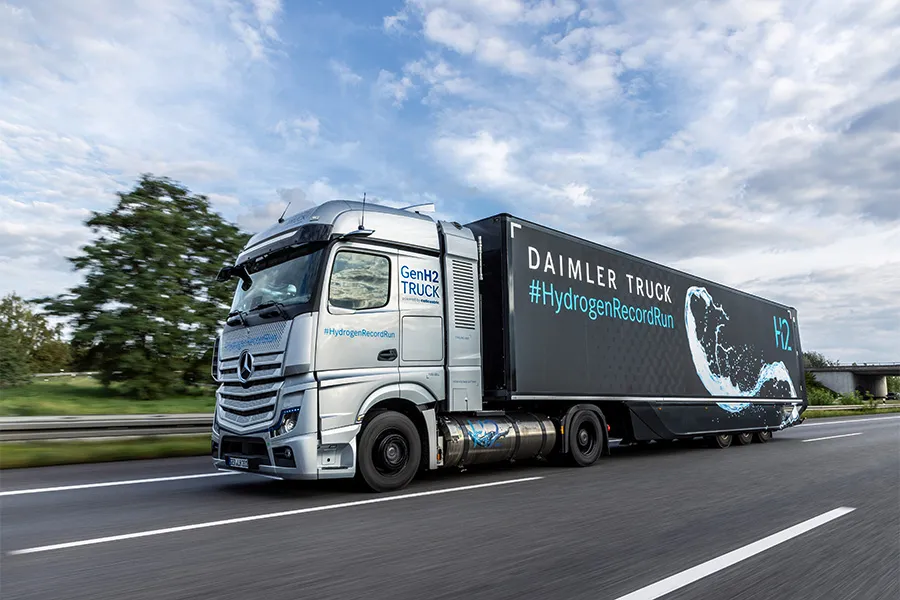
· A prototype Mercedes-Benz GenH2 Truck covered 1,047 km between Woerth-am-Rhein and Berlin.
· Daimler Truck reaches a new milestone with the #HydrogenRecordRun, as part of its ‘dual-track’ strategy involving hydrogen and battery-powered trucks.
· Andreas Gorbach, member of the Board of Management of Daimler Truck AG, responsible for Truck Technology: “The strength of fuel cell trucks lies in flexible, demanding long-distance transport operations. Hydrogen in road transport is no empty promise: we have proved this impressively by covering more than 1,000 kilometres on a single tank.”
Daimler Truck has successfully demonstrated that hydrogen fuel cell technology can be the right solution for decarbonising flexible, demanding long-haul road transport. A prototype Mercedes-Benz GenH2 Truck approved for use on public roads completed Daimler Truck’s #HydrogenRecordRun, covering 1,047 km on a single tank of liquid hydrogen.
Powered by a fuel cell system centred on the cell and equipped with a liquid hydrogen tank, the journey began on the afternoon of Monday 25 September at the Mercedes-Benz Truck Customer Centre in Woerth-am-Rhein and ended on the morning of Tuesday 26 September in Berlin, the capital of Germany. The truck completed the journey fully laden, with a gross vehicle weight of 40 tonnes, under real-world conditions and without emitting CO2 at any point. The record run, with sealed tanks and verified mileage, was independently confirmed by an inspection document from TÜV Rheinland.
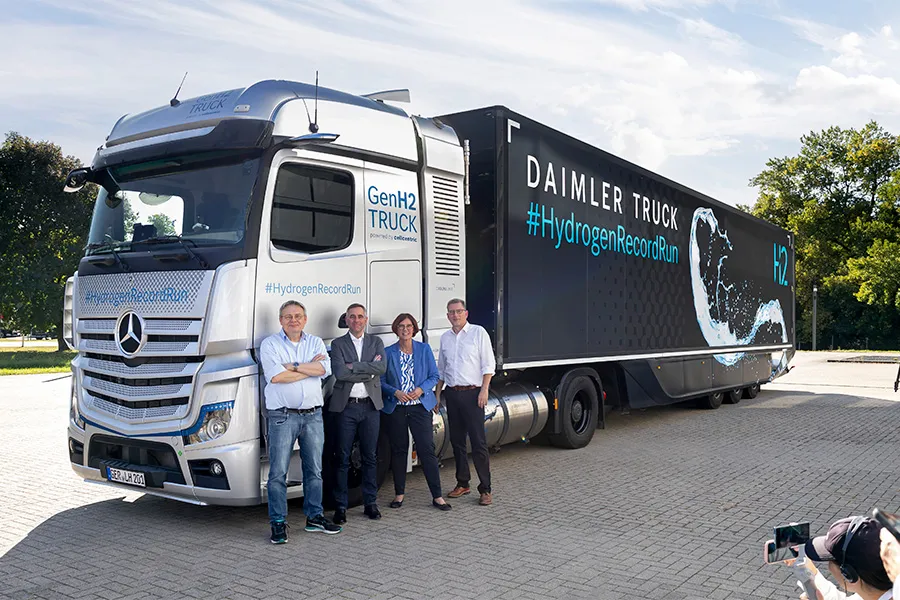
Together with Rainer Müller-Finkeldei, Head of Product Development at Mercedes-Benz Trucks, Petra Dick-Walther, State Secretary for Economic Affairs of the federal state of Rhineland-Palatinate, sent the hydrogen truck on its journey in front of international media: “Today is a great day! A hydrogen truck is leaving Rhineland-Palatinate for Berlin. We are proud that an innovation of this significance comes from Rhineland-Palatinate and was developed and tested at the Woerth plant. This is testament to the innovative spirit of Rhineland-Palatinate and will permanently change the transport industry. It marks an important milestone in the transformation and decarbonisation of the transport sector through new technologies. The GenH2 Truck’s journey from Rhineland-Palatinate to Berlin makes this tangible.”
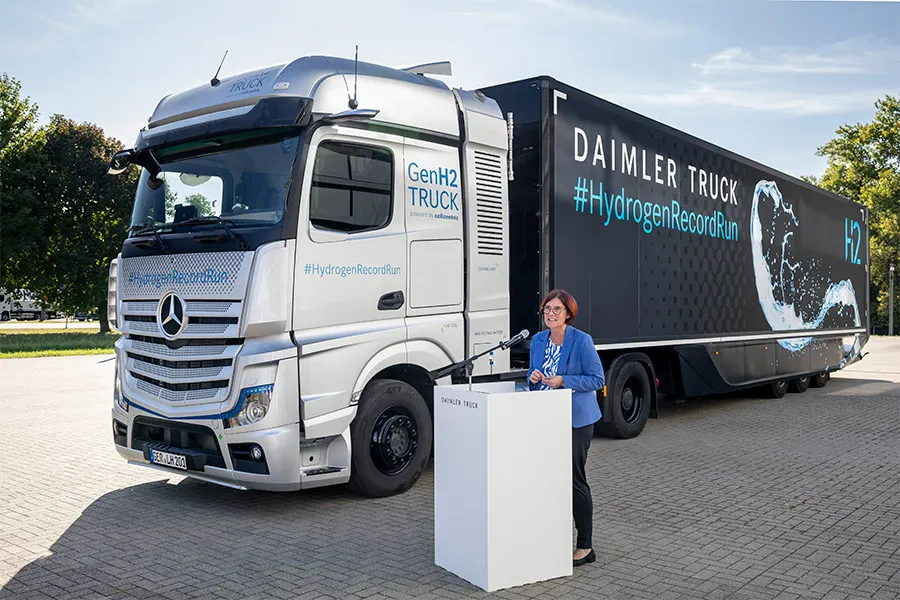
After this record-breaking run, Andreas Gorbach, member of the Board of Management of Daimler Truck AG and Head of Truck Technology, crossed the finish line in Berlin’s Ministergärten: “To decarbonise transport, we need both battery-electric and hydrogen-powered drive technologies. The strength of fuel cell trucks lies in flexible, demanding long-distance transport operations. By breaking the 1,000-kilometre barrier on a single tank, we have made an impressive demonstration: hydrogen in trucks is anything but hot air, and we are making great strides towards series production. At the same time, today’s record run reminds us that decarbonising transport requires two other factors in addition to the right drive technologies: green energy infrastructure and costs that are competitive with conventional vehicles.”
Before the challenge, the Mercedes-Benz GenH2 Truck was refuelled with liquid hydrogen at Daimler Truck’s filling station, located at the company’s development and testing centre in Woerth. The hydrogen supplied by Air Liquide is renewable, having been produced from biomethane with guarantees of origin. During refuelling, cryogenic liquid hydrogen at minus 253 degrees Celsius was dispensed into two 40 kg tanks mounted on either side of the truck’s chassis. Thanks to the tanks’ particularly effective insulation, the hydrogen can be kept at temperature for a sufficiently long period without active cooling. Both tanks were sealed by TÜV Rheinland before the #HydrogenRecordRun began.
Daimler Truck favours liquid hydrogen in its development of hydrogen-based powertrains. In this aggregate state, the energy carrier has a significantly higher energy density by volume than gaseous hydrogen. As a result, more hydrogen can be carried, substantially increasing the vehicle’s range and enabling it to deliver performance comparable to that of a conventional diesel truck.
Daimler Truck pursues a ‘dual-track’ strategy with hydrogen and battery-powered vehicles
Daimler Truck, one of the world’s largest commercial vehicle manufacturers, is committed to the Paris Climate Agreement. Its aim is to offer new CO2-neutral vehicles in its main global markets, Europe, the United States and Japan, by 2039. Battery-electric trucks are the ideal choice for distribution transport, as well as for long-distance transport with regular deployment on routes that can be planned and have suitable distances and charging options. However, hydrogen engines could be a better solution, particularly for highly flexible and especially demanding heavy-duty and long-distance transport operations. In addition, the availability of suitable infrastructure and sufficient green electricity is crucial to a successful transition to zero-emission technologies. Daimler Truck is convinced that this energy demand can be met quickly and cost-effectively only by using both technologies.
From Berlin to Berlin: three years of hydrogen road transport
Three years ago, on 16 September 2020, Daimler Truck announced its commitment in Berlin to investing on a large scale in hydrogen technology. CEO Martin Daum presented the Mercedes-Benz GenH2 Truck Concept to the public for the first time, highlighting the company’s technology strategy. This was followed by the creation of cellcentric, a joint venture with the Volvo Group that will bring one of Europe’s largest fuel cell production facilities into operation. Since 2021, the first Mercedes-Benz GenH2 Truck prototypes have been undergoing rigorous testing and have recently demonstrated their capabilities on the Brenner Pass, one of Europe’s busiest and most challenging transit routes. The success of the #HydrogenRecordRun marks a further milestone on the road to sustainable transport. The first fuel cell trucks are expected to be tested by customers in the coming years, while the goal of launching the production version of the Mercedes-Benz GenH2 Truck in the second half of the decade remains firmly in sight.
Question about this story? Ask your question
Keep following this
Get an email when a new story is published. No account needed.
- ThemeLow-carbon transport and mobility
- SubjectNews







