Successful soil treatment with quality binders
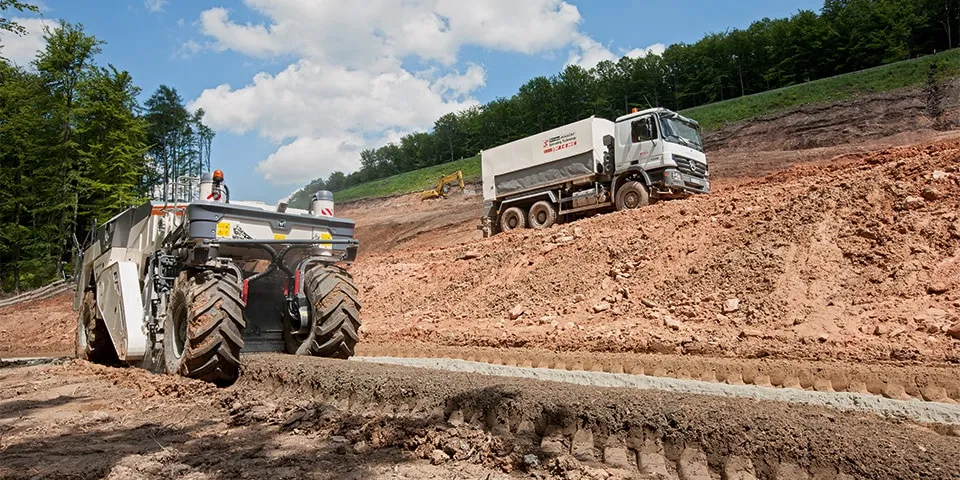
Soil treatment is an environmentally friendly and cost-effective method of making use of soil that, in its current state, does not have the properties required for its intended application. By giving it new, suitable properties, the treated soil can be used in a stable embankment, a road sub-base, a durable platform or a high-bearing-capacity structural layer. It can be used to build berms, embankments, sub-base layers and even foundations.
Non-load-bearing, deformable soils with high plasticity and moisture content, such as clay and silt, can be treated in situ to improve their geotechnical properties. Once treated, the soil is easy to compact and becomes load-bearing, meaning it can be opened to construction traffic. This is known as “soil improvement”.
Treatment designed to provide stronger, more durable mechanical properties, known as “soil stabilisation”, can also produce a sub-base or foundation that is resistant to water and frost.
Where the effect of soil improvement is practically immediate after treatment, the effect of stabilisation takes place over the medium to long term, as the soil progressively hardens in the weeks and months following treatment.
Preliminary study
Before starting soil treatment works, a thorough preliminary study is required to establish the nature of the soil, particularly its key parameters: grading, clay content and the presence of chemical components that could interfere with reactions between the soil and the binder. The condition of the soil must also be determined, especially its moisture content.
Above all, this study assesses the technical and economic feasibility of soil treatment. The soil composition can then be examined to determine which binder or binders are suitable, at what soil moisture content and at what dosage.
Binders
The binders recommended for soil treatment are lime, cement and hydraulic road binders (HRBs). Depending on the application and the properties of the soil, these binders are used separately or in combination (lime + cement, lime + HRB).
HRBs are specially designed for soil treatment applications and are made from various constituents. There are two categories: normal-hardening and rapid-hardening HRBs.
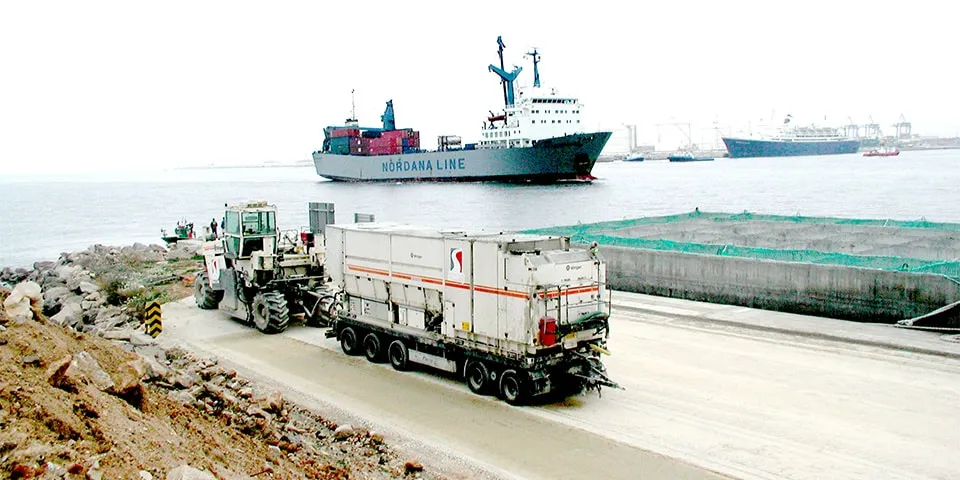
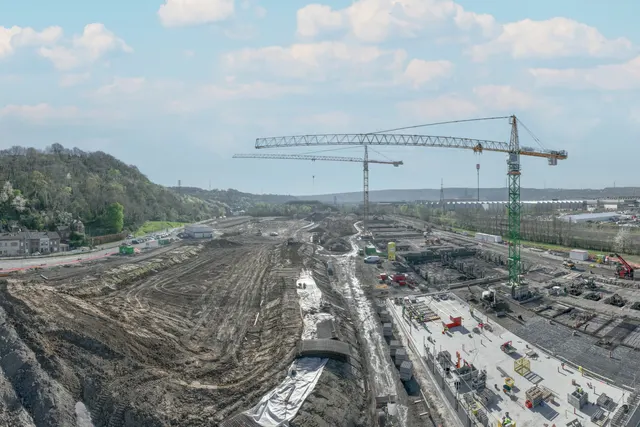
Soil treatment across a wide range of applications, including port and airport areas. (Photos: Firmes Ecológicos SOLTEC)
It is important that all three types of binder (lime, cement and HRBs) are standardised construction products and carry the CE marking, in accordance with the European Construction Products Regulation.
The relevant standards are:
• Lime: EN 459-1
• Cement: EN 197-1
• Hydraulic road binders: EN 13282-1 and -2
Checks carried out during and after production ensure consistent quality, delivering uniform results on site.
Applications
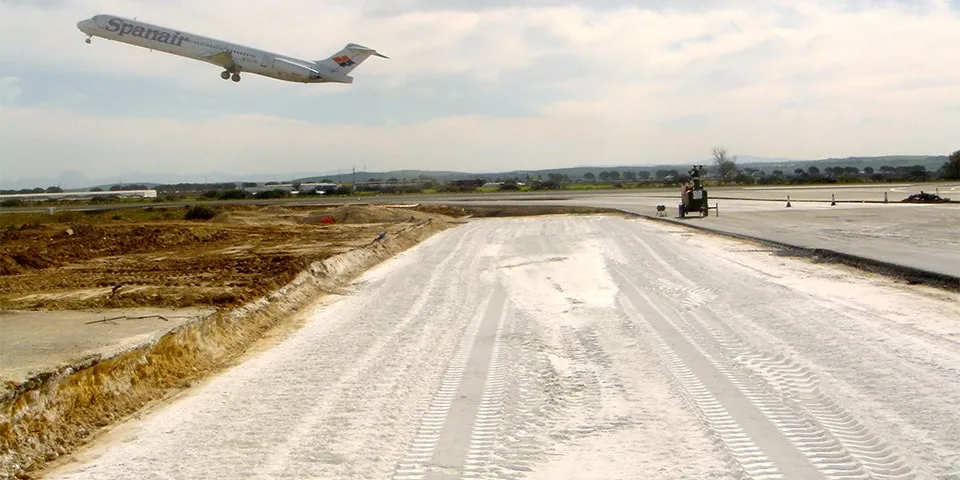
Soil improvement and stabilisation can be used in a range of fields, not only for all types of roads, but also for industrial platforms, port and airport pavements, and railway construction.
References
The definitive reference work is the “Code of Good Practice for the Treatment of Soils with Lime and/or Hydraulic Binders (A81/10)”, produced and published by the Belgian Road Research Centre (CRR), http://www.brrc.be/fr/article/r8110.
This theoretical reference work is an essential complement to the following four practical guides, which cover the different applications of soil treatment:
• Soil improvement for backfilling sewer trenches and pipe bedding;
• Soil stabilisation for sub-base layers;
• Soil improvement for earthworks and road sub-bases;
• Industrial platforms: foundations using soil treatment.
Question about this story? Ask your question
Keep following this
Get an email when a new story is published. No account needed.
- SubjectConstruction