











Formwork systems for the Irbich Viaduct: a real feat of engineering!
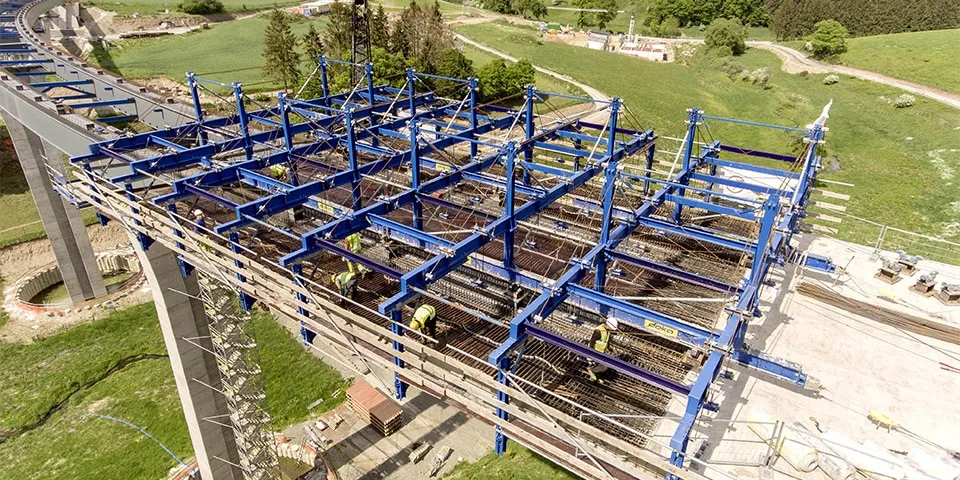
The Irbich Viaduct, in the Grand Duchy of Luxembourg, is part of the ‘Clervaux link’, a new road connecting the N7 and the CR340/N18. The bridge comprises two abutments and six piers, topped by steel beams and finished with a concrete deck. The formwork for the piers and deck is the result of ingenious bespoke work by Doka, the formwork specialist.
The Irbich Viaduct was built by Jan De Nul. The contractor called on Doka to provide the formwork systems. Doka Belgique, with offices in Ternat and Tielt, offers its clients the latest and most innovative formwork technology, enabling them to deliver projects faster, better and more efficiently. “Where necessary, we develop formwork tailored specifically to the project, working closely with the client to meet the requirements of both the client and the designer as closely as possible,” explains Koen Lamers, Executive Director of Doka. “For standard formwork applications, the technical designs are carried out directly by the Belgian team. For engineering feats such as the deck of the Irbich Viaduct, we call on the international specialists at our Competence Center Bridges.”
Climbing formwork for the piers
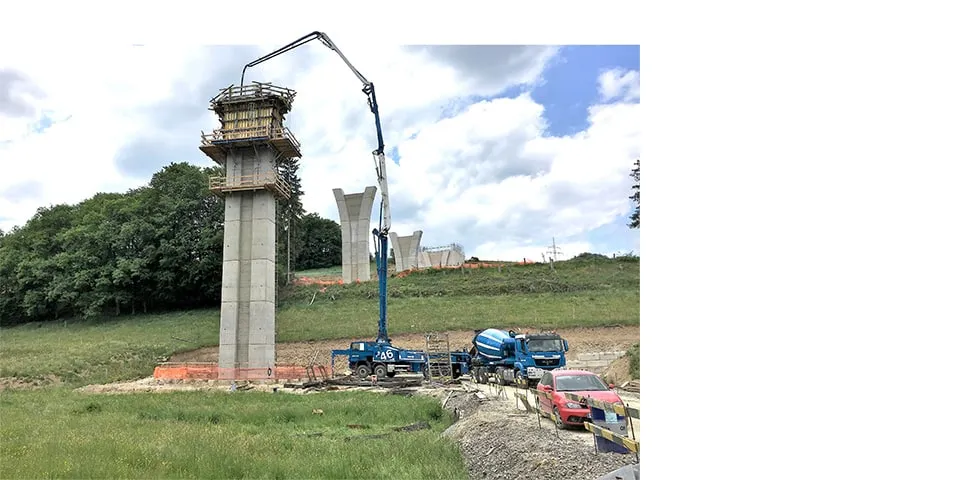
The piers were cast using the Top 50 mixed formwork system and the MF240 climbing formwork system.
Doka supports its client during the technical design stage and provides the initial impetus on site. For the Irbich Viaduct, Doka Belgique’s engineering department developed two bespoke formwork systems. Using plans supplied by Doka, Jan De Nul pre-assembled the formwork in its workshop using Doka materials purchased by the company, with additional equipment supplied by Doka if required.
“The piers are cast using our climbing formwork,” explains Brecht Diependaele, Technical Director at Doka. “Specifically, this involves our Top 50 mixed formwork system, a combination of beams, steel sections and formwork sheets assembled to match the shape being built, while allowing for possible reuse throughout the entire structure, from the first stage to the last. All the viaduct piers are different heights. We therefore had to start with formwork of different heights. The subsequent stages were repetitive, with concrete poured in 4-metre-high sections. A standard climbing formwork system was then used to build the pier head, which is shaped like an open V. The 6.96 m-high head was installed in two stages. As all the pier heads were identical, we were able to reuse the formwork for each pier.”
A bespoke cantilever form traveller for the bridge deck
While climbing formwork consists mainly of standard components, the cantilever form traveller for the bridge deck required more extensive calculations. “The formwork was lighter than usual,” explains Koen Lamers.
“The design developed by the engineering department was based on a maximum load of just 167.5 kg/m2 on the steel beams during construction, whereas the standard system available to us was designed for a load of 300 kg/m2. We therefore had to adapt our standard system to meet the specified criteria as closely as possible.”
Conversion into a finishing platform
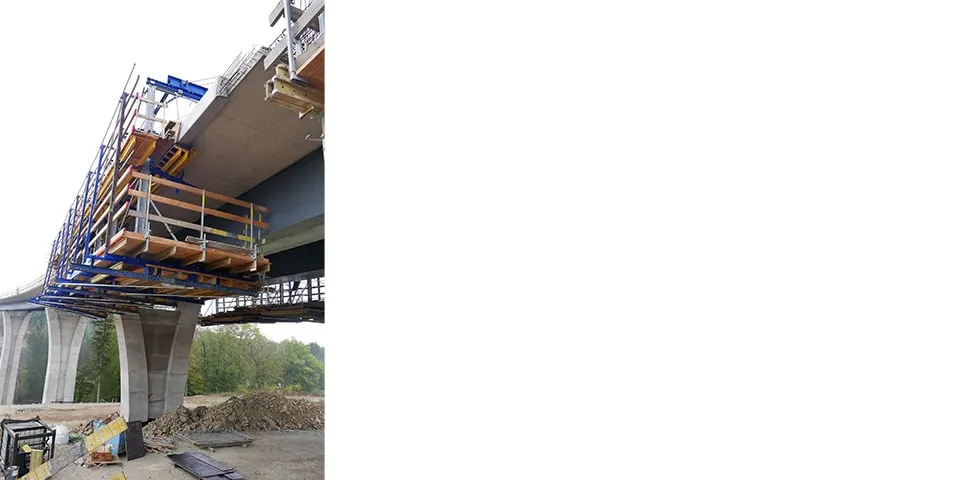
The cantilever form traveller can be converted into a finishing platform.
The crossbeam and cylinders of the cantilever form traveller are standard components, but everything else was specially designed by Doka’s engineering department in Austria. “The cantilever form traveller is 4×6 m long and casts sections measuring 20 linear metres,” explains Brecht Diependaele. “The bridge has a slight curve, which means the traveller is a little shorter on the inside than on the outside. At the client’s request, we also used the cantilever form traveller as a finishing platform after the concrete had been poured. This made inspections easier and enabled certain specific tasks to be carried out, such as installing the edge beam and the bridge deck drainage. We made sure that our cantilever form traveller could easily be converted into a maintenance platform.”
The cantilever form traveller was installed on the Irbich site under the supervision of a Doka specialist. “We didn’t need to return afterwards. This means the instructions had been clear enough for the team responsible for carrying out the work. Our support was not needed for the conversion into a maintenance platform either. This proves that our system is easy to adapt, operates optimally and improves productivity,” concludes Koen Lamers.
Question about this story? Ask your question
Keep following this
Get an email when a new story is published. No account needed.
- ThemeTransforming infrastructure and territories
- SubjectConstruction







