Circular construction: utopia or necessity?

Cradle to Cradle, sustainability, life cycle, reversibility, reuse, materials bank, circular economy, … These concepts are now taking precedence over recycling and energy performance alone. So is this a new fad or a long-term trend, perhaps even a necessity in the not-too-distant future? Can a construction material be described as “circular” in its own right? We set out to find out more by hearing from several experts.
At the recent Batibouw trade fair, Steven Beckers received a Pioneer Award in recognition of his pioneering work in sustainable construction. A Cradle to Cradle certified architect, Steven Beckers was the one who brought the concept to Belgium 10 years ago. As a professor, he was the first to introduce the concept of the circular economy and its principles to new generations of Belgian architects. Today, he continues to inspire with his visionary projects, such as Europe’s largest aquaponics farm on the rooftops of the Anderlecht slaughterhouse. Recently interviewed by Catherine De Wolf, a postdoctoral researcher at the Ecole polytechnique de Lausanne, about the environmental impact of applying the circular economy to construction, Steven Beckers attempted to define the concept: “I hesitate to give a definition, because people often understand it to mean recycling. But recycling uses energy and often reduces the quality of raw materials. You can recycle all sorts of things, even nuclear waste. So we must avoid thinking that recycling is enough. ‘Circular’ architecture, on the other hand, must have a positive, regenerative impact. With each cycle, we should create more value: return to purer materials, restore the environment, save water and energy, feed people and create jobs. The sector made a mistake by calling it a ‘circular’ economy. I would call it a positive spiral economy instead.”
Reversible connections

At the recent Batibouw trade fair, Steven Beckers received a Pioneer Award in recognition of his pioneering work in sustainable construction. (Photo: Jean-Pierre Ruelle)
A year ago, Anne Paduart, a postdoctoral researcher with the TRANSFORM research and consultancy group at the Architectural Engineering Lab of the VUB, challenged participants at Pixii Expert Day to reconsider how the meaning of the word “sustainability” had evolved in the right direction over the past 10 years. Whereas energy consumption was once the only consideration, many other aspects are now included, such as the careful selection of materials to avoid, in particular, generating waste at the end of a building’s life. She cited a current, much talked-about example that gets it wrong: gluing brick slips directly onto insulation. This solution may be good for a building’s energy performance, but is much less suitable in the long term because the materials are difficult to recover. The same applies to services integrated into concrete floors and walls, which may be more aesthetically pleasing but are difficult to access for future modifications. The advice, then, is always to favour reversible connections.
Deconstruct rather than demolish
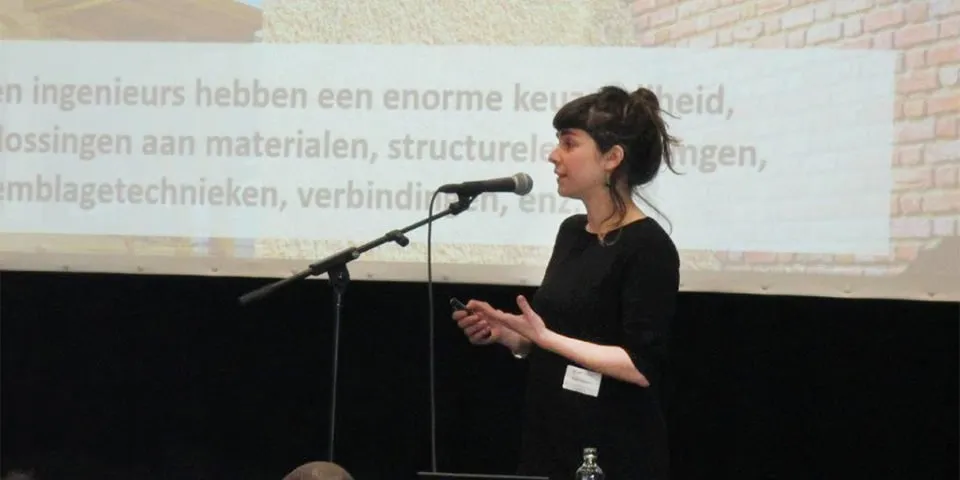
A year ago, Anne Paduart challenged participants at Pixii Expert Day to reconsider how the meaning of the word “sustainability” had evolved in the right direction over the past 10 years.
As Catherine De Wolf points out, statistics show that the construction sector produces a third of all waste generated in Europe and more than a third of global greenhouse gas emissions: “We urgently need to move from our linear economy (production, use, waste) to a circular economy (waste turned into resources), where reuse helps minimise the sector’s negative impacts. (…) Since the 1970s, demolition has become commonplace, while reuse has declined drastically. Current labels and regulations do not take account of the embodied energy of materials or the application of circular economy principles. Today, demolition has to be carried out as quickly as possible, and construction schedules no longer allow time for deconstruction, which would make it possible to reuse materials.” Political measures are needed to offset the cost difference between deconstruction and demolition.
Question about this story? Ask your question
Keep following this
Get an email when a new story is published. No account needed.
- ThemeBuilding with less carbon
- SubjectConstruction