











A major leap forward in digital construction
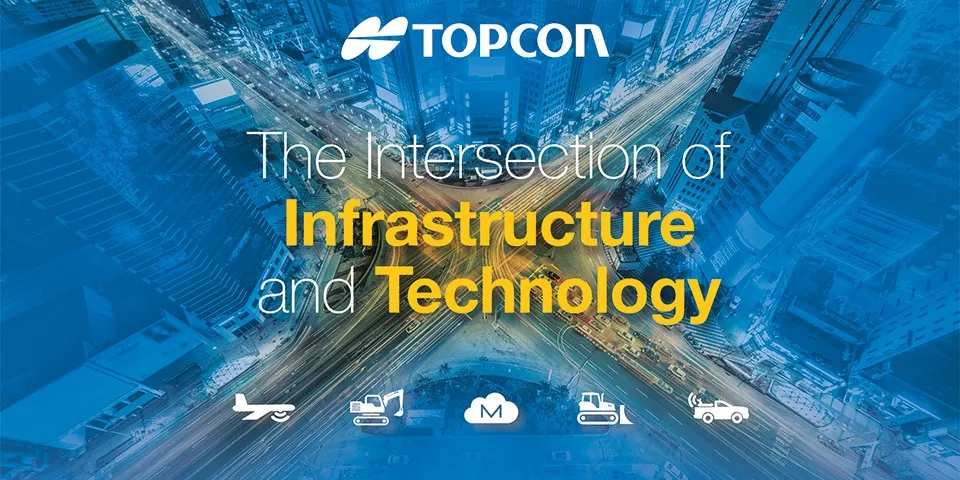
Eduardo Falcon, Executive Vice President and General Manager at Topcon Positioning Group, discusses the relationship between technology and the built environment, looking at how it has evolved over the past 25 years and what the use of technology in construction might look like in the future.
“Our business has always focused on developing technology designed to manage construction sites. We are constantly looking for solutions to improve the accuracy of data collection, as well as how data is managed and analysed.”
“At the start of my career, we were counting on technological advances to enable our customers to achieve full automation on their construction sites. Looking back at our research into digitisation and data integration nearly 25 years ago, we expected technology to have progressed much further by now.”
“The slow uptake is simply down to the conservative approach taken by construction companies. Construction is one of the least automated sectors. This is simply due to low technology adoption and the existence of disconnected (analogue) workflows.”
“However, in recent years, developments have accelerated at a very rapid pace, reaching a tipping point. The number of contractors investing more than 1% of their revenue in smart technology has increased by 50%. This represents a real investment in IT, the backbone required for a fully connected workflow. Our technology supports automation and large-scale data collection in both vertical and horizontal construction. It is increasingly becoming the industry benchmark, saving time and improving profitability on site. At Topcon, we call this ‘The Intersection of Infrastructure and Technology’: the point at which construction productivity can be improved through the implementation of advanced positioning technology.”
“In vertical construction, the way traditional surveying equipment is used is changing.
Total stations are used inside buildings to set out even the smallest details. For example, the position of a fixing for an air-conditioning unit can be defined using high-precision technology. Information about the installation is then entered into a BIM model and can be used by other facilities management teams. This change has opened the way, both now and for many years to come, for a wider range of professionals to use surveying equipment and benefit from the efficiency gains and reduced waste offered by high-precision measurements and BIM models. The equipment quickly pays for itself through the savings it generates.”
“In horizontal construction, one of the biggest advances has been 3D machine control. In recent years, our Topcon GPS equipment has been integrated into construction machinery, just as cars are fitted with satellite navigation systems at the factory. Valves, pistons and hydraulic components, as well as blades and buckets, are all controlled by the same technology. Adoption is happening very quickly, as manufacturers have all rushed to keep pace by integrating the technology into their new machines in order to remain competitive. Existing machines can also be upgraded with machine control technology, doubling their productivity. We are seeing a wave of automation on construction sites.”
“As for what construction projects of the future will look like, that is the big question! I believe the future lies in continuous reality capture. With large-scale data collection, we are no longer measuring point by point, but capturing millions of points per second. And with high-speed data collection, a full site analysis can be carried out instantly, enabling continuous comparison of design data with real-time data. This provides a high-precision picture and record of progress on site, enabling fact-based decisions, such as predicting potential clashes. This technology is already revolutionising the way we work: forward-thinking project managers use virtual reality to share digital project designs in real time with those working on site. Back in the design office, virtual reality domes provide an immersive view of a project. Teams enter the dome together to see a visual representation of the project data. This means project decisions are made collaboratively using real-time data. I believe tomorrow’s construction site and design office will be closely connected, with everyone involved able to provide and share accurate data in real time.”
Question about this story? Ask your question
Companies in this story

Keep following this
Get an email when a new story is published. No account needed.
- SubjectConstruction
- CompanyTopcon







