Pont des Trous: Tournai’s residents were not left high and dry
Texte Philippe Selke | Photos EBEMA
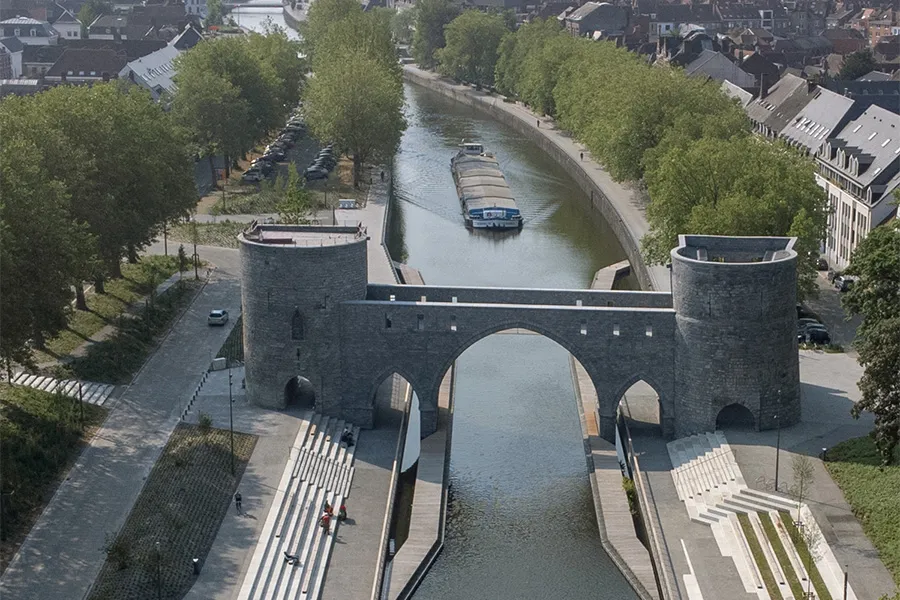
After 6 years of construction and almost as many preliminary debates, some of them heated, the saga of rebuilding Pont des Trous on the Scheldt in Tournai came to an end on 14 April with a festive inauguration of the new structure and its renovated quays. To improve the area around the iconic monument, rebuilt almost identically to the original, general contractor Galère, responsible for the works alongside Wanty, called on a specialist in the field: EBEMA. Tournai’s residents and visitors alike have come out winners, as they can now enjoy steps and seating terraces where they can rest and take in the view.
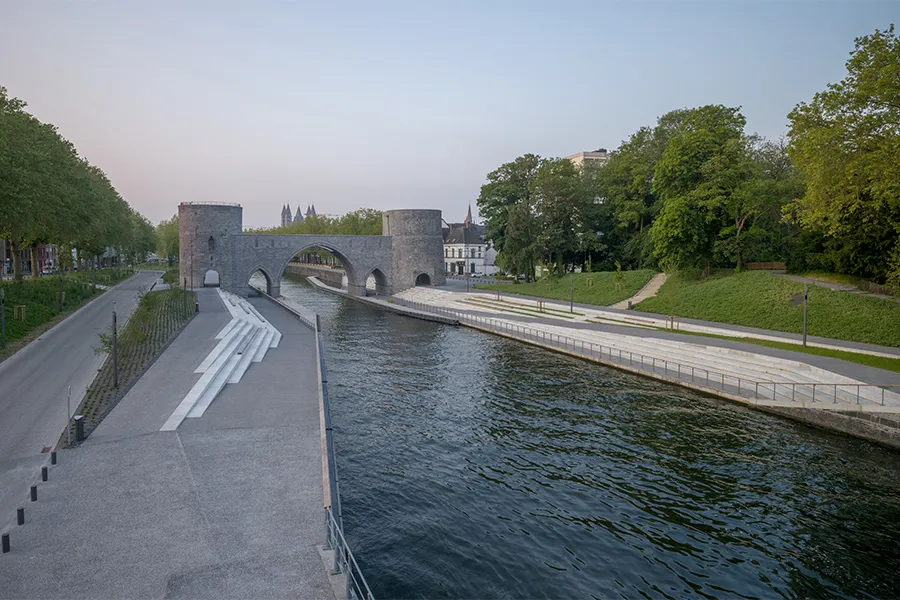
The aim was to widen (from 19 to 27 m) and modernise the Scheldt over a stretch of around 250 m in central Tournai, allowing Class Va vessels (2,000 tonnes) to pass through the city of five bell towers and connect with the Seine-Escaut Canal. This also required the demolition of Pont des Trous, a 13th -century water gate cherished by the local population, alongside the cathedral and belfry. Rebuilt after being bombed by the English in 1940, it had already been modified at the time to facilitate navigation.
New precast concrete features
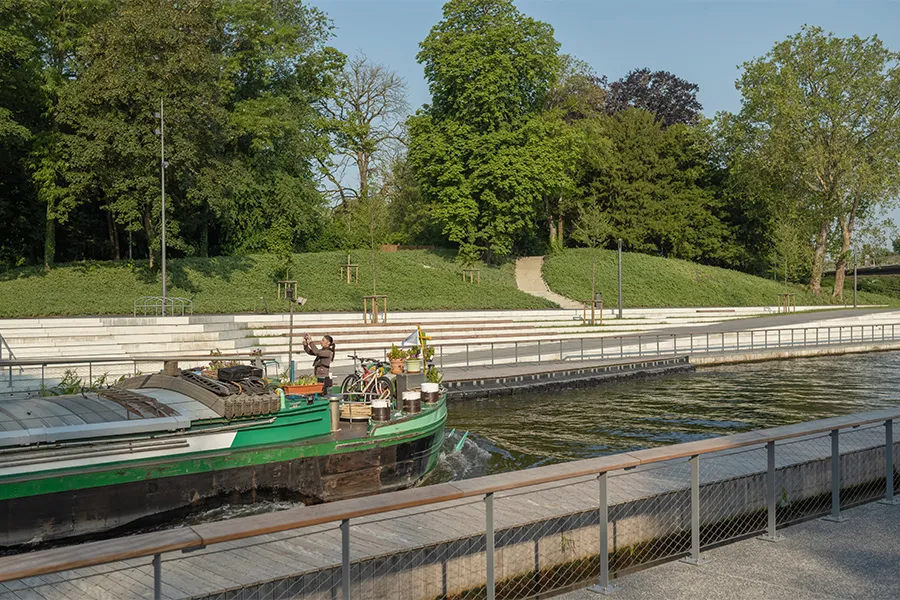
Having fought to have “their” bridge rebuilt in stone, as faithfully as possible to “the original”, Tournai’s residents will now be able to reclaim the river thanks to the improvements made along its banks. Works over more than 2.7 km of the 4 km of quays within Tournai’s city walls have transformed the area to make it more accessible to pedestrians and cyclists: seating terraces, lowered quays and walkways beneath the side arches of Pont des Trous will bring to life the ideas put forward during the participatory workshops.
The most effective solution was to use precast concrete components. Huu‑Hung Nguyen led the project for Galère: “The idea was to create a place for strolling along the water. Working with precast concrete components guarantees speed of execution and quality. We chose to work with Ebema because of the quality of its products and the company’s professionalism.”
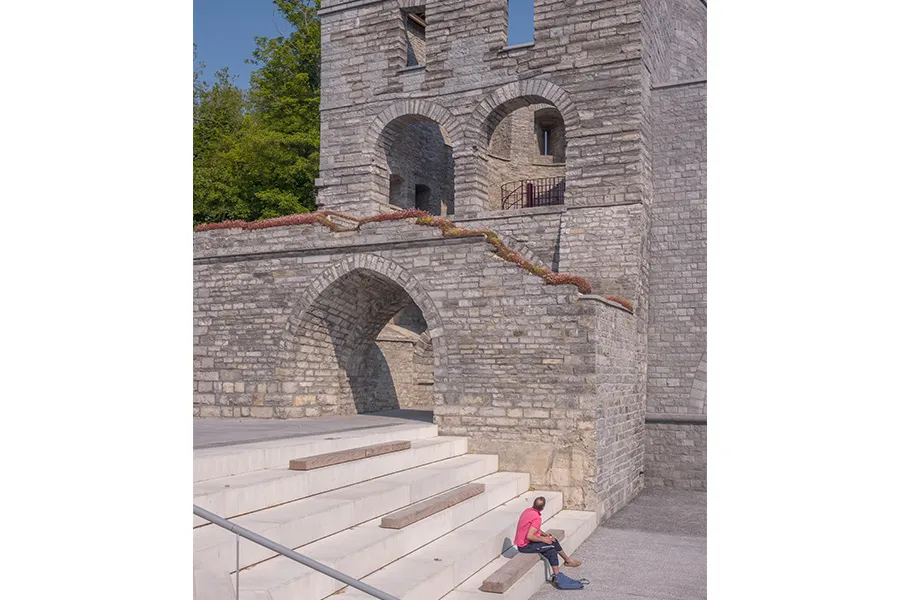
EBEMA supplied no fewer than 87 kerb units, 808 steps, 27 raker beams, 4 hydraulic walls, 61 retaining walls, … On one bank, the seating terraces were founded directly on the embankment. On the opposite bank, a more unusual solution was needed to achieve a similar effect: raker beams were fixed to the quay at one end and to the platform built over the Scheldt by the contractor using precast floor units at the other, supporting the steps that form the seating terraces. Once the work was complete, the raker beams were no longer visible. The result: seating terraces that descend to river level!
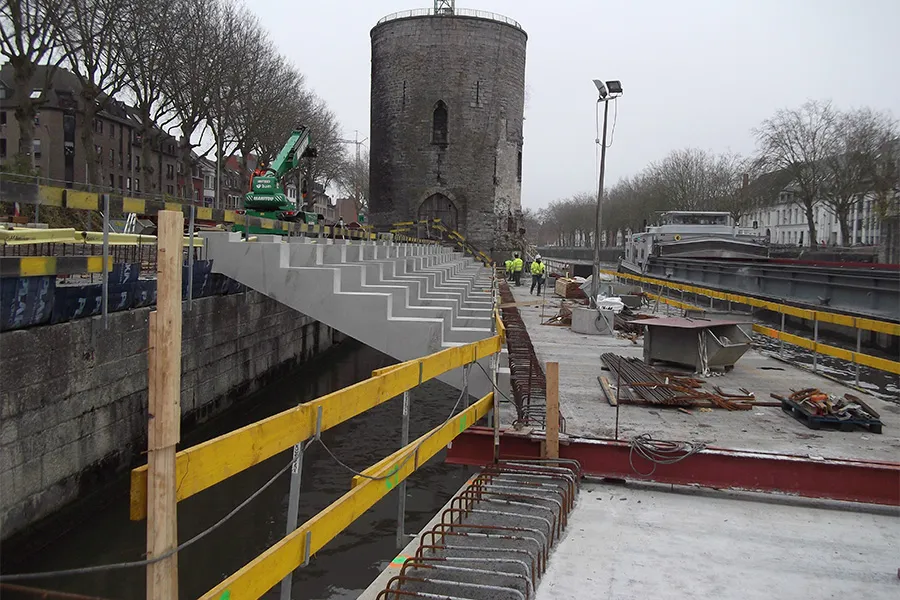
A new urban dynamic
The smooth, light-coloured concrete of the seating terraces contrasts with the dressed stone used for the bridge and its two towers. As the project manager at SPW explained in response to a few people who would have preferred to see blue stone, these precast concrete components “represent a compromise between quality, aesthetics and price, meeting the functions and requirements expressed during the participatory workshops within the available budget. The architectural principle was to distinguish the materials used in the area outside the city walls from those used within them. Concrete is therefore used mainly downstream of Pont des Trous, for these seating terraces (with very high quality requirements for the precasting of these components), and will also be used, in a washed finish with blue stone aggregates, for the road surfacing in this area. Upstream, blue stone is the predominant material.”
Even the mayor acknowledges that these improvements have revitalised an entire part of the city. It can therefore be said that EBEMA has helped improve the area for everyone’s benefit.
Question about this story? Ask your question
Keep following this
Get an email when a new story is published. No account needed.
- ThemeTransforming infrastructure and territories
- SubjectConcrete