











Making progress in sustainable concrete repair
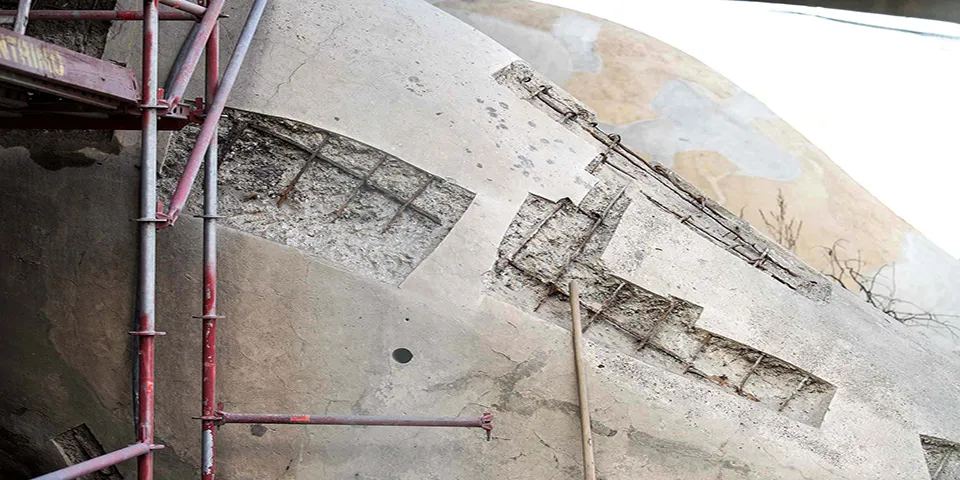
According to a study, 50% of concrete repairs show signs of damage 5 to 10 years after the work is completed. There are various reasons: inadequate diagnosis of the initial damage, an unsuitable repair solution, poor application, incorrect material selection… Premature failure of a repaired structure creates uncertainty about the service life of structures and leads to recurring, rising repair costs. That is why progress in sustainable concrete repair is so important.
Too often, priority is given to repairing visible damage. However, even when high-quality mortar is used, ‘quick fixes’ are not enough to extend the service life as much as possible.
It is vital to take a considered, multi-step approach to sustainable concrete repair.
How can concrete repairs be made to last?
A well-designed repair solution will address not only visible damage, but also provide additional protection for the concrete and reinforcement. This protection must be designed to suit the environmental conditions. It depends on the structure’s loading as well as the owner’s requirements.
Master Builders Solutions has developed a Life Cycle Cost model which uses project information and product characteristics to compare the costs of different solutions. According to the model, every euro invested in protection saves €3 to €5 in recurring repair costs.
Appropriate protection also reduces the number of repair cycles over the structure’s service life by an average of three.
The EN 1504 standard, which has been in force for more than ten years, covers all aspects of concrete repair and material selection. It sets out guidelines for the sustainable design of repairs. These guidelines must be applied more widely and more effectively.
A longer service life
Exposed reinforcement must be treated with a corrosion protection product. The concrete can then be repaired with mortar, followed by the application of a suitable protection system.
Reinforcement protection
This is generally provided using active, cement-based primers containing special anti-corrosion additives. These act as inhibitors or provide local cathodic protection. They are applied by hand to exposed reinforcement. Their key properties include adhesion to steel and concrete and/or resistance to corrosion forming on the treated surface.
Repair mortars
European Standard EN 1504-3 defines four classes of repair mortar, to be applied in different ways depending on consistency and application: by hand (small and medium-sized repair areas), by pouring or pumping (large repair volumes) or by spraying (large areas).
Protection system
Protection must be suited to the environmental conditions described in EN 206-1, while the products to be used are specified in EN 1504-2. Protection can take various forms.
In environments where there is a risk of CO2 corrosion, anti-carbonation coatings must be applied. These are often water-based acrylic emulsions. Their main properties are high resistance to CO2 penetration, water impermeability, water vapour permeability and high crack-bridging ability.
A hydrophobic treatment should be applied in environments where concrete is exposed to freeze-thaw cycles. Polymers sprayed onto the concrete impregnate its pores, making it hydrophobic. Key properties include penetration depth, freeze-thaw resistance, reduced algae growth and little or no change to the appearance of the concrete.
Corrosion inhibitors are molecules that prevent or slow corrosion of reinforcement. They are particularly useful on scaffolding, bridges and industrial structures exposed to seawater and chlorides… To work effectively, these molecules must reach the reinforcement. They are therefore dissolved in a carrier that penetrates the concrete by impregnation. Their main properties are the same as those of hydrophobic treatments.
Protection against chemical attack is often needed in industry, on tanks, bunds, reservoirs, wastewater treatment plants, sewers… The choice of protection depends on the type of chemical, the required crack-bridging ability and the environmental conditions (temperature, humidity, open or enclosed environment, temporary or permanent contact with chemicals). Adhesion, water impermeability, wear resistance and thermal compatibility are important properties. Depending on their technology and reaction speed, these coatings can be applied by hand or sprayed, cold or hot.
Concrete degradation (here at the former Waterschei coal mines) can pose a risk to a building’s stability.
Certification, safety and support
Finally, three factors must be considered: certification, safety and support.
CE marking in accordance with EN 1504 should be the starting point when selecting materials. As not all markings are equivalent, it is important to check the minimum requirements products must meet in each situation, as well as any additional requirements. It is useful to consult the products’ declarations of performance (DoPs). Products may also need to meet quality requirements and additional specifications (BENOR, BELGAQUA labels…). Other factors should also be considered, including ease of use and application, reduced risk of errors, minimised downtime, material yield and service life. These affect sustainability and investment costs. Safety for people and the environment, including the release of harmful substances and waste disposal, is also crucial, particularly in homes and public buildings. Finally, it is essential to know what level of support, including technical assistance and guarantees, the supplier can provide.
To make progress in sustainable concrete repair, a sufficiently robust protection strategy is therefore needed, using a complete repair system that complies with EN 1504. When selecting materials, their technical properties, level of certification and other factors, such as speed, ease of use, safety and support, must all be taken into account.
Een zakelijke vraag aan Master Builders Solutions Belgium nv? Get in touch
Companies in this story
Keep following this
Get an email when a new story is published. No account needed.
- SubjectConcrete
- CompanyMaster Builders Solutions Belgium nv







