











Cement & Concrete Roadmap 2050

Under the Green Deal, Europe has committed to becoming the first climate-neutral continent by 2050. It also entails moving towards a more circular economy, in which growth is decoupled from resource use. These goals are intended to make the European Union a modern, sustainable and inclusive economy.
As has already been emphasised, the construction sector offers a particularly effective means of action. Buildings have a significant environmental impact, both during the production of materials and technical equipment and during their use. At European level, buildings are estimated to account for 40% of energy consumption and 36% of the climate footprint.
Against this backdrop, FEBELCEM, the Belgian Cement Industry Federation, has drawn up its “Cement and Concrete Roadmap 2050”. Concrete is the guiding thread, as an essential material for the infrastructure and buildings of a sustainable society. The Roadmap sets out how cement, through the production and use of concrete, can contribute to circular, carbon-neutral construction. The “roadmap” metaphor represents the journey towards the 2050 goals. It is structured around five areas of action, abbreviated as the “5Cs”: clinker, the active ingredient in cement; cement; concrete; construction; and (re)carbonation.
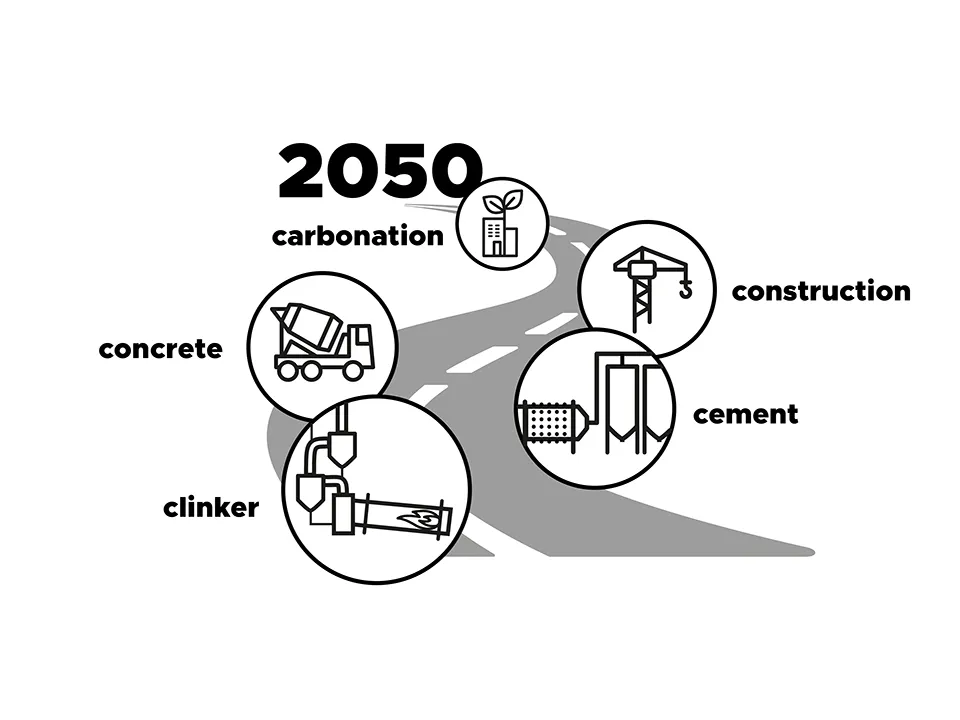
This Roadmap represents a far-reaching transformation of the construction value chain and requires the commitment of all its players: clients, architects, materials producers, contractors, public authorities and others. Every phase of a project must likewise be assessed in terms of its environmental footprint and circularity, from design through construction and use to recycling or reuse.
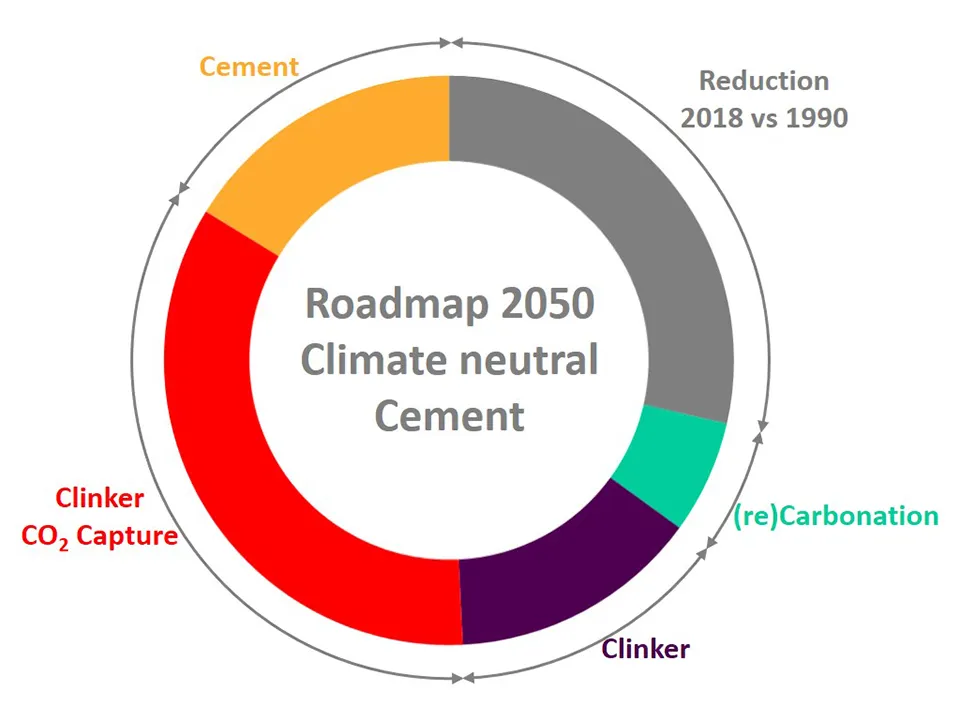
The cement industry intends to play a pioneering role in this transformation. The Roadmap therefore sets out milestones for reducing the carbon intensity of cement (kg of CO2 per tonne of cement) against the 1990 baseline, with a view to achieving climate neutrality by 2050. It is worth noting at this stage that part of the journey has already been completed, with the carbon footprint of cement reduced by nearly 30%. Although many uncertainties remain, the Roadmap describes how the “remaining 70%” reduction is envisaged, as well as the sector’s contribution to the EU’s interim 2030 target of cutting greenhouse gas emissions by 55%.
As a central player in industrial symbiosis, the cement sector will need to step up collaboration with other industries, particularly on carbon-neutral electricity, hydrogen, and the transport and use of CO2.
Finally, it should be borne in mind that this far-reaching transformation will require massive investment. The funding provided by the European Union through various mechanisms is not sufficient. For the sector to invest in new processes and facilities, the role of the authorities is crucial in providing legislative certainty and mechanisms to prevent carbon leakage.
The “Cement and Concrete Roadmap 2050” concerns the entire construction value chain and covers a wide range of topics. Each topic requires more than a brief explanation. FEBELCEM is therefore committed to exploring them in greater depth over the coming weeks and months, and to reporting on progress towards circular, carbon-neutral construction.
Question about this story? Ask your question
Keep following this
Get an email when a new story is published. No account needed.
- ThemeBuilding with less carbon
- SubjectConcrete







