At Ciney, concrete bends to every requirement
Texte Philippe Selke Photos Ets Ronveaux
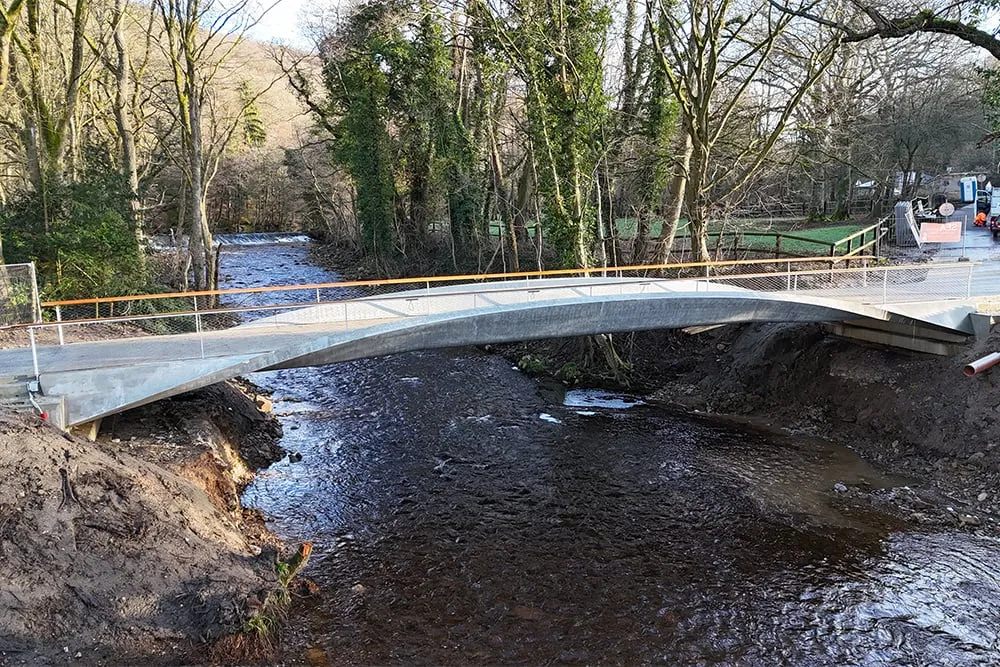
In the east of the country, many civil engineering structures were damaged to varying degrees by the floods that hit in July 2021. Some bridges even sustained damage that could jeopardise their stability. In such cases, the structure may need to be rebuilt, as is happening, for example, in the municipality of Eupen, on the Vesdre and the Helle. Four new concrete structures there are notable for their helical beams, manufactured by Ets. Ronveaux.
This geometry, chosen by the Servais engineering and architecture firm, allows these cycle and pedestrian bridges to blend more harmoniously into the landscape. Julien Grosjean, business engineer at the Ciney-based company, explains: “Beyond the aesthetic aspect, this particular shape also reflects the aim of increasing the clearance beneath the beams and avoiding a central pier. This improves the river’s flow conditions and limits damage in the event of future flooding.”
The 8 beams for this order of 4 bridges are up to 25.50 metres long and 2.10 metres high once turned upright. The largest beams weigh 21 tonnes. All 8 beams were precast at Ronveaux in one continuous production run, but installation on site is spread over several weeks. The first structure to open is the one at Langesthal, where the beams were installed at the end of November.
A challenge at every level
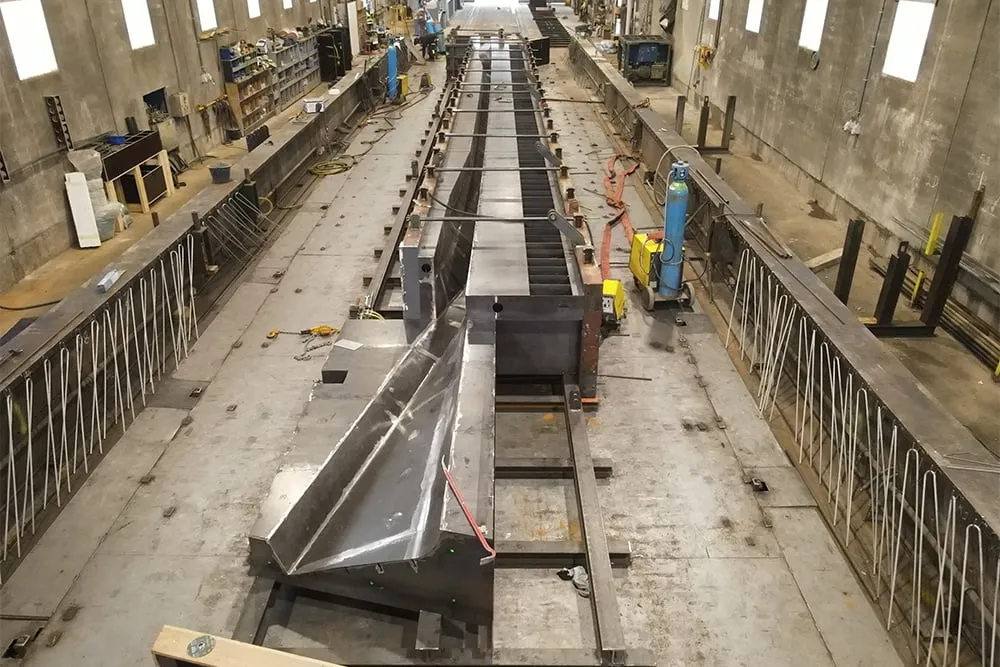
Given their highly unusual shape, these elements posed a challenge for Ronveaux’s teams, from design through to delivery. Julien Grosjean says: “This was a first. To properly assess the project’s feasibility and cost, we had to consider, among other things, how the beams would be reinforced and poured, as well as how to make the formwork, which required no less than 20 tonnes of steel.”
The formwork drawings were produced in 3D to match as closely as possible the requirements of the client and designer. Ronveaux’s metalworking workshop then had to cut, bend and assemble all the sheets to create the unusual curves of the formwork, which was made in two sections. It is 26 metres long, 1.20 metres high and 2.60 metres wide.
The concrete beams themselves also stand out for their use of stainless steel reinforcement, another first for Ronveaux. With this reinforcement, the concrete will suffer less damage from corrosion of the bars, a recurring problem in many civil engineering structures in Belgium. The durability of the beams will help extend the structure’s service life. In addition, this type of reinforcement was well suited to the relatively slender structure sought by the Servais engineering and architecture firm, as it requires a slightly thinner concrete cover than conventional reinforcement.
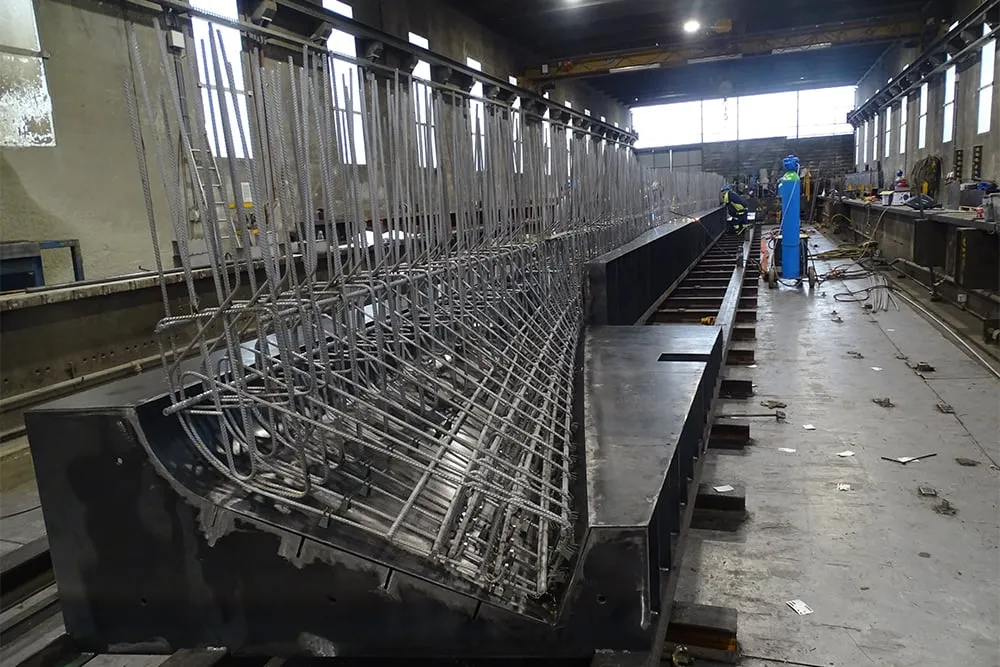
In a cradle…
But there is more. Julien Grosjean continues: “The beam is cast on its only horizontal face, its edge, so it then has to be turned through 90°. This operation required specialised lifting equipment because the beam’s centre of gravity is not aligned with its longitudinal axis, unlike a straight beam. Since the beam acts as an arch in its final configuration, it risks breaking if handled in the usual way. Once stripped from the formwork, it is therefore placed in a metal cradle so it can be turned inside the factory hall before being stored.
Each beam is then transported to the site in its cradle, ready to be installed by Haas&Co, working with Bodarwé. “Once everything has been concreted together, the cradles are removed and reused for the next bridge.”
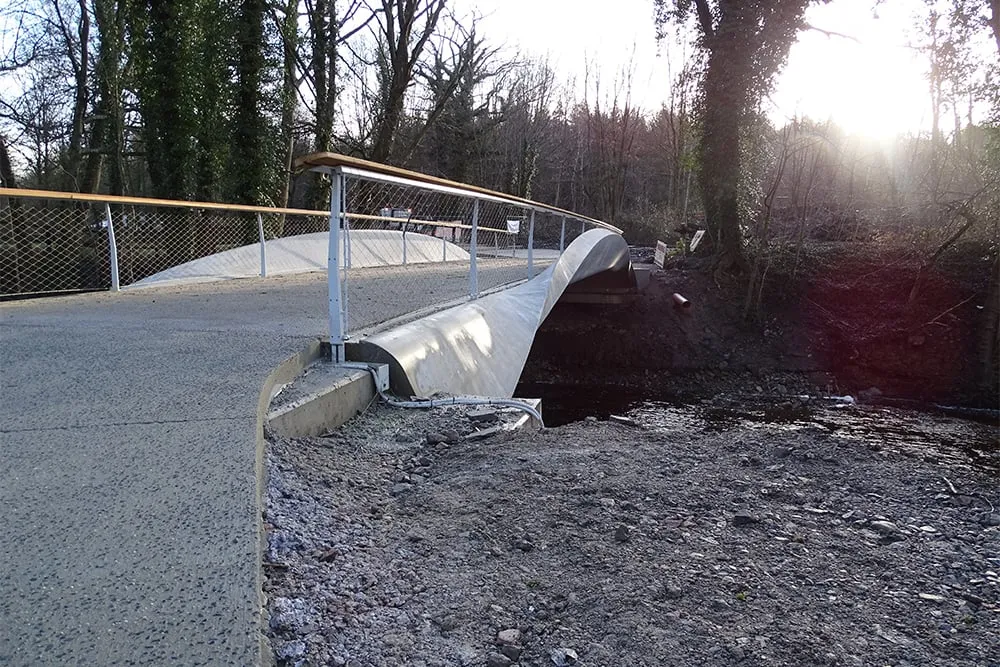
An unusual project
Julien Grosjean concludes: “What I take away from this project is the adaptability shown by every department at Ronveaux in responding to an unusual request. Few companies in Belgium are capable of producing components like these. We found the right solutions for every stage of execution to meet the client’s requirements. Hats off to the whole team!”
Question about this story? Ask your question
Keep following this
Get an email when a new story is published. No account needed.
- ThemeTransforming infrastructure and territories
- SubjectConcrete