Underground infrastructure and sewerage
Deep foundations specialist brings hand-dug, shored excavations back into the spotlight
Texte Philippe Selke Photos Franki Foundations
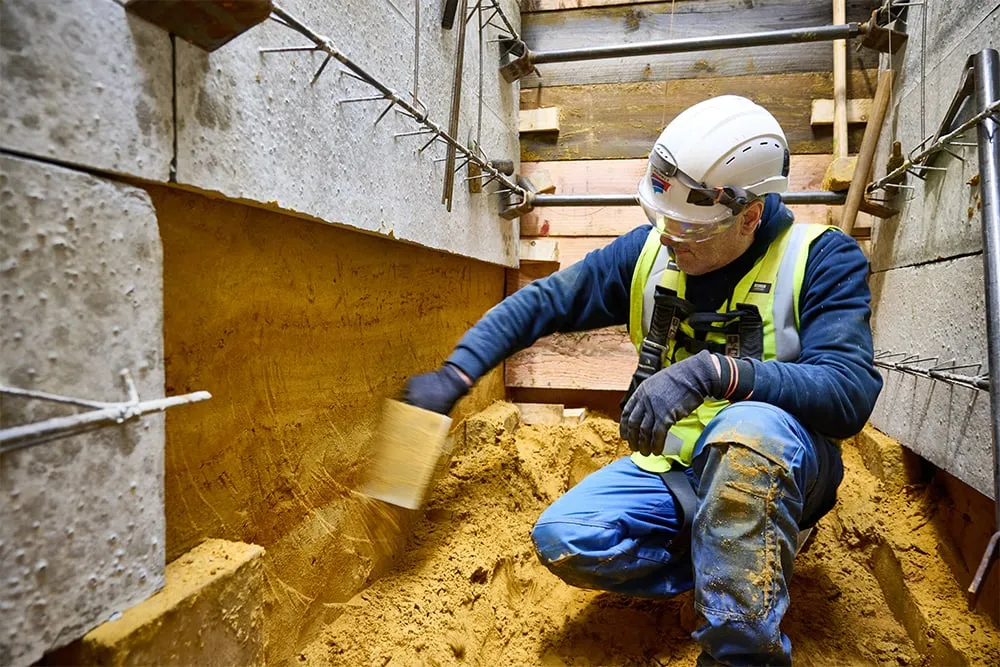
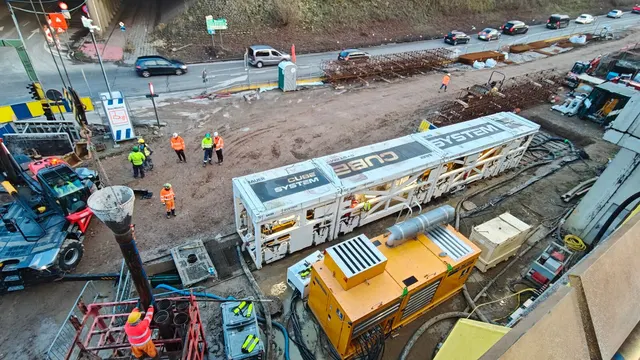
Franki Foundations is bringing the entirely manual technique of shored excavation back into the spotlight. The deep foundations specialist is seeing a growing number of requests for work in confined spaces where construction equipment cannot be used, for example on cramped sites wedged between two obstacles. This is currently the case on the RER project in Watermael-Boitsfort, where emergency exits are being added to an existing covered railway cutting.
Etienne Delheusy, Project Manager at Franki Foundations: “In Watermael-Boitsfort, we are working as a subcontractor for Socogetra, a general contractor in the BESIX Group, near the point where the railway lines pass beneath chaussée de la Hulpe. Initially, some of the emergency exits were to be built using soil mixing or secant piles. However, the load-bearing capacity of the covered cutting meant that machinery could not be used. The client therefore opted for shored excavations.”
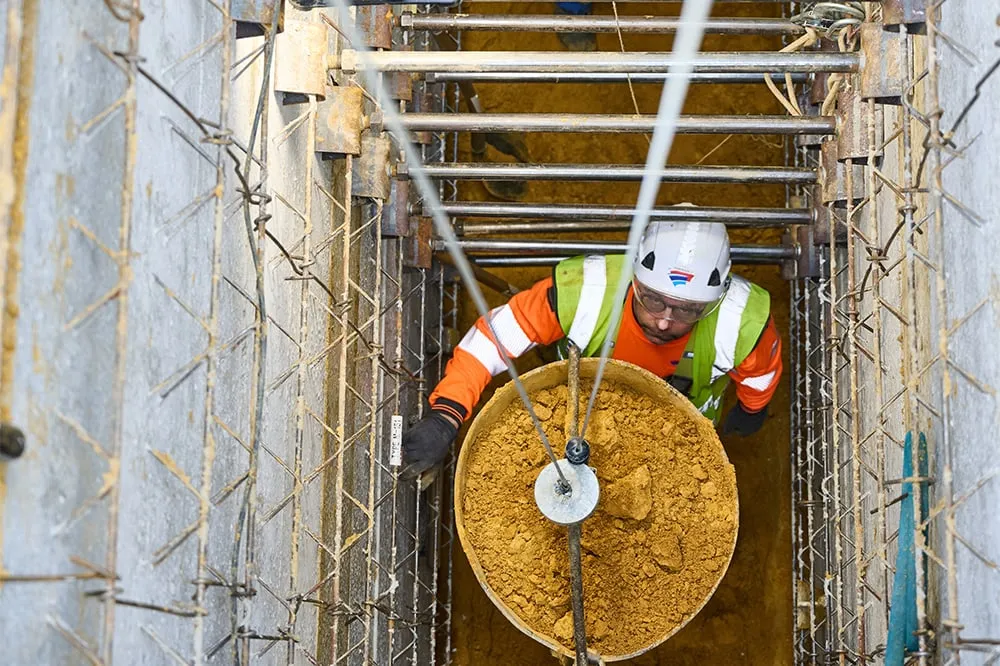
Picture the scene: at the bottom of the excavation, workers dig the ground with shovels, filling a container of around 70 litres. A labourer then hoists the container using a winch and empties it into a wheelbarrow to remove the excavated earth… In the excavation, workers use a trowel to cut a square section out of the ground to receive and position a precast slab lowered into the excavation using the winch. Struts are placed between the precast slabs, and work continues at greater depth.
In Watermael-Boitsfort, the maximum depth reached in this way is 17 metres, with an excavation width of 1.1 metres, corresponding to approximately 1300 m3 of excavated earth. The contractor then only has to excavate the volume between the excavations and the walls of the covered cutting to create an opening.
Etienne Delheusy: “The shored excavation technique is used on many sites where there is no other way to proceed, often in railway environments, both on train and metro projects. We are currently working at Hasselt station, for example. In Brussels, some projects easily involve 1000 m3 of shored excavations. Underpinning and underground gallery works are also among our specialities. We are always ready to help!”
Question about this story? Ask your question
Keep following this
Get an email when a new story is published. No account needed.
- SubjectUnderground infrastructure and sewerage