The Arc Majeur on the E411: a work of art, but above all a technical feat
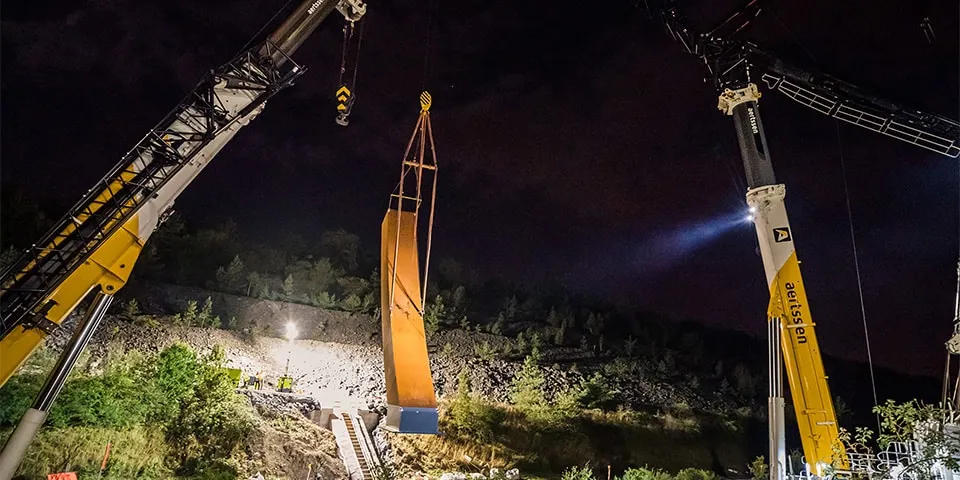
In recent months, the media have repeatedly covered the assembly of the Arc Majeur and its installation on either side of the E411 motorway at Lavaux-Sainte-Anne. A remarkable technical feat, this gigantic metal sculpture designed by Bernar Venet is made from 200 tonnes of Corten steel rolled by NLMK Clabecq. The work of art came to fruition above all thanks to the determination of the Fondation John Cockerill.
Bernar Venet had to be patient. The story began in 1984, when he sketched out his work of art at the request of Jack Lang, then French Minister of Culture. First considered for the Autoroute du Soleil, and later for eastern France, the project was eventually abandoned. The Arc Majeur remained buried in drawers and memories until a few years ago, when the Fondation John Cockerill brought it back to life.
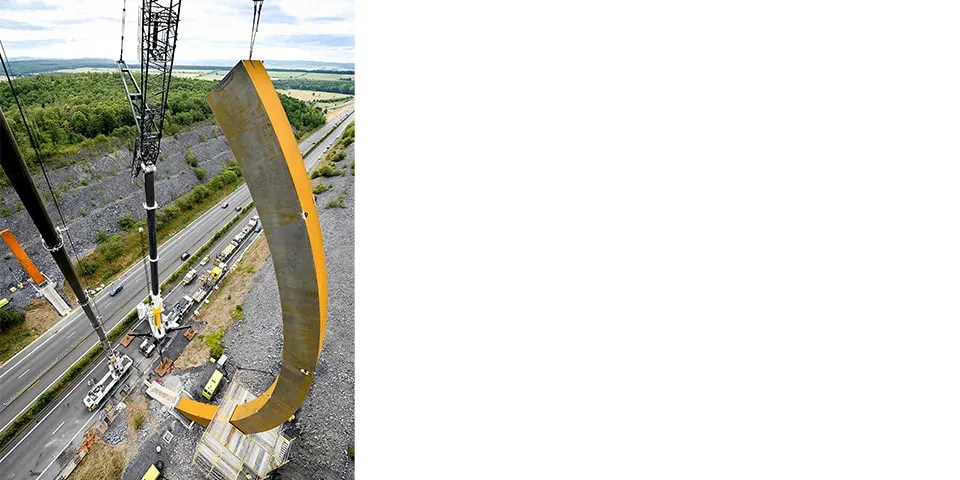
© bureau greisch / JL DERU: photo-daylight
A Corten steel work manufactured in Belgium
A monumental sculpture in the shape of a 205.5° arc, Venet’s work is made from Corten steel. « In 2017, NLMK Clabecq rolled 171 tonnes of Corten-grade steel (Grade S355 J2W+N, in accordance with European standard EN 10025-5) for CMI, now John Cockerill. This is the steel used to build the Arc Majeur », explains Dionisio Cotti, Western Europe Sales Manager at NLMK.
The sculpture was manufactured at the Cockerill Group’s Centre d’Expertise Soudage (CES) in Seraing, in collaboration with engineering consultancy bureau Greisch, civil engineering contractor Eloy, Aertssen (lifting), the
WindLab at the University of Liège, monitoring consultancy v2i, Diwydag Systems, which carried out the hazardous task of tensioning the prestressing bars that secure the arc in the foundation, and GERB.
The Arc Majeur is made from 200 tonnes of Corten steel rolled by NLMK Clabecq.
A few years earlier, the CES had already ‘cut its teeth’ by building another steel arc for Bernar Venet, this one 38 m high, installed in Seoul.
« To build the Arc Majeur, we had to rethink the Centre, invest in equipment, work with the workshop to establish the technical processes, and find and oversee subcontractors », explains Luka Vanhaeren, Welding Development Manager at John Cockerill.
« It was like an orchestra whose every instrument had to be precisely tuned. »
Properties of the steel used
« We usually sell this weathering steel, known for its resistance to atmospheric corrosion, for applications such as architectural structures, certain steel constructions, monumental art sculptures and some bridges », explains Dionisio Cotti. « Demand for this steel is particularly strong in southern Europe, although it is increasingly being used in northern countries too. »
For the Arc Majeur, steel was supplied in various thicknesses (20, 30 and 40 mm) and widths (between 2300 and 2500 mm), with no particular problems for the steelmaker. « These sizes are fully within the capabilities of NLMK Clabecq S.A.’s process and presented no particular difficulties. One distinctive feature of this production, however, was our insistence on producing the steel without heat treatment. This ensures a surface free from defects and makes the steel easy to work. The choice was also supported by a relatively low carbon content (<0.12%) for this type of steel, which ensures both a carbon equivalent below 0.45% and excellent impact resistance. This gives the steel a very high safety margin, making it easier to work with during construction. »
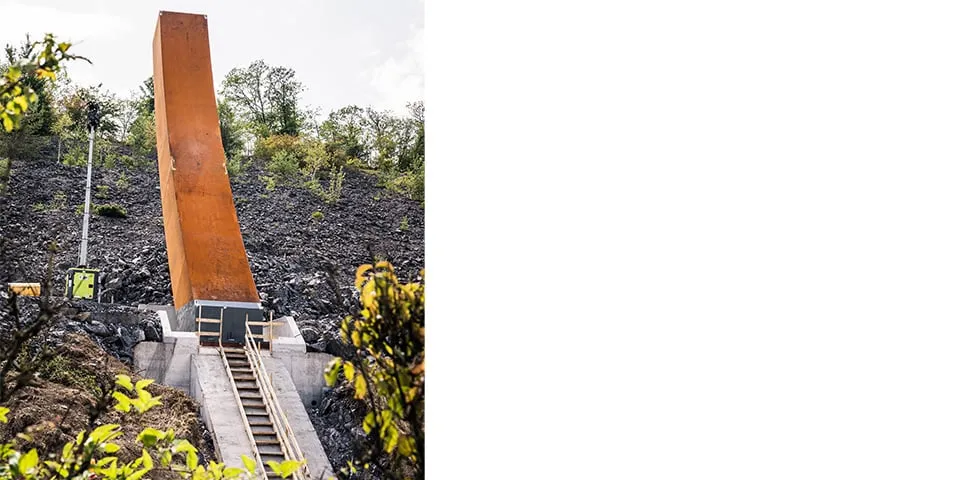
The work of art consists of four sections, which were assembled on site.
A remarkable technical feat
The total project budget is close to €2 500 000! A huge sum, in keeping with the other figures associated with the Arc, the world’s largest metal sculpture: 60 m high, a 75 m span, a cross-section measuring 2.25 m on each side, 200 tonnes of steel and 1000 m3 of concrete used…
But beyond being a work of art, the Arc Majeur is a remarkable technical feat. The large arc (60 m) consists of 3 curved box sections, each 20 m long; the smaller arc (20 m) is made from a single 20 m-long box section. Both have a cross-section measuring 2.25 m on each side. The sections of the large arc were transported to the site, lifted into position, then assembled and welded together.
To manufacture this steel sculpture, with its unusual dimensions and geometry, which required a 750-tonne crane to lift, the CES used semi-automatic welding carriages. Pascal Godelet, who has worked as a fitter at John Cockerill for 30 years, says: « The Arc Majeur reminded me of the large steelwork components we used to make. But we had to be even more precise, as the plates had to fit together perfectly, with no visible welds. And given the weight, with the heaviest element weighing 56 tonnes, handling was extremely delicate. »
At every stage, the work was inspected by specialists from the Vinçotte Group using an advanced non-destructive testing technique, Phased Array Ultrasonic Testing. Other companies and engineering consultancies also contributed to the development of the Arc Majeur: the WindLab at ULiège tested the work’s strength and stability under various atmospheric conditions, v2i analysed potential issues related to the structure’s dynamics, and the German company GERB worked on vibration control and developed a bespoke aerial dynamic absorber (ADA) for the Arc Majeur.
Question about this story? Ask your question
Companies in this story
Keep following this
Get an email when a new story is published. No account needed.
- SubjectProjects
- CompanyBureau greisch