Piscine communale Saint-François, Brussels | Renovating a swimming pool is no straightforward matter!
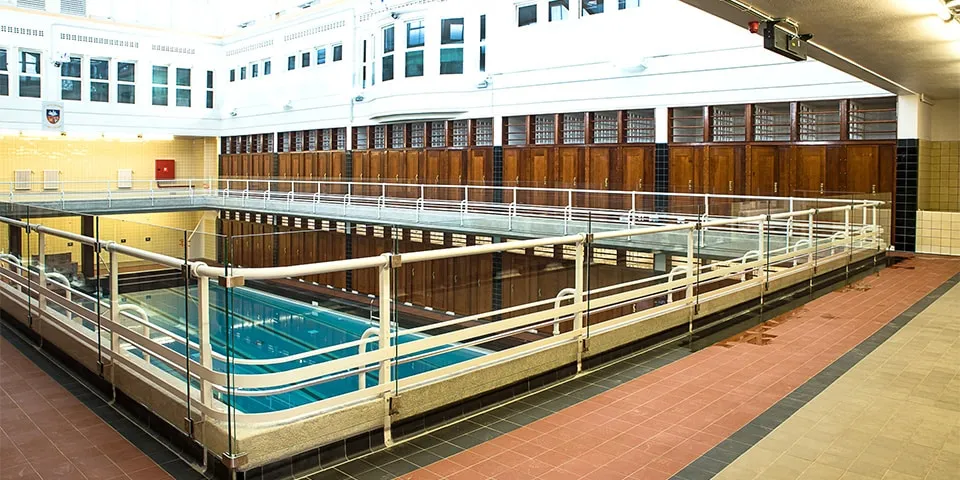
Les Bains de Saint-Josse, also known as Piscine communale Saint-François, is currently being renovated and is due to be inaugurated in September. Built in 1930-1933 on the site of three cul-de-sacs, to plans by architects Bytebier and Schaessens, its inauguration marked the end of a process that began in 1912, when the municipality considered building its own bathing facilities. The venue combined an indoor swimming pool, Turkish baths and individual shower baths, following the tradition of building public baths, particularly in working-class neighbourhoods, to promote public hygiene.
Piscine Saint-François is a fine Art Deco example of this distinctive type of bathing establishment. Its aesthetic and historical significance led to it being listed as a monument on 4 June 2009. However, successive alterations, conservation problems and leaks in the pool tank had altered the building and led to its closure in 2010. A restoration project was then prepared in consultation with the DMS and CRMS, culminating in the issue of a single permit for the restoration on 31 January 2017. The work was carried out by ACH Construct.
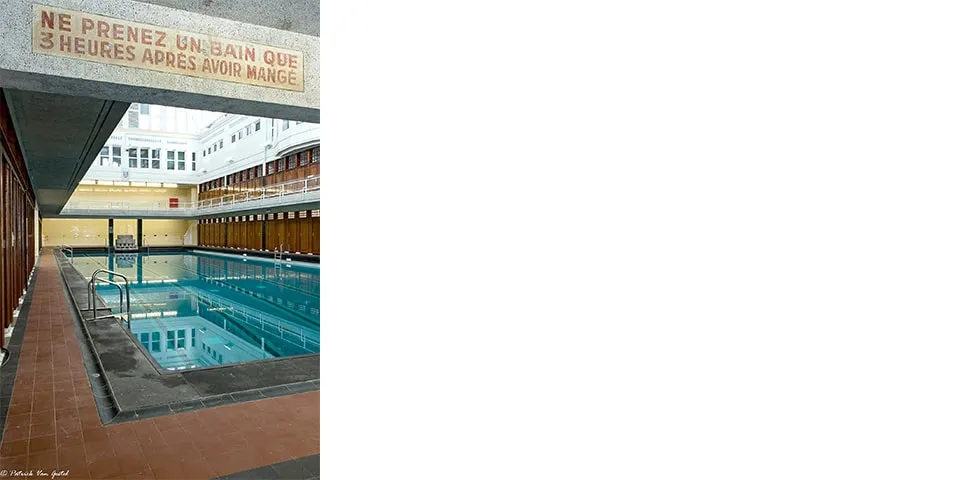
Public baths aimed to promote public hygiene in working-class neighbourhoods… and offer good advice.
The design was entrusted to AAC Architecture, a practice with extensive experience in renovating listed buildings (Théâtre du Parc, Théâtre de Toone, Wielemans breweries…) and swimming pools (Ixelles, St-Gilles…). Céline Vandewynkel, architect-engineer at AAC: « Initially, the project was mainly concerned with the technical issue of making the pool tank watertight. However, we highlighted the building’s architectural and historical significance. Brussels’ first swimming pools were closely linked to the development of cities and society. Renovating them poses a major technical challenge: restoring and treating old concrete in a chlorinated environment. Durable solutions are available and should serve as an example for preserving historic swimming pools. The restoration work at the St-Josse pool went far beyond the pool tank. The entire building was returned to its original state. Alterations made in the 1970s were removed. The architectural, technical, historical and social aspects all came together in this project. »
Technical and other challenges
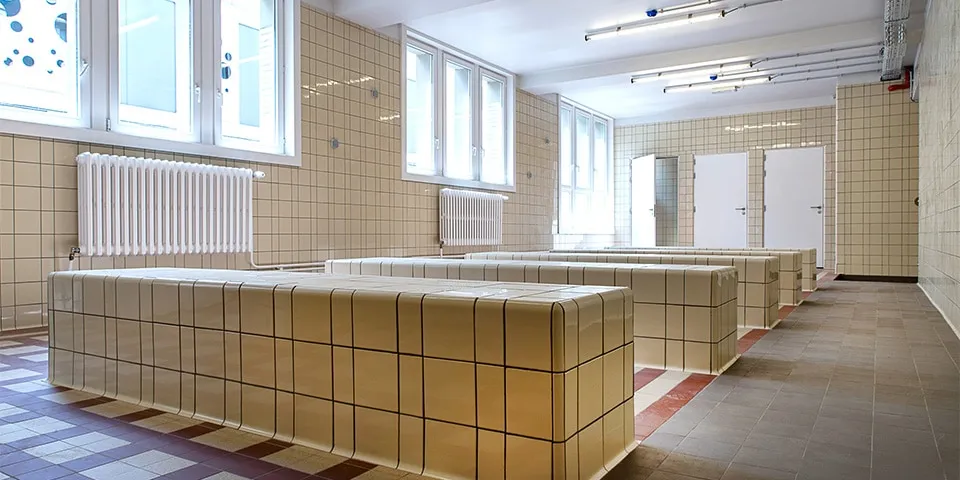
Renovating this type of swimming pool presents several major challenges. Thierry Dupont, site manager for ACH Construct: « The building is listed both externally and internally. This meant that we had to carry out extensive work on the building while preserving heritage features and existing technical elements, such as the water filtration system and ventilation. » Céline Vandewynckel: « The first challenge is structural stability: in a swimming pool, even the slightest instability can trigger a chain reaction. It causes cracks, leading to failures in the waterproofing, allowing chlorinated water to seep in and attack the structure, causing further cracks, and so on… Until the pool tank is completely stable, we cannot make the waterproofing durable. And if the waterproofing is not perfect, there is no question of carrying out durable repairs to the structure. There is also the challenge of overall watertightness: preserving the original tiles is essential to retain the atmosphere of the historic swimming pools.
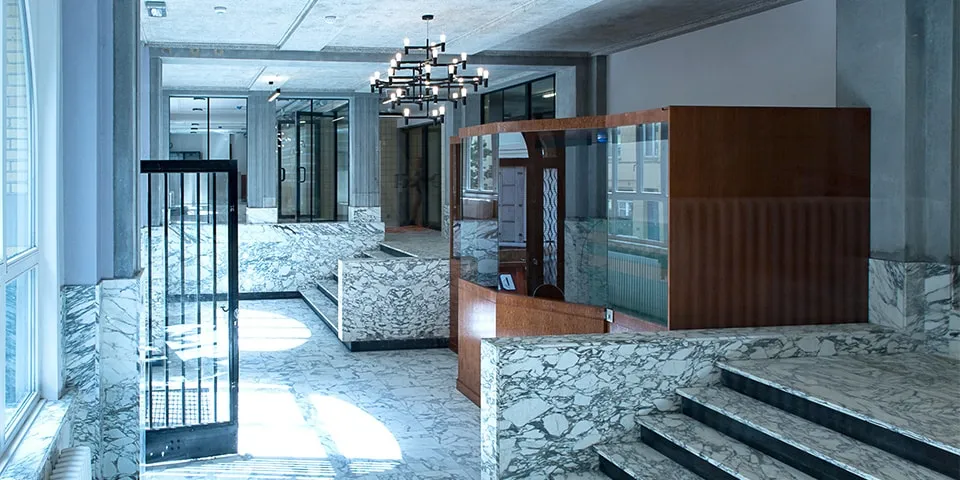
However, they are not watertight. To preserve the tiles while ensuring complete watertightness, seamless resin membranes are installed beneath them to act as waterproofing. The tiles are then relaid on top of these waterproof membranes. Finally, hygiene standards and new regulations must be met, including the separation of dry-foot and wet-foot areas. Here, rather than building new corridors, we designed areas where swimmers can remove their shoes. This preserves the traditional layout, with changing cubicles surrounding the pool. » The cubicles were also restored, and the Formica doors were replaced with solid wood doors. Finally, an anti-drowning detection system was installed and accessibility for people with reduced mobility was improved by adding a lift.
The work brought a few surprises, as Thierry Dupont explains: « Removing suspended ceilings and partitions revealed extensive areas of terrazzo. The project was amended to showcase them. Structurally, the entire floor system had to be strengthened using a wide range of techniques to preserve the heritage features as far as possible. »
The Brussels-Capital Region is subsidising 80% of the restoration work, to the value of around €1.295 million.
Question about this story? Ask your question
Keep following this
Get an email when a new story is published. No account needed.
- ThemeRenovating existing buildings
- SubjectProjects