Lines 161 and 162, Ottignies–Arlon | Modernising 175 km of railway between Ottignies and Arlon
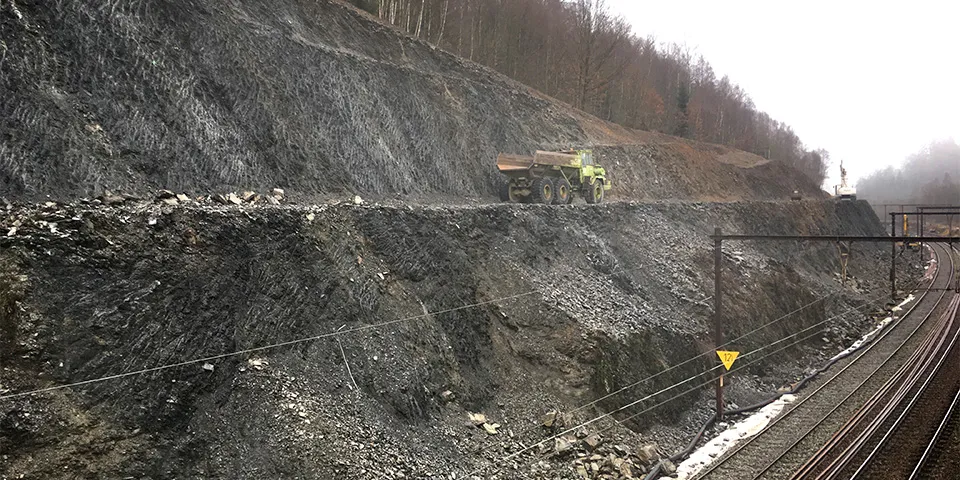
As part of the priority trans-European projects established by the European Commission, the Federal Government and the Walloon Region decided in 2006 to undertake major modernisation works on lines 161 (Brussels–Namur) and 162 (Namur–Luxembourg), which were built in the… 1850s!
The project aims in particular to improve the competitiveness and profitability of rail. Its objectives are to raise the reference speed from 130 to 160 km/h, electrify Line 162 at 25 kVAC and renew railway equipment, including track infrastructure, engineering structures, signalling and overhead line equipment. Other works include widening the track spacing to 2.25 m, stabilising some embankments and rock faces, eliminating level crossings and improving track formation.
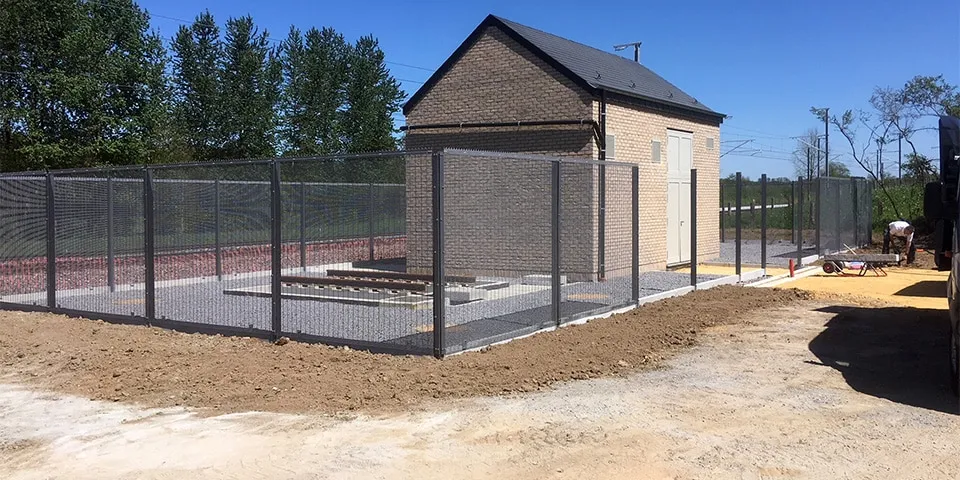
The 25 kVAC autotransformer station at Houdemont.
Modernising the 175 km ‘Axis 3’
This major project, known as the ‘Modernisation of Axis 3’, runs from the Louvain-la-Neuve junction to Arlon. It was entrusted to TUC RAIL, an Infrabel subsidiary specialising in the construction of new railway infrastructure and the adaptation and modernisation of existing infrastructure. Initially responsible only for the re-electrification of Line 162, TUC RAIL has managed the entire programme since 2013.
Yannick Lecluse, Program Manager for Axis 3 at TUC RAIL: « Our role is to coordinate the studies relating to the various railway disciplines, obtain the various permits required to carry out the works, plan them across the 175 km of lines while maintaining traffic with a reasonable level of punctuality, and finally certify the completed works. »
The project divided into 4 sections
« To make the project easier to manage, it was divided into 4 sections », explains Yannick Lecluse. « The first runs from the Louvain-la-Neuve junction to Namur. Work will not begin until early 2021, but Gembloux station has already been completely modernised. The second runs from Namur to Ciney; all the work here has already been completed, four curves have been realigned and the speed has been increased. The third section links Ciney to Hatrival. Modernisation of Ciney station began in February. The platforms will be extended from 250 m to 350 m.
Track and overhead line equipment renewals, along with the realignment of rock faces, began this year and will be completed in 2026-2027. Lastly, work on the fourth section, through to Luxembourg, is complete, with the exception of modernising the section between Lavaux and Habay, redeveloping Arlon station, and installing equipment at the autotransformer stations and the Heinsch substation. These works will be fully completed by the end of 2020. »
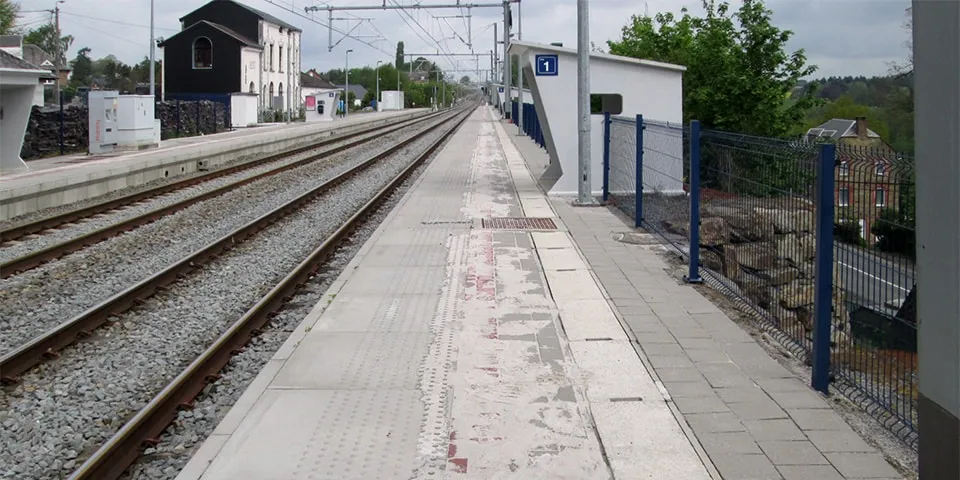
New station platforms, extended from 250 m to 350 m.
Major re-electrification
One of the major elements of this large-scale project is the re-electrification of both lines. The existing overhead line dates from the 1960s and was due for renewal: « Converting Line 162 to a dual-voltage overhead line (3kVDC / 25 kVAC) has several benefits. First, it will make it easier to increase train speeds on Line 162 by providing more power.
Second, it reduces the investment cost by limiting the number of traction substations that need to be built. Third, it will standardise the overhead line voltage across the province of Luxembourg. A first 2 km test section has already been converted to 25 kVAC, between the Luxembourg border and Barnich, after Infrabel took advantage of the general voltage change in Luxembourg. The programme provides for the voltage to be increased from the Luxembourg border to Namur in two major changeovers, in August 2020 and 2026/2027. On the third section, we will also use a new signalling technology called SIMIS-W, which is more recent than PLP. It will enable the deployment of ETCS, an on-board signalling system that includes continuous speed supervision, scheduled for the end of 2025. »
Unexpected challenges
Managing a project of this scale is never easy. In addition to obtaining work permits, the team had to comply with new safety standards, which meant more night work and full closures to traffic. And that is not all, as Yannick Lecluse explains: « As the line passes through Natura 2000 areas, we had to take account, for example, of bats’ hibernation patterns when planning the rock-face realignment work. We also ‘collected’ lizards and snakes, which are now being housed at the domaine des grottes de Han, as we had to work in their natural habitat…
Question about this story? Ask your question
Keep following this
Get an email when a new story is published. No account needed.
- SubjectProjects