GRP jacking pipes beneath Chaussée de Lille in Tournai
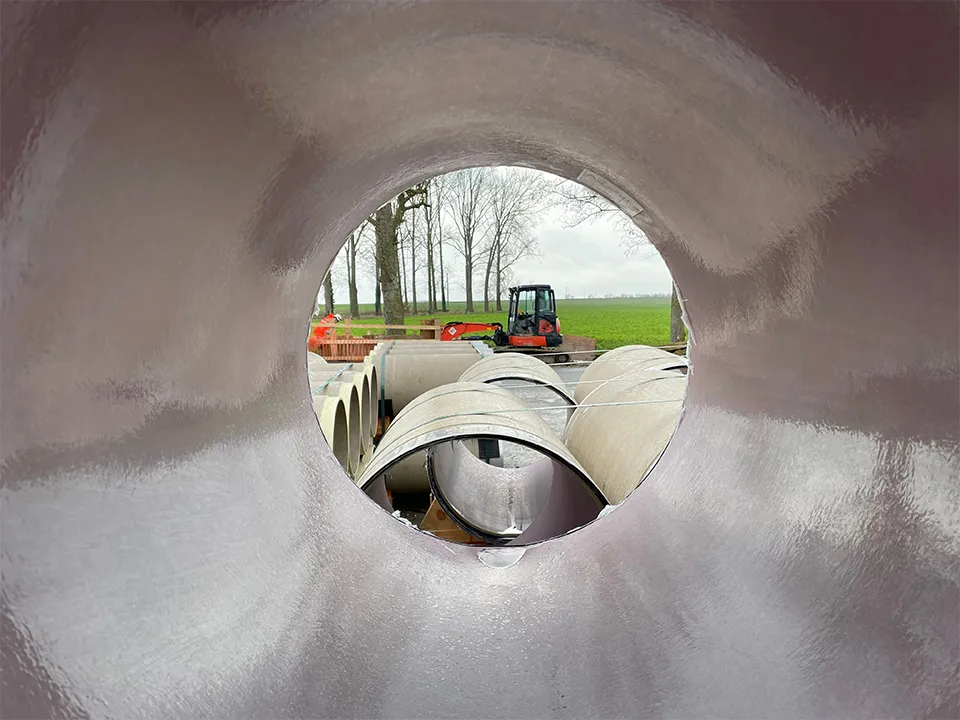
What do you do when gas and electricity pipes need to cross a busy road? Follow the ‘no-dig’ principle and pass beneath the road using GRP pipes, as at Chaussée de Lille in Tournai.
Sewer specialist Rio-Construct, part of Dekabo Group, carried out the pipe jacking, with the pipes supplied by another sewer specialist, Deschacht, through its ‘Public Utility Ducts’ department. “This project clearly demonstrates the benefits of trenchless working and GRP jacking pipes,” says Nick Van Coppenolle of Deschacht.
It quickly became clear that digging up the busy Chaussée de Lille was out of the question. A trenchless technique was therefore needed to keep disruption to an absolute minimum. Bram De Ridder, CEO of Rio-Construct, explains: “This two-lane road connects Tournai’s boulevards to the E42 motorway. ORES, the distribution network operator, asked us to jack two 22 m-long ducts beneath the road at Froyennes, one with a diameter of 500 mm and the other 600 mm. These ducts were to carry the gas and electricity pipes.”
From one excavation pit to the other
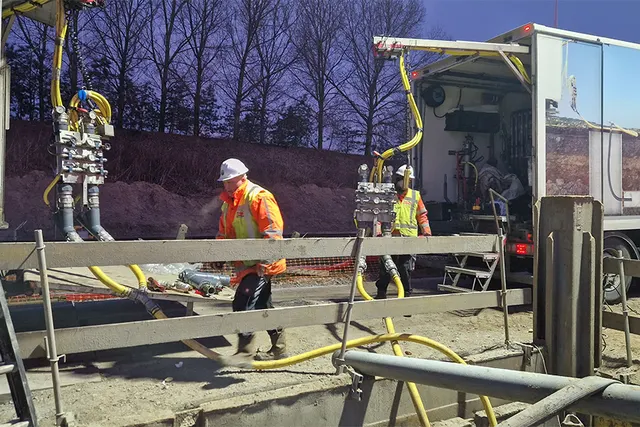
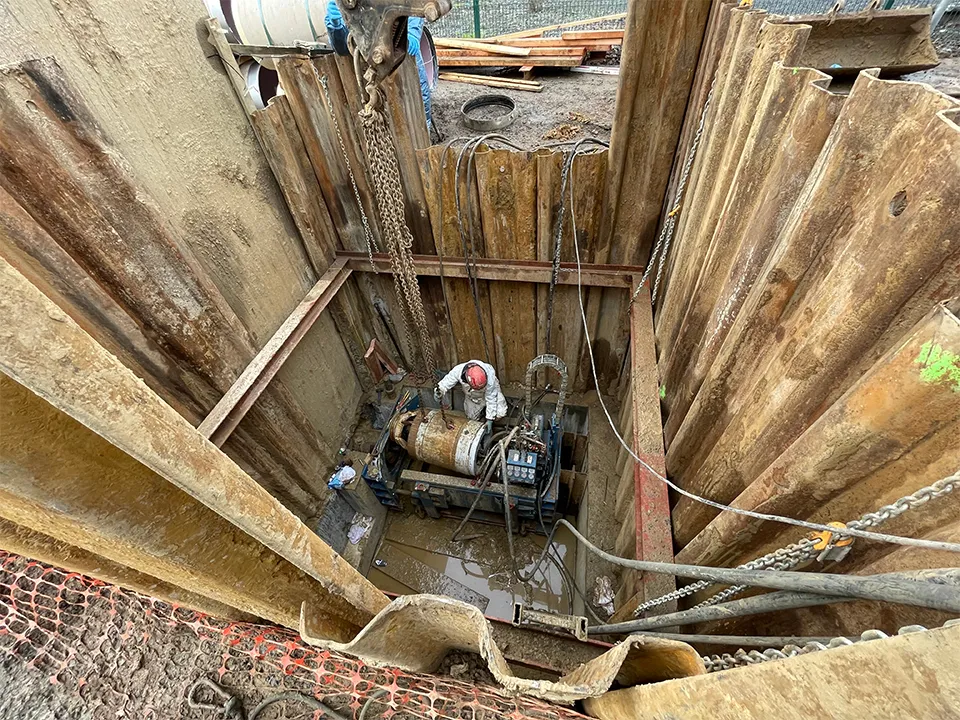
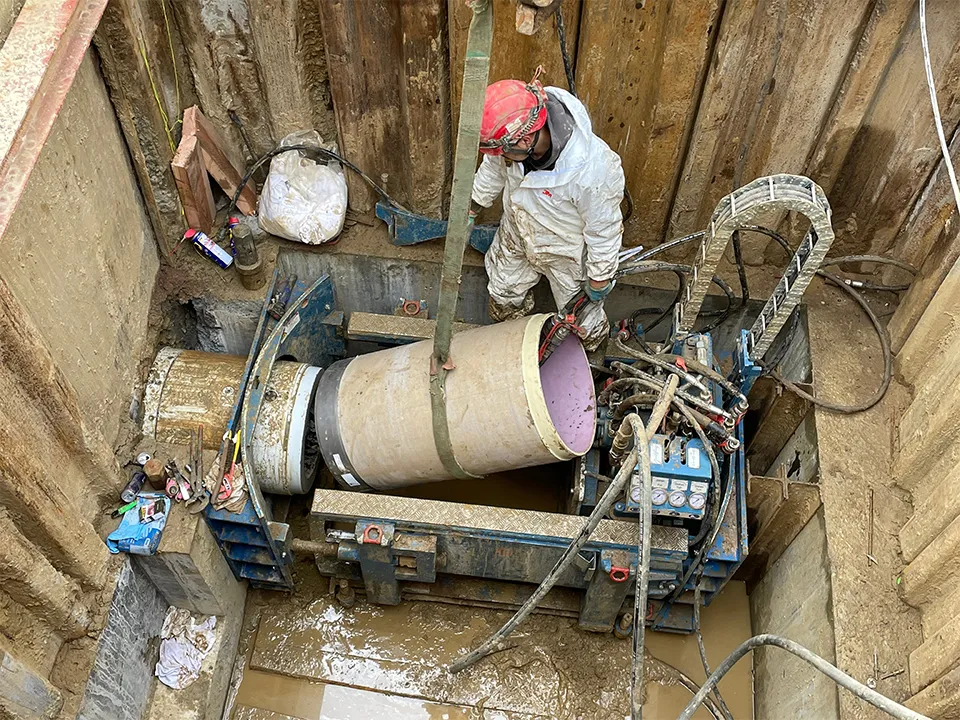
“For the pipe jacking, we first dug an excavation pit on each side of the road, down to 4 m below the surface,” Bram De Ridder continues. “We used a state-of-the-art, very compact jacking machine, so an excavation pit 2 m in diameter was sufficient. We drilled a pilot bore from one pit to the other, using a theodolite for guidance. We then inserted ducts of the required diameter and jacked them from the launch pit to the reception pit. The augers remove the soil inside the ducts and bring it back to the launch pit. Finally, we jacked the pipes in the same way. They push the ducts in front of them, and we remove the ducts through the reception pit.”
Jacking pipes
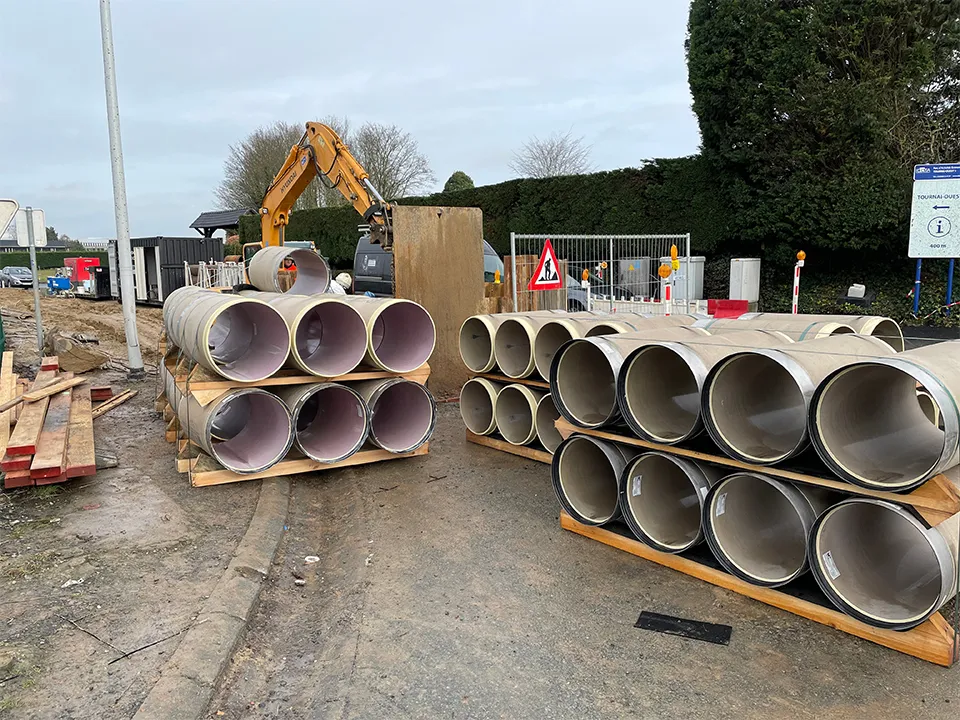
Rio-Construct, which specialises in sewer construction techniques, often works with another specialist, Deschacht, and in particular its ‘Public Utility Ducts’ department. Bram De Ridder says: “It is our main supplier for everything to do with sewers, pipe jacking, … It supplied the GRP jacking pipes. These are glass-reinforced plastic pipes with stainless steel sleeve couplings that allow them to be connected to one another.” At Froyennes, 1 m-long pipes were chosen. This meant the excavation pit could be smaller, and the sections are also very easy to handle.
Deschacht’s specialist expertise
The advantages of GRP jacking pipes over other materials are considerable. “GRP jacking pipes have very thin walls, giving them a small external diameter and a large internal diameter,” explains Nick Van Coppenolle. “A smaller external diameter means a more compact installation, lower costs, a smaller excavation pit and therefore less disruption for local residents. The bore itself is also smaller, reducing soil drainage and the amount of bentonite required. What is more, the smooth interior of these GRP pipes, made possible in part by the fully integrated sleeve couplings, ensures excellent hydraulic performance. Finally, thanks to its high stiffness, the material is suitable for long sections.”
This project was a perfect fit for Deschacht. “It aligns with our strategy of specialising in public utility ducts. We specifically serve contractors involved in building underground infrastructure, such as electricity lines, telecoms, drinking water distribution, wastewater drainage, district heating networks, fire-fighting pipes, transport pipelines, sewer renovation…,” concludes Nick Van Coppenolle.
Question about this story? Ask your question
Keep following this
Get an email when a new story is published. No account needed.
- ThemeTransforming infrastructure and territories
- SubjectProjects