











The major undertaking of reforming school buildings
Anyone who has attended a school in Wallonia or Brussels, whether recently or some time ago, will have noticed that many school buildings are in a poor state of repair. Responding to these concerns and recognising that high-quality education also depends on high-quality facilities, Minister Frédéric Daerden has decided to put an end to several decades of underinvestment in school buildings. He has tasked Chantal Dassonville, previously head of the FWB’s Cellule archi, with coordinating an ambitious reform of school buildings. A major and fascinating undertaking!
Fire safety, thermal and acoustic performance, accessibility for people with reduced mobility, … these are all issues that need to be addressed urgently to ensure that pupils and teachers can be accommodated appropriately. There is also demographic pressure, which means that many additional school places will need to be created in certain areas in the years ahead.
Interconnected challenges
However, reforming school buildings goes far beyond addressing urgent needs. The aim is to give physical form on the ground to the educational reform brought about by the Pacte d’excellence: a common core for all pupils up to the age of 15, offering not only traditional teaching but also practical and artistic subjects, and opening schools up to their neighbourhoods, … This educational challenge intersects with another, equally important one: meeting climate ambitions. Chantal Dassonville: «The current target is to bring the entire building stock into compliance by 2040, across all networks and including higher education. That gives us 20 years! By the end of 2021, we need to have developed an energy strategy for our building stock. Of course, we will use this strategy to incorporate all the other factors too.» The reform is therefore intended to be comprehensive: the Pacte d’excellence, climate ambitions and bringing school buildings up to a high-quality standard.
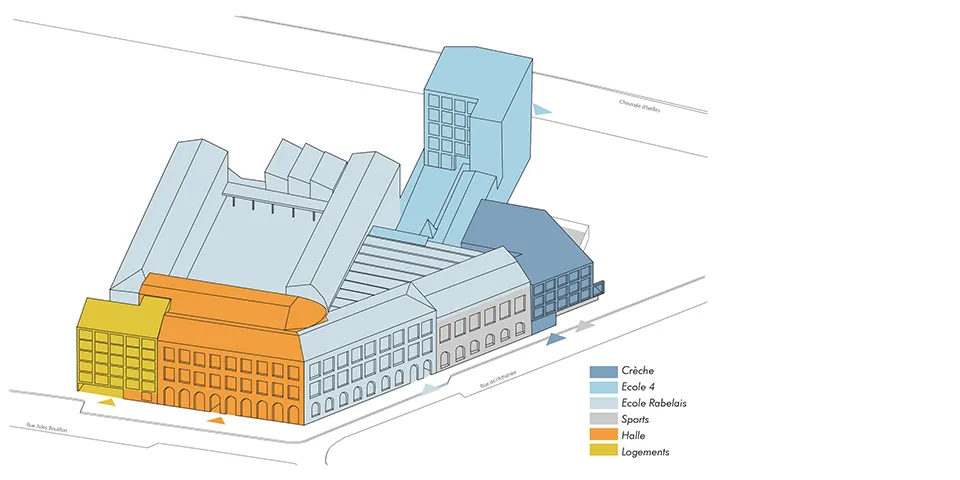
In Ixelles, Pôle Rabelais is using the former Athénée as the basis for a new school complex that puts the common core into practice and is connected to its surroundings. (Image: R2D2, Urban Platform)
Funding
The figure of 1.2 billion euros, cited at the start of the project, gives an idea of the scale of the undertaking, but still needs to be refined. Chantal Dassonville: «The idea is that we could use several funding models, depending on the type of work involved. Our approach would vary according to the circumstances: a building that cannot meet the new criteria and must be demolished and replaced with a new one; a building with further potential that can undergo major renovation; or a building in good condition that can be improved through more targeted work. We are entering a new wave of European plans, structural funds and recovery plans. In this respect, the climate framework could provide an entry point for our reform.»
Although the WBE network, through its regional directorates, has a good understanding of its property portfolio, there has never really been a perceived need for a register of school buildings belonging to other organising authorities. That could change: «There is now talk of a register of all school buildings, including those we do not own. It would not, however, be exhaustive, but would be based on criteria that would enable us to better target subsidies towards addressing the fundamental challenges.»
Architectural quality
«Wherever prefabricated buildings dating from the 1960s still stand, we know they will have to be demolished and rebuilt. Major renovations will also provide an opportunity to raise architectural quality. In the Flemish PPP Scholen van Morgen, the Flemish Government Architect’s team was involved in some projects. This resulted in a certain level of architectural quality. If there is one sector in which we want to promote architectural quality, it is schools. Giving our children a high-quality working environment helps them to incorporate this appreciation of quality into the way they see the outside world, and that benefits everyone!»
More collaboration
Whether in urban or rural areas, school buildings are key facilities that help shape their surroundings. Their design therefore calls for greater collaboration with all the parties concerned: urban planning, mobility, sports facilities, … Chantal Dassonville also has a message for businesses: «To deliver this strategy of renovating the entire school building stock by 2040, we will need businesses with the expertise to carry out all this work. Especially as we will not be the only ones in the market looking to upgrade buildings to meet climate ambitions. Businesses will therefore need to get ready to handle these types of projects. There will be plenty of work!»
Question about this story? Ask your question
Keep following this
Get an email when a new story is published. No account needed.
- SubjectNews







