











The cement industry reaffirms its unwavering commitment to circular, carbon-neutral construction
Texte & photos FEBELCEM
A few weeks ago, FEBELCEM published its ‘Roadmap Net Zero’. With this roadmap, Belgian cement producers reaffirm their unwavering commitment to the transition to circular, carbon-neutral construction. It confirms that cement decarbonisation projects are being accelerated to achieve ‘Net Zero’ by 2050 at the latest, and probably sooner.
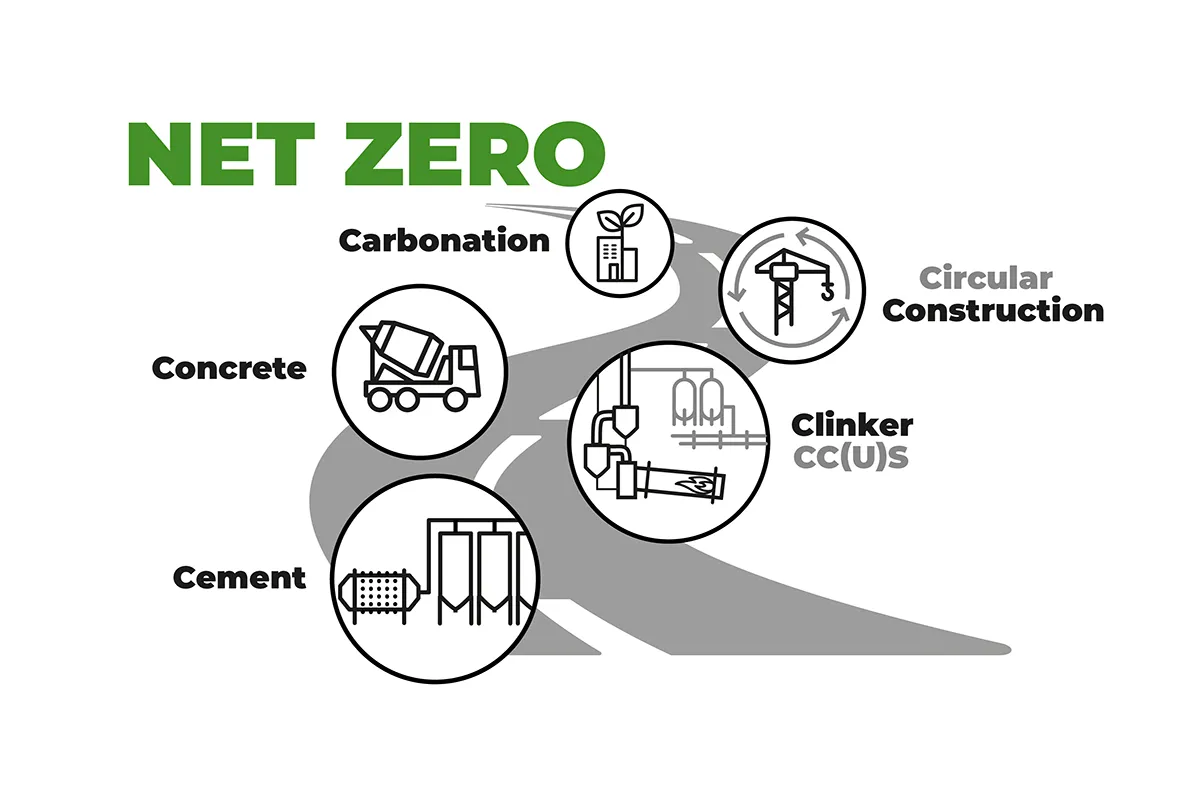
The ‘5 Cs’ illustrate the role of cement and concrete in the transition to a more sustainable construction value chain. These five key levers are in the hands of the various construction industry players, not just cement producers.
• Construction (circular): this means using construction materials, including concrete, responsibly. An important aspect is adopting circular construction practices, whether reusing entire structures or recycling concrete aggregates.
• Cement: one traditional way to reduce cement’s environmental footprint is to use materials as substitutes for clinker, known as SCMs (‘Supplementary Cementitious Materials’), such as blast furnace slag. Since 2020, to anticipate the medium-term disappearance of slag and further reduce the clinker content of cement, Belgian cement producers have been carrying out pre-normative research projects to demonstrate the suitability of cements containing new components, including calcined clay, for specific applications.
• Clinker: this lever covers all measures taken at the kiln level to reduce the impact of clinker production. These include traditional measures, such as using decarbonised raw materials, co-processing waste and improving energy efficiency, as well as breakthrough technologies such as CCS (‘Carbon Capture and Storage’).
• Concrete: sustainability is not just a matter of environmental footprint, but also of longevity. Specifying an appropriate concrete mix and ensuring good workmanship are the basis for durable concrete structures. The concrete sector also has a number of levers at its disposal: electrifying transport, digitalisation, using recycled concrete aggregates, and so on.
• (Re)Carbonation: throughout their life cycle, concrete structures absorb a significant proportion of the CO2 emitted during clinker production. The overall impact of this natural process has recently been quantified, and some projects aim to accelerate the reaction using recycled concrete aggregates.
It is worth remembering that over the past 30 years, we have already cut the average carbon footprint of cement production by 31%, making Belgium a world leader.
Two thirds of the decarbonisation effort will rely on deploying CCS. It is therefore clear that rolling out this new value chain is an absolute priority for the cement sector. It consists mainly of three elements:
• Capture: CO2 in the flue gases is separated and concentrated to prevent it from entering the atmosphere.
• Transport: the purified CO2 is pressurised and transported by pipeline to a port terminal, where it is liquefied and shipped to storage sites in the North Sea. The operator of the CO2 transport network has yet to be appointed by the Walloon Region and the Flemish Region.
• Permanent storage: the CO2 is injected under pressure and stored deep underground in depleted offshore natural gas fields or deep saline aquifers in the North Sea.
Two major industrial projects are being prepared for operation before 2030: GO4ZERO by Holcim in Obourg (Mons) and Anthemis by Heidelberg Materials in Antoing (Tournai).
With these two projects, the Belgian cement sector is clearly an ‘early mover’ in implementing the CCS value chain. This is a unique opportunity for the construction sector and an essential link in developing a decarbonised, competitive industrial base in both Wallonia and Flanders.
Question about this story? Ask your question
Keep following this
Get an email when a new story is published. No account needed.
- ThemeBuilding with less carbon
- SubjectNews







