











The Belgian cement industry, caught between concerns over the health crisis and confidence in the future…
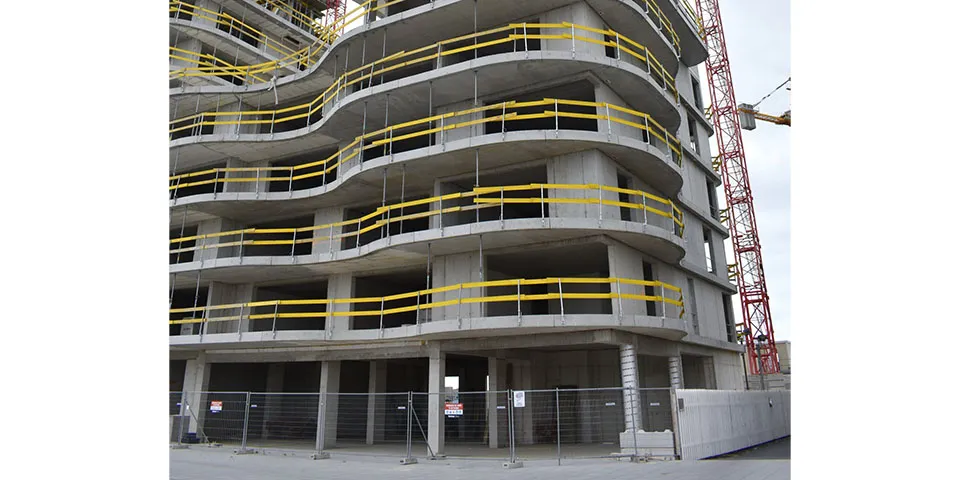
On 3 June 2020, FEBELCEM, the Federation of the Belgian Cement Industry, held its General Assembly. The Federation’s annual report is published on this occasion. In accordance with the compliance rules established by the cement industry at European level, figures for cement consumption in Belgium are published with a one-year delay. This means that this year, for its 2019 annual report, the industry is publishing figures for 2018.
Cement imports gather pace
Belgian consumption of grey cement reached 6,302,943 tonnes in 2018, compared with 6,148,312 tonnes in 2017, an increase of 2.5%. By way of reminder, 2017 had seen a slight decline of 1% compared with 2016. That said, while 2018 was a good year for cement consumption, it was also marked by a very significant increase (+16.5%) in imports from non-members. It is also worth highlighting the strength of exports by members themselves, which rose by 10.1%. At the beginning of the year, the estimate for 2019 indicated an increase in cement consumption of around +1.6%, but the slowdown in the second half of the year brought the latest estimates back to stable consumption or even a slight decline. In any case, we will have to wait until 2021 to know precisely how much cement was consumed in Belgium in 2019.
The construction market in 2020
There is no need, perhaps, to point out that the uncertainties linked to the health crisis are considerable. 2020 will therefore be an exceptional year, with results depending on the type of recovery now taking shape. At the height of the crisis, barely 20% of contractors were operating at a normal level of activity. According to BNP Paribas Fortis, the impact on the sector was 21% in March and 52% in April.
Although 80% of businesses were operational again at the beginning of May, the Construction Confederation now expects the sector to see a sharp decline in activity. Its Managing Director, Robert de Mûelenaere, even says that “only a recovery from the third quarter onwards will limit the decline in our sector this year to 10%”. The outlook is therefore very bleak, due in particular to the market having truly collapsed since the start of the health crisis. Housing sales, for example, have fallen by 47%, according to the Construction Confederation.
It is clear, then, that the construction sector as a whole urgently needs a major recovery plan, focused primarily on supporting investment by households, businesses and public authorities. The starting point must be an ambitious policy on property taxation. Building and rebuilding must become more attractive from a tax perspective!
In the shorter term, many construction companies are discussing changes to the length and/or timing of the summer holidays, in order to maintain the momentum of the recovery and potentially make up some of the lost ground. In any event, FEBELCEM members’ plants will run at full capacity, including over the summer, to provide effective support to construction contractors.
Outlook for the cement sector
At the beginning of the year, the Construction Confederation forecast cement consumption growth of around 2.6% in 2020 and 1.9% in 2021. According to the latest forecasts, the crisis’s negative impact on the residential and non-residential sectors should be offset by civil engineering. This segment was expected to grow by around 7.5%, driven by major landmark projects such as the construction of the tramway in Liège, the Oosterweelverbinding in Antwerp, metro works in Brussels and the RER works. These projects should continue as planned, or even be accelerated.
In the longer term, the Belgian cement industry remains firmly positive. Cement consumption is underpinned by strong fundamentals (‘bouwshift’, nearly zero-energy homes, essential infrastructure, etc.), which should enable FEBELCEM members to look to the future with a degree of optimism. This is why Mr Eddy Fostier, President of FEBELCEM, speaks confidently about the future of the cement and concrete sector: “The construction industry has immense needs, and a revolution is also under way. Reconciling the needs of a growing p111opulation, zero-energy housing and putting an end to urban sprawl: these challenges can only be met by integrating every stage into a circular process, from design through to the reuse or recycling of a building. Cement and concrete are undoubtedly part of this approach and are essential players in it ”.
Question about this story? Ask your question
Keep following this
Get an email when a new story is published. No account needed.
- SubjectNews







