











On-site recycling to cut transport and costs
Texte Philippe Selke Photos Fisse sprl
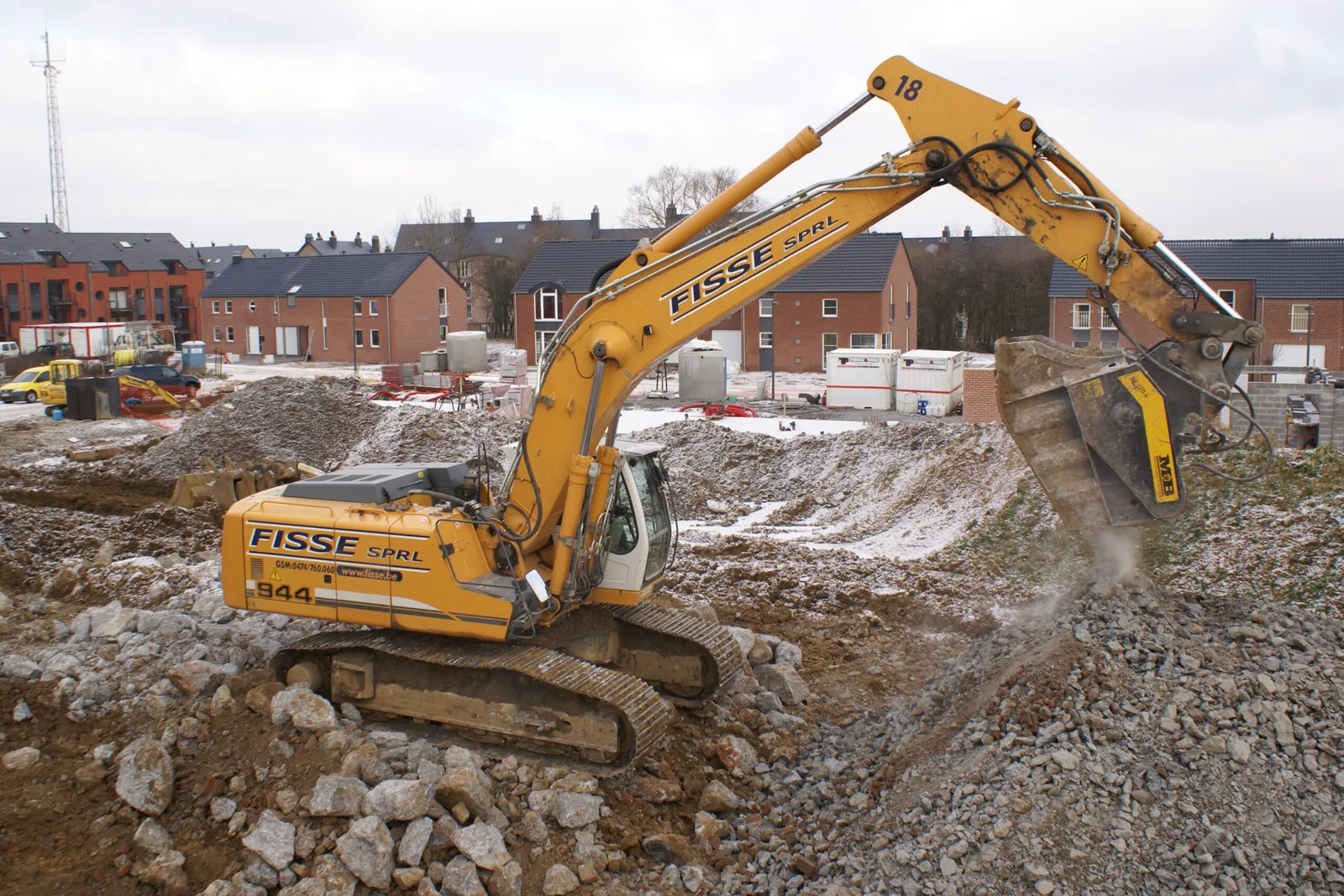
Active since 2000 in earthworks, demolition, landscaping and decontamination, Fisse works on a wide range of projects across Wallonia. Its work covers the entire preparatory cycle of construction projects, from demolishing existing buildings to completing the surrounding areas and external infrastructure. With a focus on managing materials as a whole, the company has been using the MB BF120.4 crusher bucket for around fifteen years. The equipment is designed to recover materials from demolition directly on site.
According to Sébastien Fisse, CEO of the company of the same name, based in Bossière (Gembloux), the equipment meets a practical need on site. During renovation or reconstruction projects, demolition materials traditionally had to be taken to a recycling centre before new materials were brought in for road and car park sub-bases. “We realised that, for small demolition jobs, doing things that way or bringing a large crusher on site to process a few hundred tonnes was not cost-effective,” he explains.
The BF120.4 crusher bucket processes bricks, concrete and other inert demolition materials directly on site. The resulting aggregates can then be reused for various applications on the project, including as hardcore or a foundation layer.
Cutting transport and supporting recycling
The main benefit of this approach is the reduction in logistical movements. By avoiding trips to treatment centres, companies cut both transport costs and the fees associated with off-site recycling.
This approach to on-site reuse is increasingly common on construction and demolition sites. It also reduces the need to buy new materials while making use of resources already available on site.
A simple, proven technology
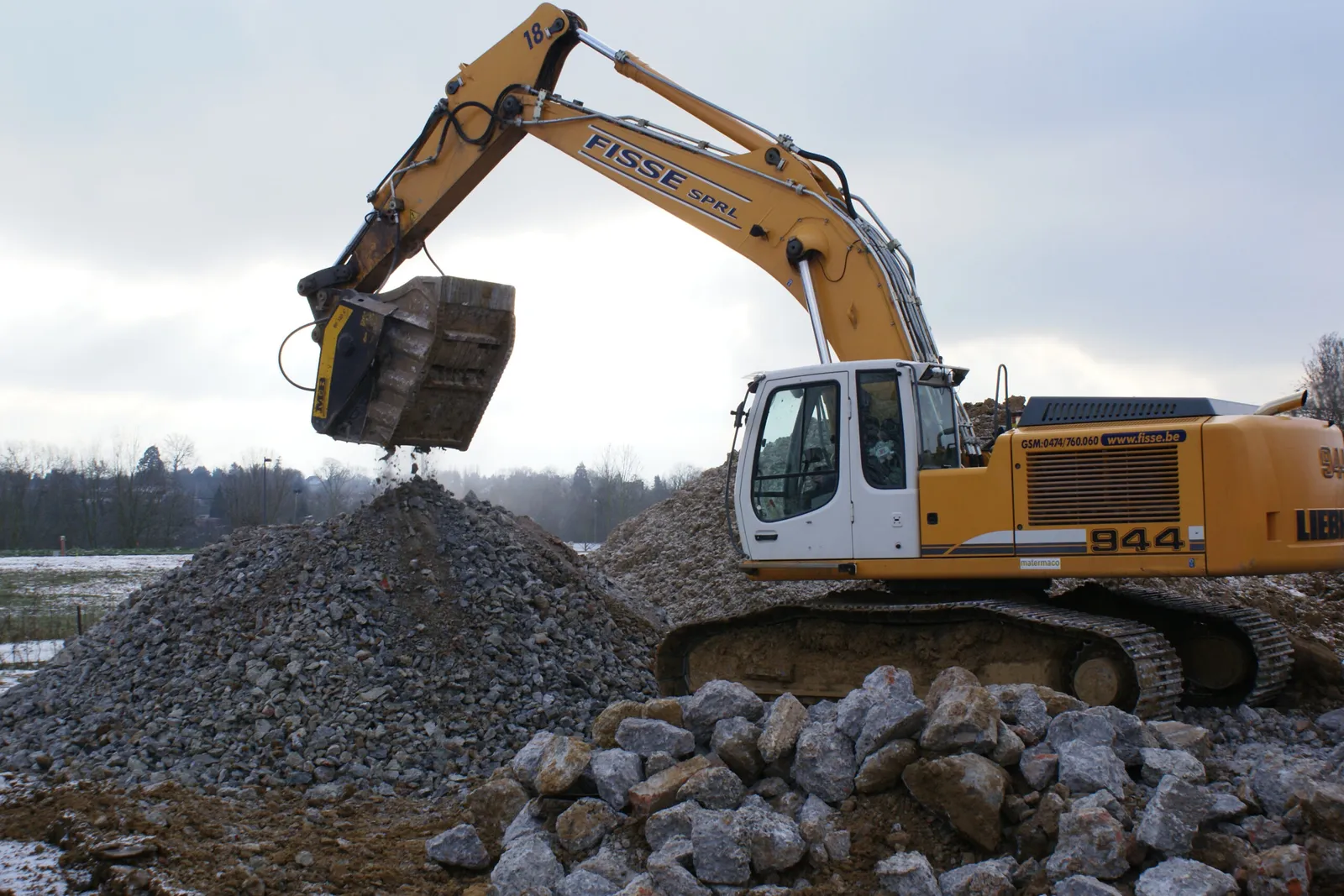
The MB BF120.4 is based on the jaw crusher principle, widely used in quarries and primary crushing plants. Adapted as a bucket mounted on a hydraulic excavator, it uses the carrier machine’s hydraulic flow. “It’s essentially the principle of a primary crusher in miniature,” says the company’s CEO.
Compatible with various excavators with sufficient hydraulic power, the equipment has been used by the company for nearly sixteen years. Routine maintenance is carried out in-house, while spare parts are supplied by the manufacturer.
Choosing the right solution for each site
For Sébastien Fisse, the crusher bucket is particularly well suited to modest volumes. For up to around 500 tonnes of material, it remains cost-effective and offers considerable flexibility on site.
But the crusher bucket is not just for small sites: it is neither a fixed crusher nor a self-contained mobile crusher. Its defining feature is that it is an attachment for a machine, compact, easy to move and ready to operate within minutes. This makes it an effective complement, even on high-volume sites. It can be used upstream to reduce the largest blocks, process hard-to-reach areas or handle residual materials that larger equipment would not recover.
Beyond a certain threshold, other equipment naturally takes over. Compact mobile crushers are preferred for intermediate volumes, while large sites require larger crushing plants. Even in these settings, the crusher bucket has a valuable supporting role: agile where other equipment cannot go, and cost-effective for scattered or occasional volumes.
The aim, however, remains the same: to recover as much material as possible close to where it is generated. Although regulatory, noise or planning constraints may sometimes require off-site processing, on-site crushing remains an effective way to strengthen the circular economy in the construction sector whenever conditions allow.
Question about this story? Ask your question
Keep following this
Get an email when a new story is published. No account needed.
- ThemeBuilding with less carbon
- SubjectNews







