











Glass fibre-reinforced plastic solutions are gaining ground in infrastructure projects
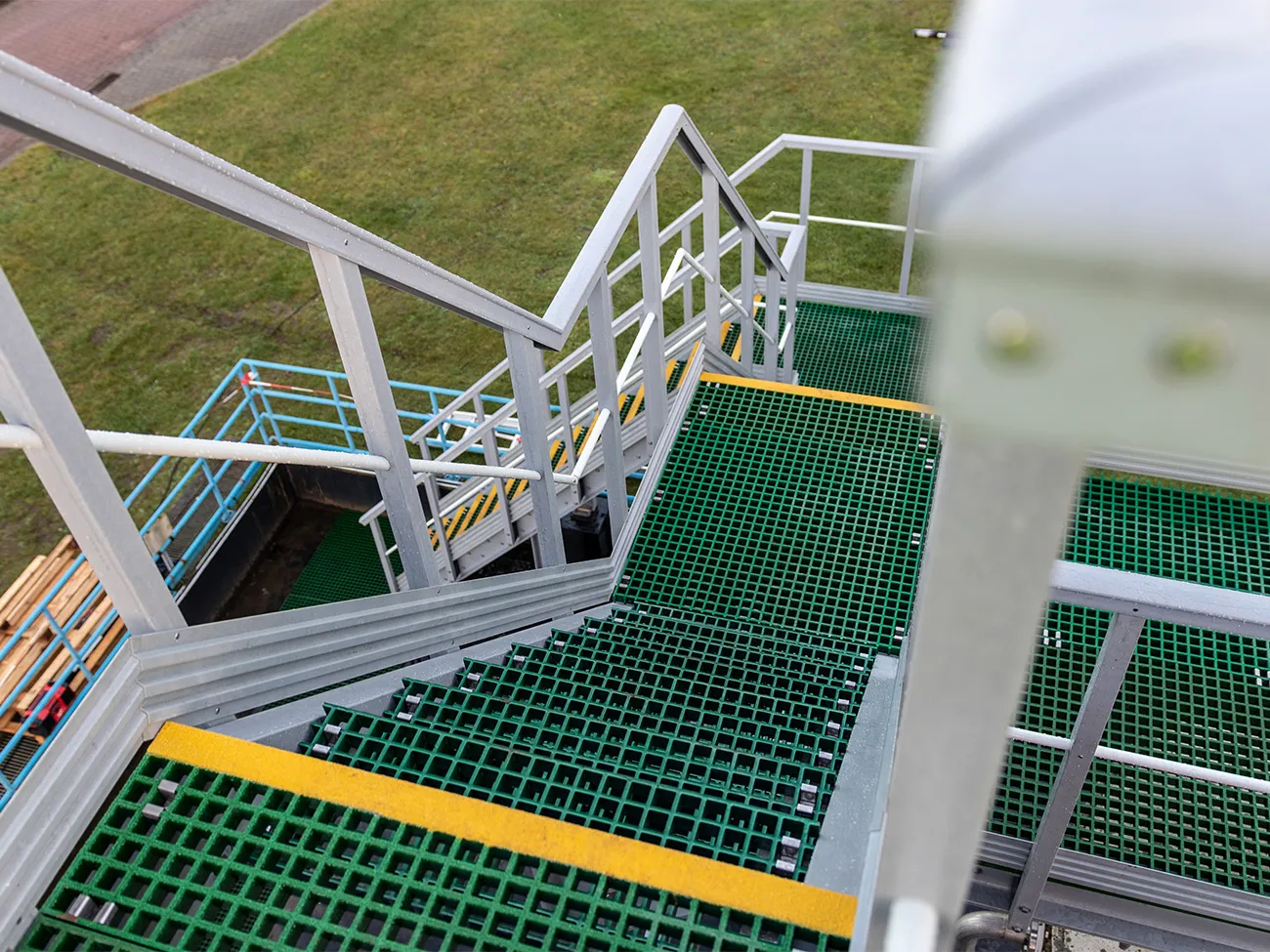
Glass fibre-reinforced plastic (GRP) grating, profiles, handrails and platforms are increasingly being used for bridges, locks and maritime walkways. “Thanks to its chemical resistance, excellent corrosion resistance and electrical insulation properties, the range of applications is virtually unlimited,” explains Jan Swyngedouw, business unit manager at CGK Group.
Originally specialising in the manufacture and supply of storage equipment for chemicals, CGK Group has established itself as a composite materials specialist over many years. Its clients include companies in industry, construction, the maritime sector and infrastructure. The CGK Maritime & Infra Constructions department also offers every type of installation accessory, including M, C and round clamps, as well as suitable connectors, all made from stainless steel.
“Our own installation teams also use GRP profiles, composite pipe supports and a full range of paving slab supports to provide complete solutions for our customers,” explains Jan Swyngedouw. “Thanks to GRP’s chemical resistance and excellent corrosion resistance, our products are used wherever processes involving hazardous substances are carried out, as well as in the maritime sector for safety and infrastructure. Our grating also has a very long service life and requires little maintenance, which is why it is used in a range of other sectors too. We can be of service to any company.”
A wide range of applications
GRP bridges and bridge decks have been in use for some time, but traditional steel platforms and grating are increasingly being replaced by GRP alternatives too. Their low weight makes handrails, complete staircases, landings and grating easy to install on existing structures. Jan Swyngedouw says: “GRP bridge decks and walkways are also maintenance-free, durable and environmentally friendly, lightweight, mould-resistant, and easy to adapt and install on site. They can also be made non-slip.”
Solre-sur-Sambre
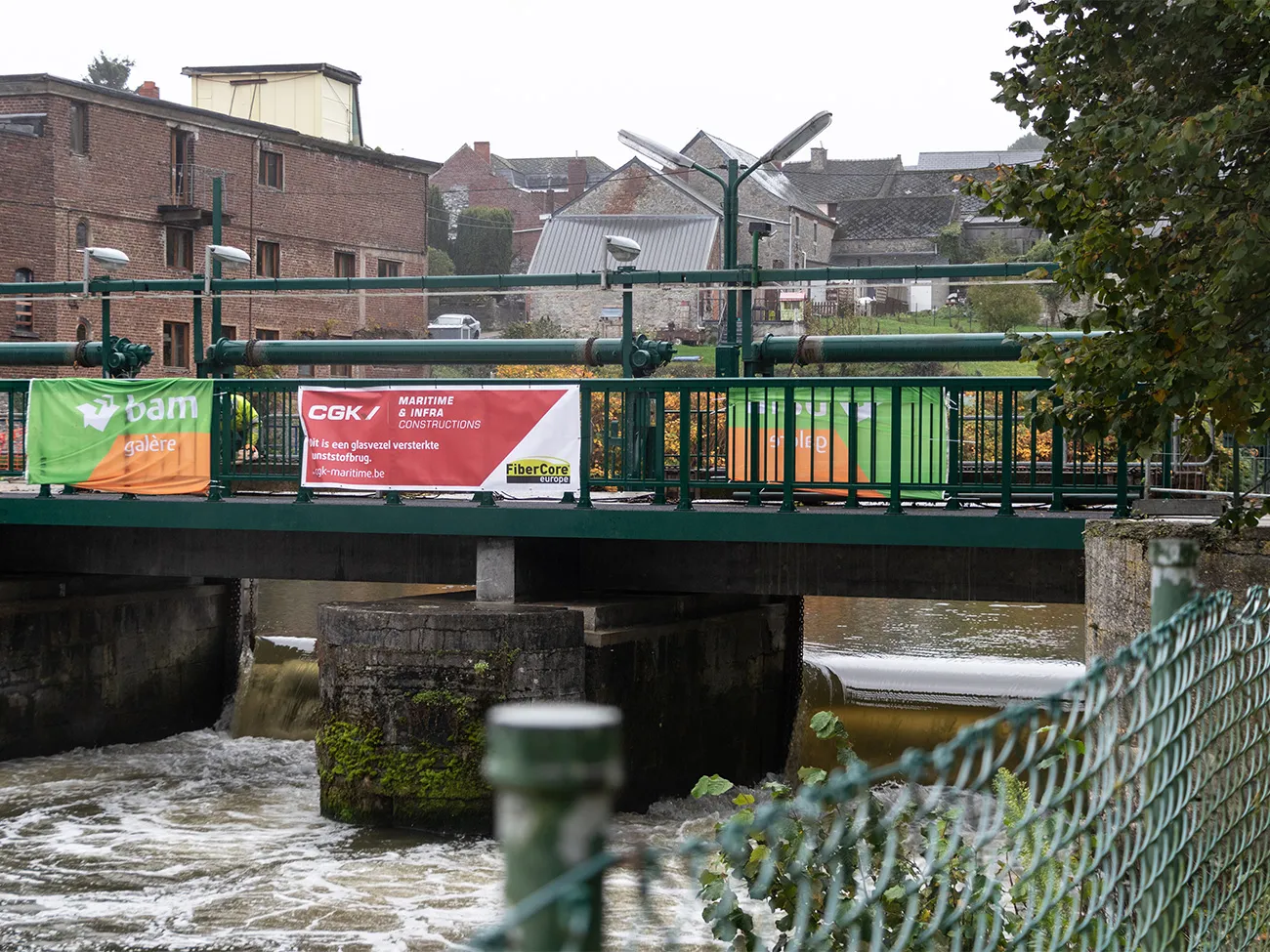
One of the projects for which CGK Croup recently supplied GRP solutions was completed in Solre-sur-Sambre (Hainaut), in collaboration with BAM Galère. Two GRP walkways, each measuring 14 x 2 m, were installed at a landmark site and fitted with maintenance-free GRP handrails by CGK. The decisive factors were the low weight, low maintenance requirements and durability of the GRP materials used. Jan Swyngedouw says: “Although this was a two-part pedestrian walkway, we also build short road bridges wherever concrete piers are in place, with a load-bearing capacity of up to 60 tonnes. For longer spans, we use a concrete or steel substructure topped with a plastic deck. In every case, the main advantage of our system is the exceptionally low weight of the structure.”
Theunisbrug
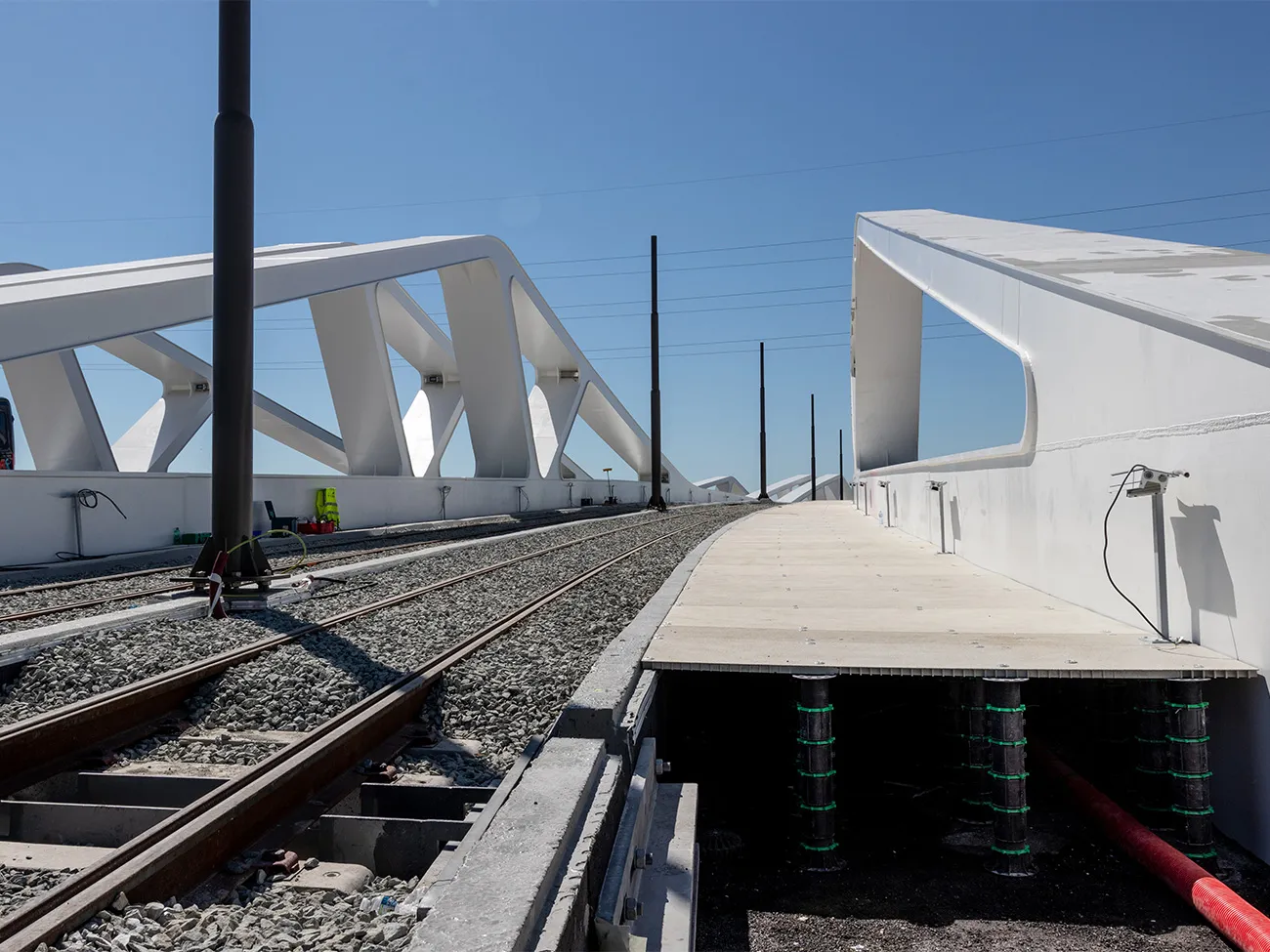
Another example is Theunisbrug in Antwerp, delivered in collaboration with Artes Roegiers. For this bridge, CGK Martime & Infra Construction supplied and installed isophthalic GRP grating with a 38 x 38 mm mesh, a height of 30 + 3 mm and a closed, quartz-coated non-slip finish. The two GRP emergency exits were installed on paving slab supports to bridge a height of 600 to 850 mm. The entire assembly was fixed and mounted on the concrete structure using rubber pads to create a vibration-free installation. GRP was chosen in part for its ideal strength-to-weight ratio and because the panels can be lifted without a crane during maintenance work.
Rail sector
CGK Group can also point to several notable projects in the rail and water sectors, including the supply and installation of orthophthalic resin grating to cover service ducts in Herstal, in collaboration with Kristof Papeleu (Grammont). Another project was on the Aalter-Beernem line, in collaboration with De Bonte, Van Hecke (Waasmunster), where grating was used to cover infiltration units. Covers over the buried units can serve as emergency exits if passengers need to be evacuated. The walking surface must have virtually no changes in level or large openings, so as not to make evacuation more difficult. The channels and grating were designed to form a seamless whole. The grating’s low weight also makes maintenance and cleaning of the buried units easier. “In both of these rail projects, the decisive factors were low weight, fast installation, no maintenance and GRP’s electrical insulation properties,” explains Jan Swyngedouw.
Water sector
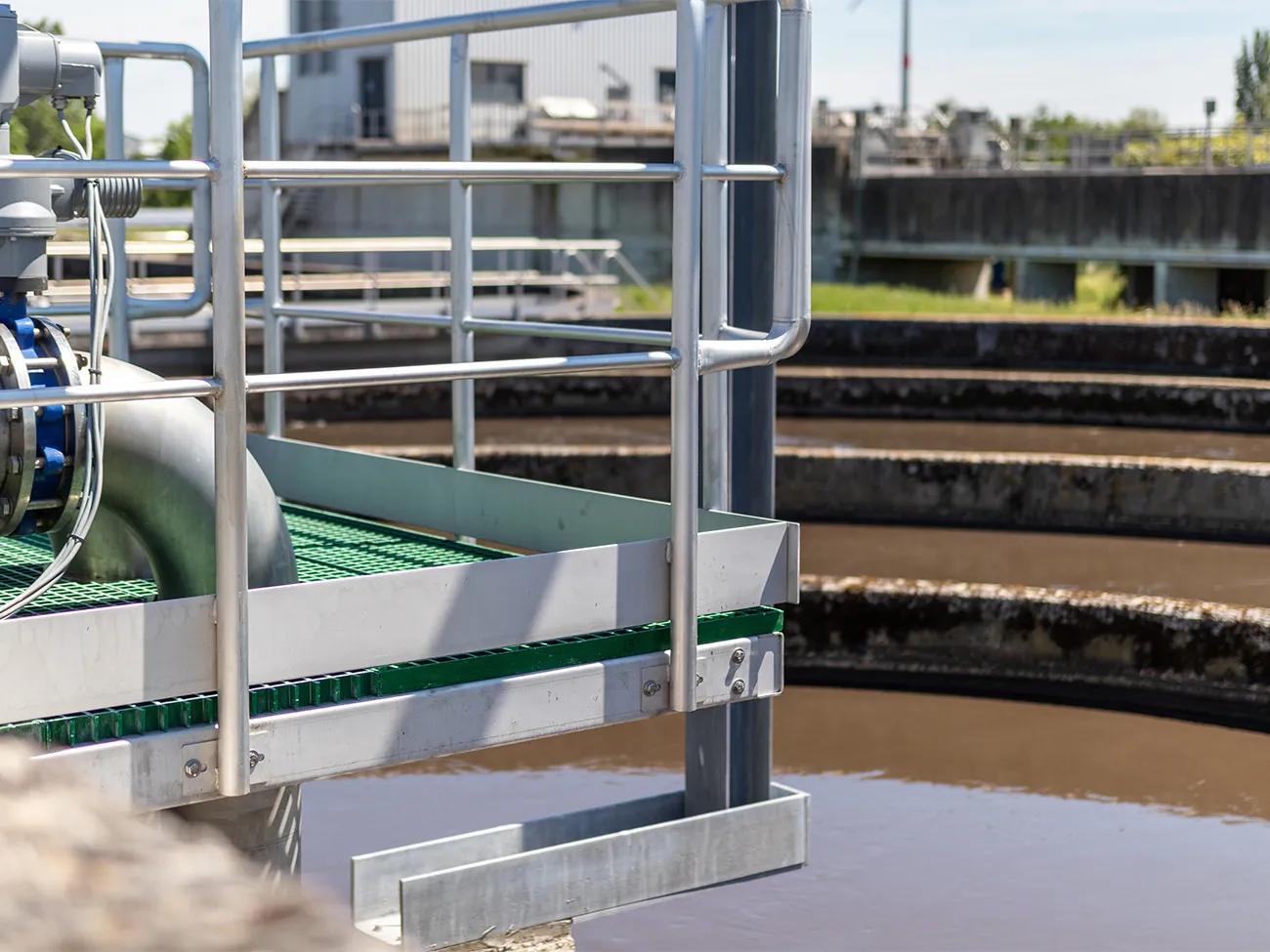
At De Gavers water production centre in Harelbeke, CGK is installing four single-wall tanks for De Watergroep in a concrete bund lined with PE. Jan Swyngedouw says: “Platforms, grating and GRP handrails have been installed alongside and above the tanks. We also supplied GRP stairs to allow access to the tops of the tanks.”
“These structures must meet relatively high load and deflection requirements, and required detailed strength calculations.”
Aquafin also turned to CGK for its site in Bruges. The aim was to provide safe access to the automatic valves installed on the wastewater pipes. CGK therefore devised a solution in the form of a platform accessible by ladder. Jan Swyngedouw says: “We installed a total of 8 platforms, complete with the necessary stainless steel guardrails and ladders, to ensure the structure’s strength. We chose GRP grating because of its high chemical resistance, including resistance to corrosive wastewater vapours,” concludes Jan Swyngedouw.
Question about this story? Ask your question
Keep following this
Get an email when a new story is published. No account needed.
- ThemeBuilding and site safety and security
- SubjectNews







