











Big Brother is helping you
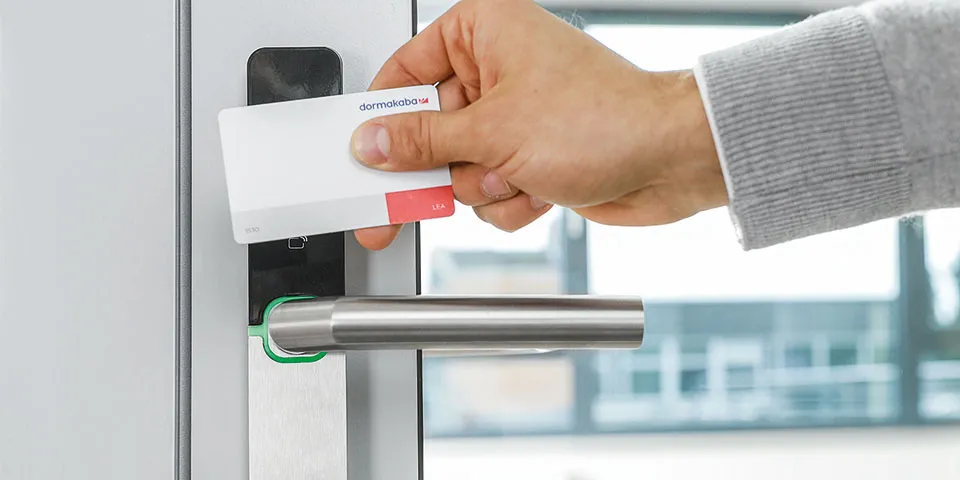
It may be regrettable, but the fact is that the need for security is constantly growing in society. Alongside the anti-burglary systems fitted to windows and doors, access control has become increasingly important, expanding into sectors where it had previously had little presence. In recent years, we have also seen a rapid shift from mechanical to electronic access control. And the health crisis has brought contactless systems to the fore…
Prisons, police stations, psychiatric centres, as well as hospitals, hotels, laboratories, airports, banks, museums, embassies, data centres, … and even private homes: these solutions are used wherever specific security requirements call for the protection of people and property.

Smartphone-controlled access systems are already available for the residential market.
(Photo: Schüco International KG)
‘Smart’ and wireless
In the wake of Smart Cities, Smart Access, or intelligent access control, aims in particular to improve infrastructure management and security. To this end, it stores large amounts of information, which can also be used to carry out audits, improve performance or meet quality standards. This information is also crucial in the event of a security incident, as it can reveal who last used a key in the building and where they went.
A recent development, wireless access control has the obvious major advantage of not requiring the entire building to be wired. In a survey conducted in France by IHS Markit in late 2018, nearly two-thirds of the security professionals questioned said they had a more positive view of wireless technology than they had five years earlier, thanks to technological advances.
However, many still have reservations about using smartphones as keys. In fact, plastic access cards remain by far the most common option in workplaces. In a 2016 Harvard Business Review survey, 60% of respondents considered smartphone-connected devices to be the biggest vulnerability in an access control system.
Touch-free entry
Until now, manufacturers had proudly promoted their simple touch access systems, in which the hand acts as a key (RCID technology). The coronavirus has changed that, and touch-free opening systems, based in particular on motion sensors, are now in favour. Their functionality is not the same, however, since the user is not identified. Touch-free access is particularly important in healthcare facilities and public spaces such as restaurants, schools, offices and toilets.

Could access control systems also become commonplace in shopping centres, to regulate traffic and enable social distancing? (Photo: Schindler)
Managing traffic
In towers and other large buildings that accommodate a large and varied public, access control makes it possible to manage incoming and outgoing traffic more effectively. In hotels, guests check themselves in at a kiosk and are issued with an access card for their room. The same card can also operate the lift, taking them directly to the right floor. Similarly, in office towers where hundreds of workers arrive at the same time, an access control system can improve mobility by managing the lifts more efficiently. We are not there yet, but restricting the number of people in shops to enable social distancing could be a future application for this kind of technology.
Horizontal integration and open standards
In large complexes, access control needs to be integrated into the building management system, whereas traditionally this was reserved for HVAC. The days of ‘vertical’ systems operating alongside one another are over. What is more, interoperability is crucial to ensure that installed systems remain viable over the long term, and adopting open standards will make this easier. This will free the client from dependence on a single supplier.
Question about this story? Ask your question
Keep following this
Get an email when a new story is published. No account needed.
- SubjectNews







