











An intelligent transport system to encourage intermodality in Namur
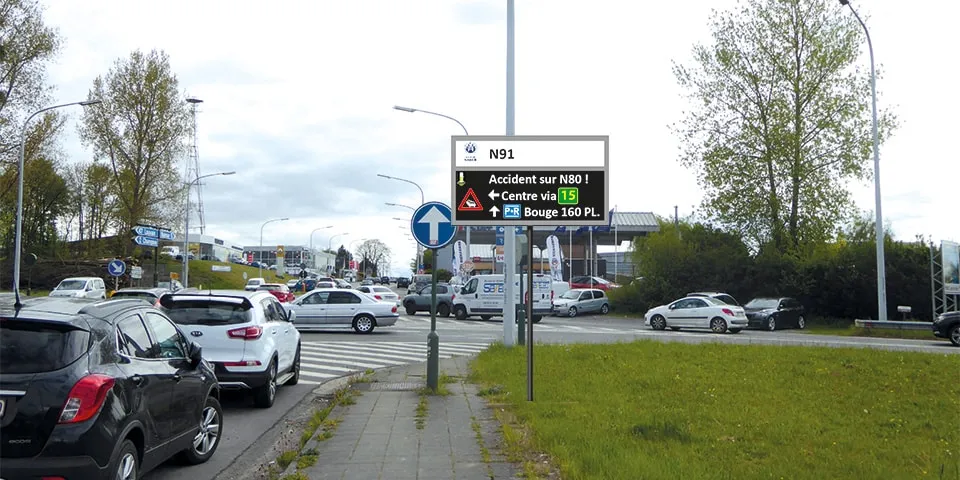
The consortium formed by ENGIE Fabricom and Macq, with Tractebel as engineering consultant, has won the contract launched by the City of Namur to equip it with an Intelligent Transport System (ITS, see the article on Namur’s mobility strategy on the previous pages). The aim? To improve accessibility and promote multimodality, making everyday life easier for the citizens of the Walloon capital and its visitors. Due to launch in September 2019, this ambitious and innovative project is set to be a first for Wallonia, if not for Belgium! We wanted to find out what the system consists of and how it works, so we spoke to the various technical partners involved in the project.
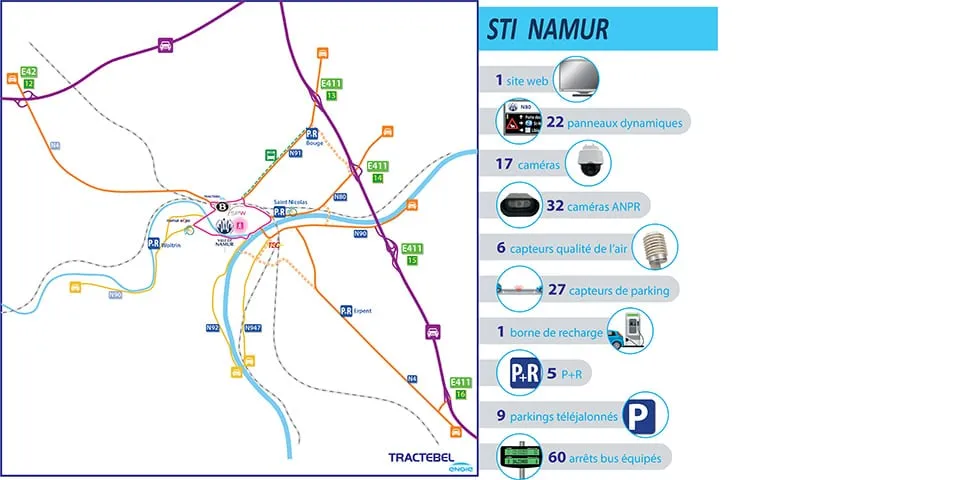
Components of the system as set out in the tender submission.
Such a system first requires the installation of ANPR cameras (for number plate recognition, primarily to count vehicles and calculate journey times), supplemented by surveillance cameras and sensors (to measure air quality, check parking space availability, and so on) at strategic locations around the city. In addition to further data supplied by third parties (bus waiting times, shared bicycle availability, and so on), all this information is then processed by a centralised management system (M³, developed by Macq) and finally made available to users in real time via dynamic signs and a website accessible on smartphones. Among other things, this intelligent transport system will enable residents of Namur and visitors to choose the best route, check parking availability, get a clear picture of the various transport options available and combine them. This multimodality will reduce traffic in the city and thereby limit pollution. }
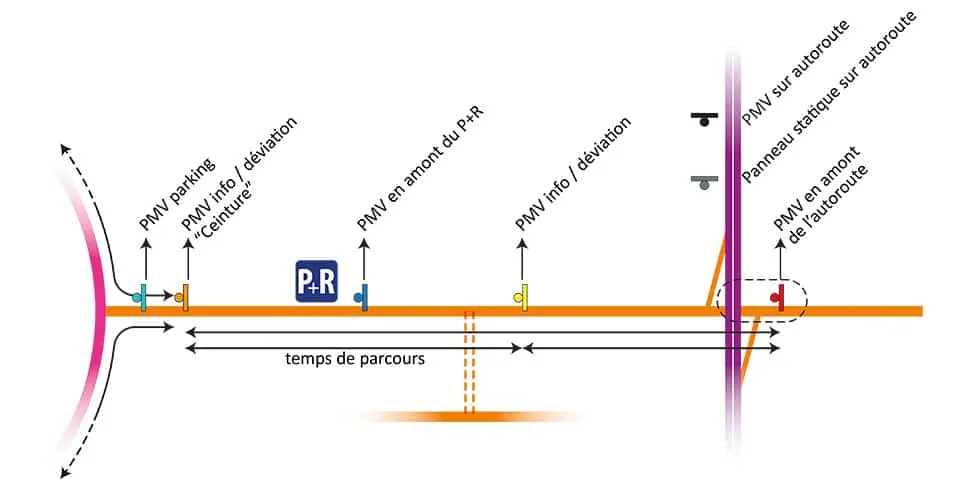
Overall strategy for installing signs on a route from the motorway to the city centre.
Much more than traffic information
“Drawing on the wealth of data available to the City of Namur (the municipal mobility plan, feasibility studies for park-and-ride facilities (P+R), a preliminary feasibility study for an ITS with strategic sign locations, and so on)
which we examined in greater depth and verified on site, we developed a mobility strategy aligned with that of the City of Namur, with an emphasis on multimodality. This means having the choice of taking the most suitable mode of transport and switching between modes to reach your destination. The signs are not just there to ease traffic flow, but also to make people aware that alternatives to the car are available for reaching the centre of Namur,” explains Gauthier Blieck, Consultant Mobility at Tractebel.
From the motorway, road users will be guided by a series of strategically positioned dynamic and static signs. Near the city centre and on the main routes into Namur, a network of ANPR cameras will calculate journey times, which will then be displayed on variable message signs further along the route. Drivers will thus be able to choose their route according to traffic conditions, change route or switch to another mode of transport. These ANPR cameras could also be used to implement other strategies, such as introducing a restricted traffic zone (ZTL), similar to the low-emission zone in Brussels.
Gauthier Blieck: “We chose the type of equipment to install according to its location. Each equipment location was selected by balancing mobility, technical, urban-planning and physical constraints, in consultation with ENGIE Fabricom. Most of the signs on routes into the city centre are 2 metres wide, while those installed in the city centre are smaller (1.5 metres wide) and square, to ensure they fit well into the urban environment. All the signs are full-matrix colour displays, which means they can show ‘whatever we want’: colour logos, a simplified diagram of the central boulevards showing traffic density in the same way as on Google Maps, as is already done in the Netherlands. We want to avoid displaying too much text on the signs, so drivers can read them easily. ENGIE Fabricom carried out the detailed design and is responsible for supplying and installing the equipment, connecting it to SOFICO’s existing fibre-optic network, and maintaining it for 4 years.”
Matthieu Trenchant, Department Manager Infra at Fabricom: “Our knowledge of the SOFICO fibre-optic network route and the available electricity connection options enabled us to optimise the sign locations with Tractebel, keeping costs down and avoiding the need to dig long trenches that would cause disruption for local residents.”
Gauthier Blieck: “The signs will show journey times along the route, parking availability at both park-and-ride facilities and car parks in the city centre, shared bicycle availability, congestion, accidents and other incidents. Most of the time, the system will operate automatically, based on data collected in real time. There is also a calendar mode for recurring events such as the Fêtes de Wallonie, and a manual mode that allows a specially trained municipal official to take control in the event of an unforeseen exceptional situation. When there is no specific event, multimodality will be prioritised. In the event of an incident, such as an accident on a route, the first line of the sign will provide information about it. The second line will show the suggested alternative, with multimodality then appearing in 3rd place.”
Changing people’s attitudes takes a long time. According to Gauthier Blieck, the City of Namur is one of the Walloon cities making the greatest efforts on mobility through innovation. “For another project in Mons, we drew inspiration, among other things, from what Namur has done for buses: intelligent traffic lights, dedicated lanes, hybrid buses, and so on. Other cities of a similar size or smaller have told us they are interested in this system as a way of improving citizens’ quality of life. We could support them with its implementation.”
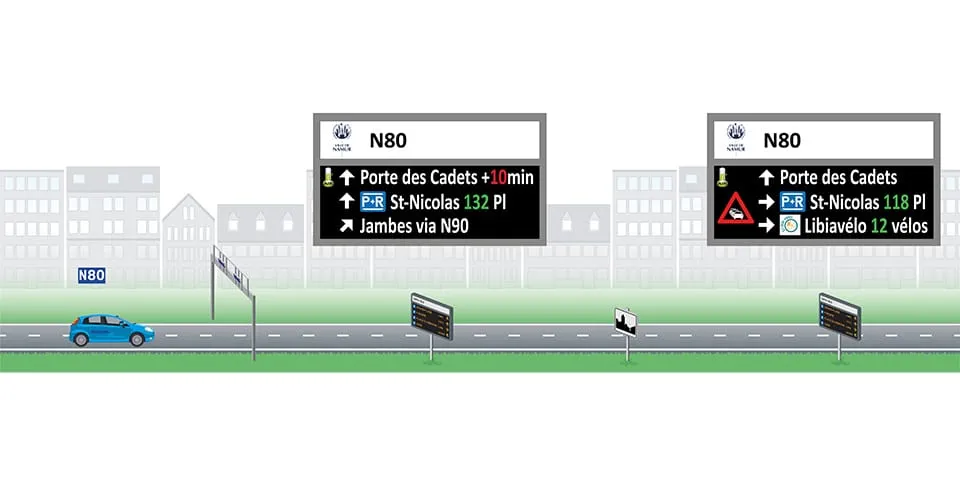
Examples of displays on a route leading to the city centre.
Bringing together a wealth of data from different sources
For Alain Dagonnier, Account Manager M3 at Macq, who is responsible for the software side of the project, the challenge is to integrate a whole range of information from third parties: available shared bicycles (JC Decaux), bus waiting times (TEC), floating car data (Google), taxi and parking availability, and so on. The system’s credibility depends on the quality of this data and its reliability over time. Data collected by the cameras and sensors alone is not enough to cover the full range of mobility options.
Alain Dagonnier: “I’m not concerned about the volume or scale. For over a year, we have been managing data with M3 for the low-emission zone in the Brussels Region, where there are far more cameras than in Namur. Many applications already display available parking spaces on signs. M3’s strength lies in bringing all the mobility alternatives together on a website. Only the traffic management component, reserved for the manager at the City of Namur, has a dedicated application. For the public, everything is displayed via the website, whether on a smartphone or computer.”
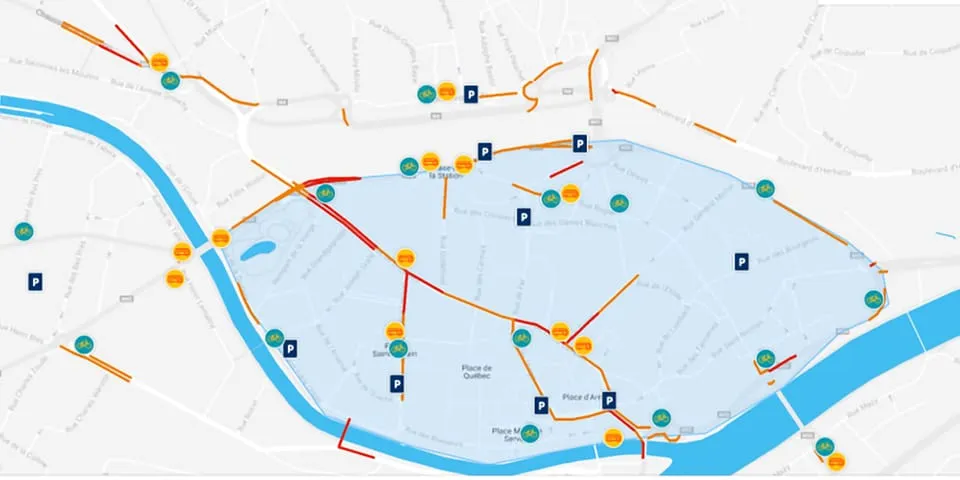
Real-time visualisation on the website.
Matthieu Trenchant (Fabricom): “Variable message signs, sensors of all kinds, cameras, cabling, and so on: there is nothing particularly new for us about the techniques involved in this project. What is new is that this is the first time we have tried to interconnect everything to promote multimodality. We hear a lot about the energy transition, but the mobility transition is also under way. Combined with the digital revolution, it is giving rise to ITS 4.0, a market with a bright future.”
This ambitious and innovative project was made possible with financial support from Wallonia and the EU (ERDF 2014-2020 Programme) and through partnerships with all the mobility stakeholders (TEC, Perex, SPW-Direction des Routes, Police, SOFICO and AWaC).
Question about this story? Ask your question
Keep following this
Get an email when a new story is published. No account needed.
- SubjectNews







