











Access control: the age of smartphones and predictive maintenance

This has helped drive the development and sale of a range of contactless systems, often with the option to count entries and exits. Today, access control is mobile, can be managed remotely and no longer requires dedicated items such as keys, cards or fobs. Predictive maintenance, meanwhile, is increasingly finding its place alongside preventive maintenance.
Beyond the legitimate questions around site security and the resulting handling of data, access control can sometimes be seen simply as a convenience in everyday life. Apartment buildings (holiday lets, airBnB, …), co-working spaces, schools, gyms, shops… wherever a manager, who need not be on site, can grant remote access to a room or building without any ‘face-to-face meeting’ or handing over keys or fobs.
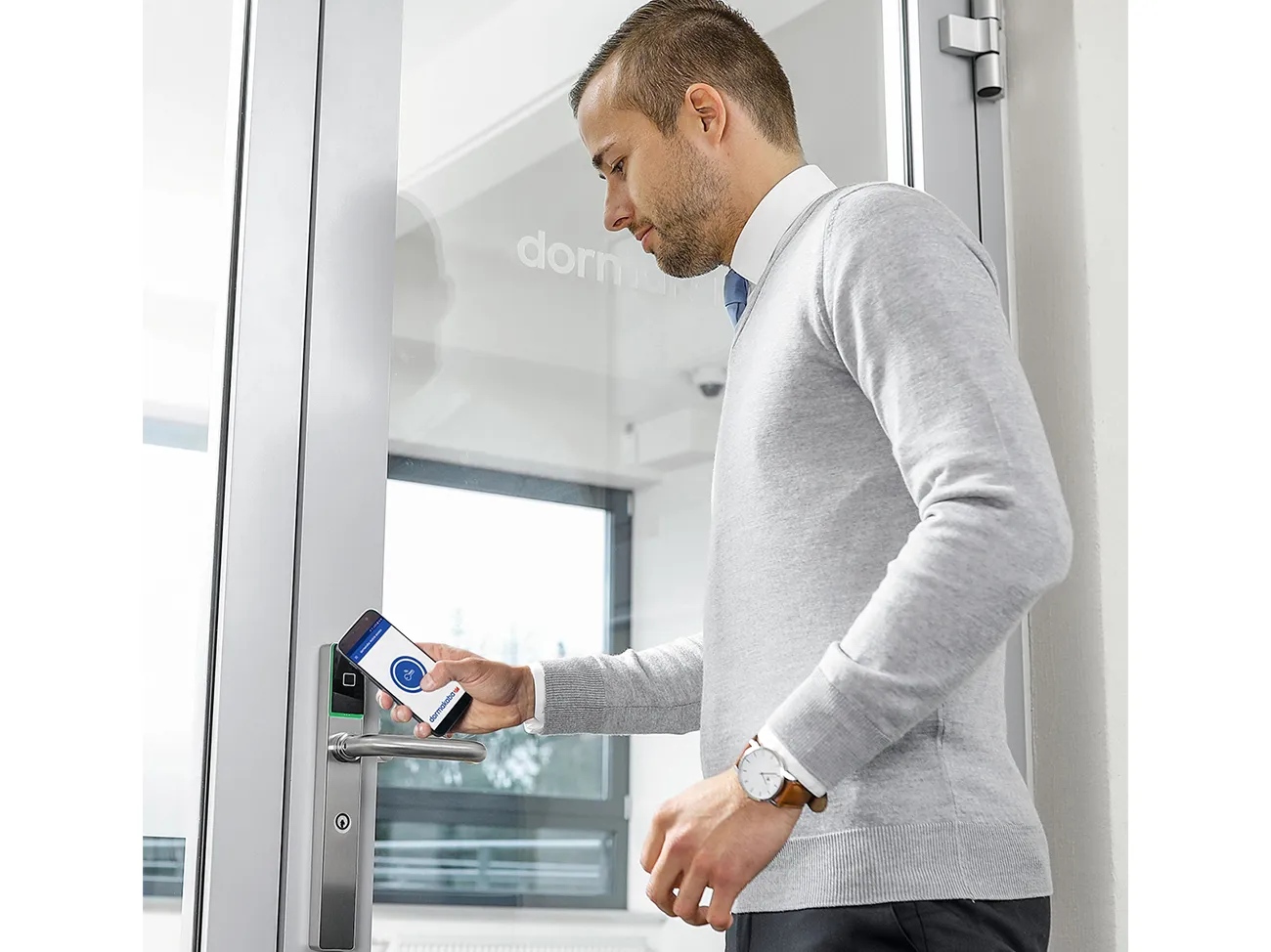
The growing role of smartphones
Many businesses now recognise the potential of smartphones for access control, replacing traditional keys, cards and fobs. According to research conducted by Gartner in 2019, 20% of businesses expected to adopt smartphones in the near future instead of traditional physical access cards. “In addition, IHS Markit estimates that almost 20% of the access control readers currently installed will be mobile-compatible by 2022,” says the blog of Dormakaba, a company with more than 150 years’ experience in security and access control. But this change is happening very gradually, as Paul Studerus, Vice-President of the ‘Strategic Innovation’ division, explains: “Digital solutions will not completely replace older technologies within a reasonable timeframe. In reality, mechanical, electronic and cloud-based access control solutions will coexist.”
The benefits of smartphones include built-in convenience, greater security and control, and improved flexibility. With smartphones, there is no longer any need to regularly activate or deactivate access keys and fobs, or replace them if they are lost or damaged. Combining smartphone data with digital and/or biometric data also increases the level of security for access and identification.

Artificial intelligence and predictive maintenance
As access control becomes increasingly digital, system maintenance is taking on greater importance. Alongside ‘traditional’ preventive maintenance, predictive maintenance is now emerging, carried out ‘in advance’. At Dormakaba, it is believed that, thanks to artificial intelligence (AI) and the Internet of Things (IoT), this new maintenance approach strengthens the effort to limit the risk of breakdowns and failures and improve the performance of access control systems, while making these goals easier to achieve. Predictive maintenance makes it possible to “collect, analyse and use data from various sources in manufacturing, such as machines, sensors or switches. Intelligent algorithms help technicians identify any risk of errors or failures before they occur.” Prevention is better than cure, then …
With the use of smartphones and the introduction of predictive maintenance, the focus is now increasingly on simplicity and anticipation. Leonardo da Vinci had already foreseen this when he said that ‘simplicity is the ultimate sophistication’.
Question about this story? Ask your question
Keep following this
Get an email when a new story is published. No account needed.
- ThemeBuilding and site safety and security
- SubjectNews







