











A new direction for CSTC and CRR!
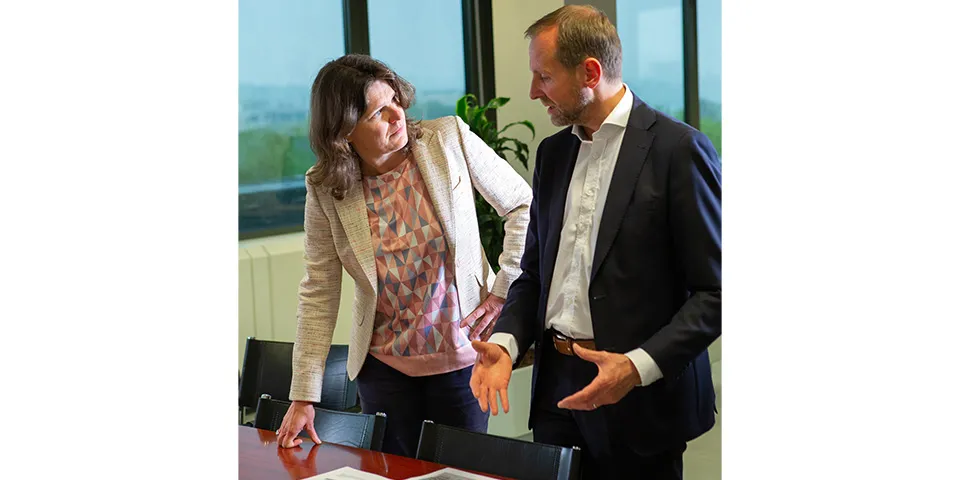
The Centre scientifique et technique de la construction (CSTC) and the Centre de recherches routières (CRR) have, in a rare occurrence, appointed two new directors general. This is an opportunity not to be missed to take stock of these two centres, their strategies and their visions for the coming years. We meet Annick De Swaef and Olivier Vandooren, Director General of the CRR and Director General of the CSTC respectively.
After a year at the helm of the Centre de recherches routières, how do you see the future of the road sector?
Annick De Swaef: The Centre de recherches routières was founded in 1952 under the De Groote Act. Its mission was to promote technical progress in road construction through scientific research and by providing documentation and information. In a constantly evolving society, the need for research to address today’s and tomorrow’s challenges remains immense.
The CRR must therefore anticipate new trends and social developments, as well as the expectations and needs of road contractors, road authorities and all types of road users, vehicles and infrastructure. To this end, quality, sustainable road construction, sustainable mobility and safety have long been key areas of focus in our projects and activities.
Digitalisation is another current concern, both for the Centre and for the road construction sector as a whole. Let’s set off together towards the CRR’s 100th anniversary!
Can we also expect new challenges and major changes at the CSTC?
Olivier Vandooren: Although the CSTC is younger than the CRR and is celebrating its 60th anniversary this year, we share the same missions and enthusiasm. As the sector’s research and innovation centre, we bridge the gap between fundamental research and practice on site. To help companies seize the opportunities presented by the transformation currently taking place in the construction sector, we are launching an action plan with 5 priorities, forming a kind of agreement between the CSTC and its members. So it was only natural to call it “Give Me Five”.
How do you stay in touch with contractors and public authorities?
Annick De Swaef: At the CRR, our contacts operate on two levels. Our statutory bodies, Technical Committees and Programme Committee include representatives of contractors, road authorities and other road-sector stakeholders. Our current president is ir Tom Roelants, Administrator General of the Agentschap Wegen en Verkeer (AWV). We also work closely with Confédération Construction and the sector federations (FBEV, FWEV, VlaWeBo), which are valued partners.
We also prioritise direct contact on site and close links with the road community through our services, particularly our technical support and training, and our three offices, one in each Region.
Olivier Vandooren: As with the CRR, the CSTC’s statutory bodies and Technical Committees comprise construction contractors and professionals. The CSTC is currently chaired by Johan Willemen of Willemen Groep.
At the CSTC, our 260 employees ensure that the findings of the Centre’s scientific and technical research benefit construction contractors, as well as other sector professionals. The experience and pragmatism of some, combined with the innovative spirit of others, enable us to publish practical guides, provide tailored technical advice by visiting sites, and organise courses and training that meet the sector’s real needs. Our website is the cornerstone of the CSTC’s digital communications strategy.
But the CSTC’s strength also lies in its many networks. The structural partnerships it has built with sector organisations, and particularly with Confédération Construction and the Trade Federations, are now essential to carrying out our work.
Is it still possible to take an SME-focused approach?
Annick De Swaef: The CRR works for all road construction companies, whatever their size. Despite the sector’s growth in scale at every level, road construction is and will remain predominantly an SME sector. In fact, around 85% of companies are SMEs.
Because of their size, SMEs do not always have the financial and human resources to conduct research, and they have specific needs in terms of training, support and more. However, they too need to be able to develop, ensure optimum quality and maintain, or even strengthen, their position. A targeted approach is therefore essential, and we devote considerable care and attention to this.
Olivier Vandooren: The CSTC serves all contractors, who should be able to find the support they need, whatever the size of their company or their area of activity. Craftspeople and SMEs are naturally a particular focus for us: they account for 70 % of CSTC members and around half of the construction sector’s employees. This is why small and large companies make almost equal use of the direct, personalised support service provided by the engineers of the Technical Advice department.
Are the two sectors experiencing digitalisation in the same way?
Annick De Swaef: The CRR is fully committed to digitalising its internal processes and operations. We have developed an IT Roadmap with several priority projects. We are also implementing, or taking part in, digitalisation projects for the benefit of the sector. One example is the “URBANWISE Construction” project: a prototype IT platform developed to optimise communication and the planning of deliveries in city centres, as well as the supply of building and road construction sites.
At Digital Construction Brussels 2018, we also launched the
“Digi-Barometer” project. This initiative aims to measure digital maturity and progress. At the 2019 edition, the results were presented and appropriate actions were set out. The CRR will also lead the CSTC “BIM for infrastructure” working group.
Olivier Vandooren: Since the early days of computing, the CSTC has developed numerous tools and services to promote and support digitalisation in the sector. This process is now accelerating with the fourth industrial revolution and the adoption of BIM. In Belgium, the sector took the initiative by setting up the BIM&ICT Technical Committee in 2016. In a unique move in Europe, this sector committee immediately chose to bring together representatives of all professions. Working with the CSTC, these professionals have spared no effort in delivering the first reference documents as quickly as possible. Belgium has thus caught up with neighbouring countries and even pulled ahead in some areas. But we are still only at the beginning of the journey…
BIM is first and foremost a collaborative tool. BIM on its own does not work. Our focus today is therefore on how best to support all stakeholders in developing their digital skills, including craftspeople and subcontractors. Without revisiting the many initiatives launched, often in collaboration with Confédération Construction, we are working in particular to establish two Demonstration Centres dedicated to Construction 4.0 and to develop a BIM ecosystem called “BIMio”. This online ecosystem will make it easier to exchange information from a digital model by providing each trade with the relevant data. For example, extracting quantity data would make it easier for subcontractors to prepare quotations, while also reducing the number of potential errors.
INFO: www.cstc.be, www.crr.be
Question about this story? Ask your question
Keep following this
Get an email when a new story is published. No account needed.
- ThemeTransforming infrastructure and territories
- SubjectNews







