Mercedes-Benz eActros 600’s high level of passive safety confirmed in crash tests
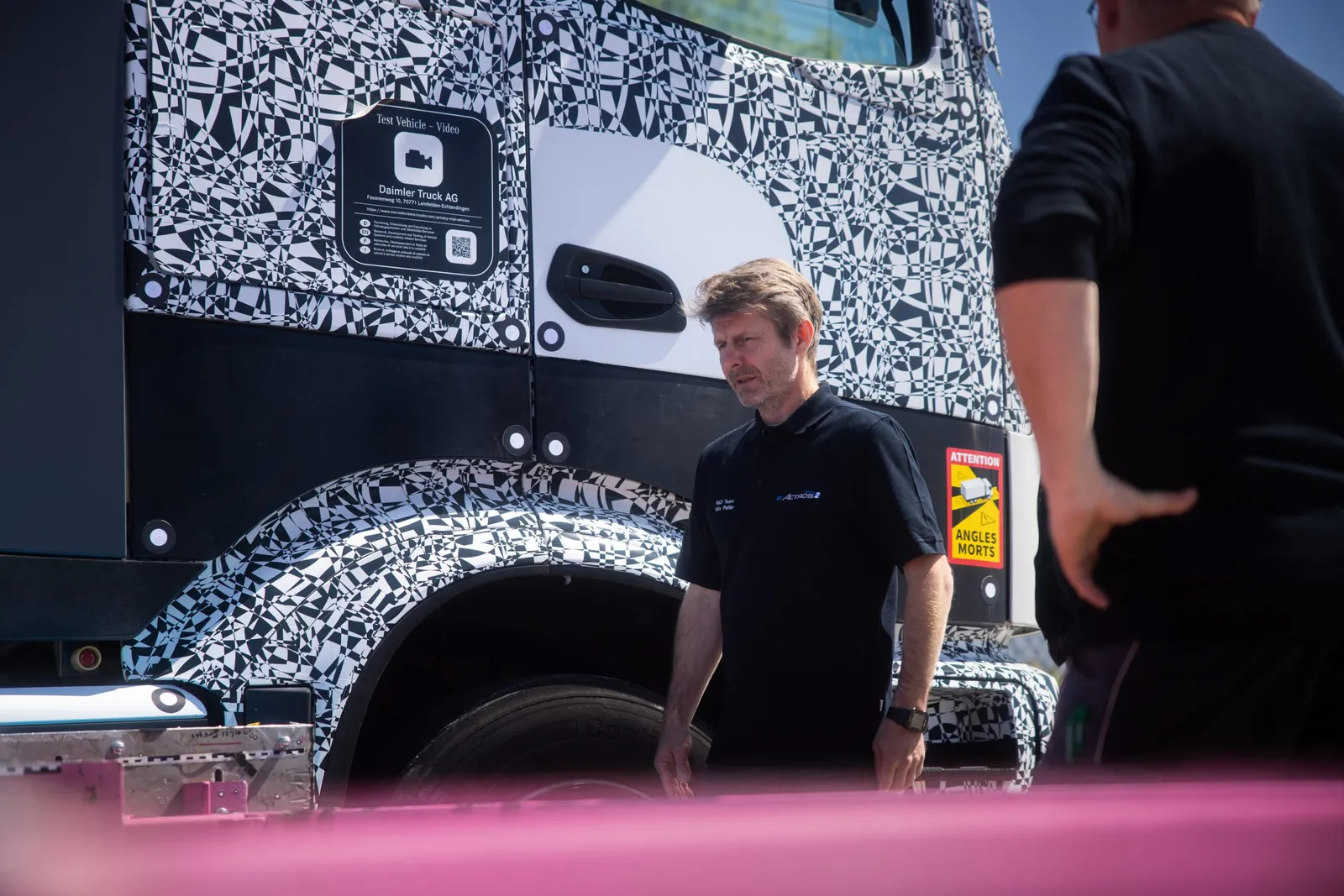
The battery-electric Mercedes-Benz eActros 600 for long-haul transport combines efficiency and sustainability with the highest standards of active and passive safety. From the very start of the development phase, Mercedes-Benz Trucks’ in-house accident research team assessed existing data on real-world accidents and applied it specifically to the vehicle’s design features. The aim was to systematically tailor protective measures to typical accident scenarios involving heavy goods vehicles.
- A comprehensive safety concept provides enhanced protection for drivers, the surrounding area and emergency services
- Real-world crash tests confirm structural stability and battery integrity
- Accident research is integrated from the earliest stages of development
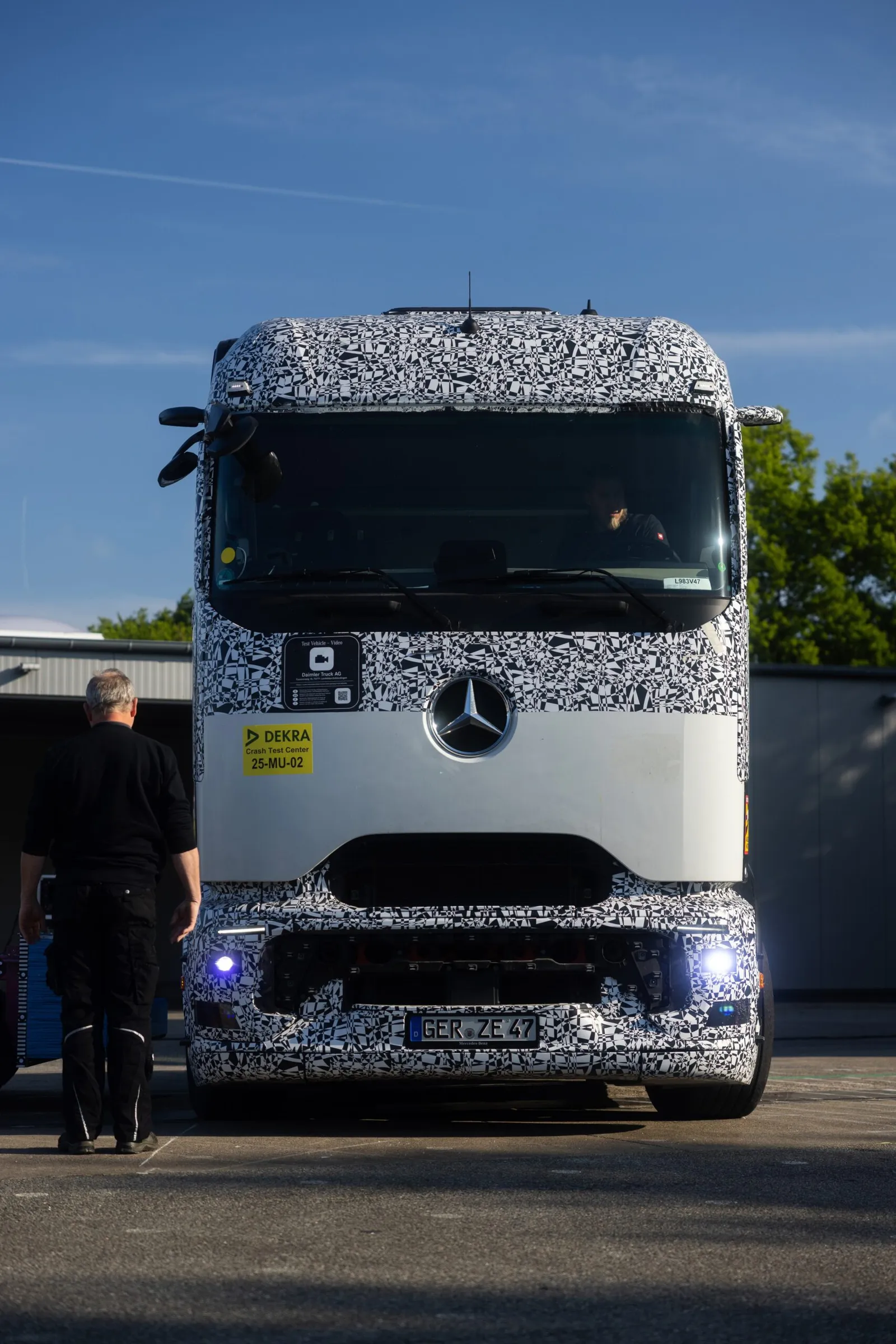
As part of a series of real-world crash tests in Neumünster, in the state of Schleswig-Holstein, the eActros 600 was subjected to a side impact of the kind that can occur in serious road accidents. Test result: despite the considerable force involved, the entire high-voltage battery system and all electrical components remained intact.
“Our aim from the outset was to make no compromises when it came to vehicle safety,” explains Felix Pietler, passive safety developer at Mercedes-Benz Trucks. “With electric drive systems in particular, it is important not only to protect occupants, but also to take measures to safeguard the immediate surroundings.”
A comprehensive crash concept ensures a survival space in extreme conditions
The reinforced cab and defined energy-absorbing zones at the front of the vehicle channel impact forces in a controlled way in a frontal collision, thanks to crash-optimised structures. In side-impact scenarios, the latest test confirmed that the high-voltage battery modules remained intact and the casing suffered no critical deformation, thanks to a chassis architecture specifically developed for heavy-duty crash scenarios. Airbag systems and seatbelt pretensioners are also available to enhance occupant protection across all vehicle variants. Frank Müller, Head of Accident Research and Passive Safety at Mercedes-Benz Trucks, adds: “The test showed that the mechanical stresses were high, but our concept works reliably.”
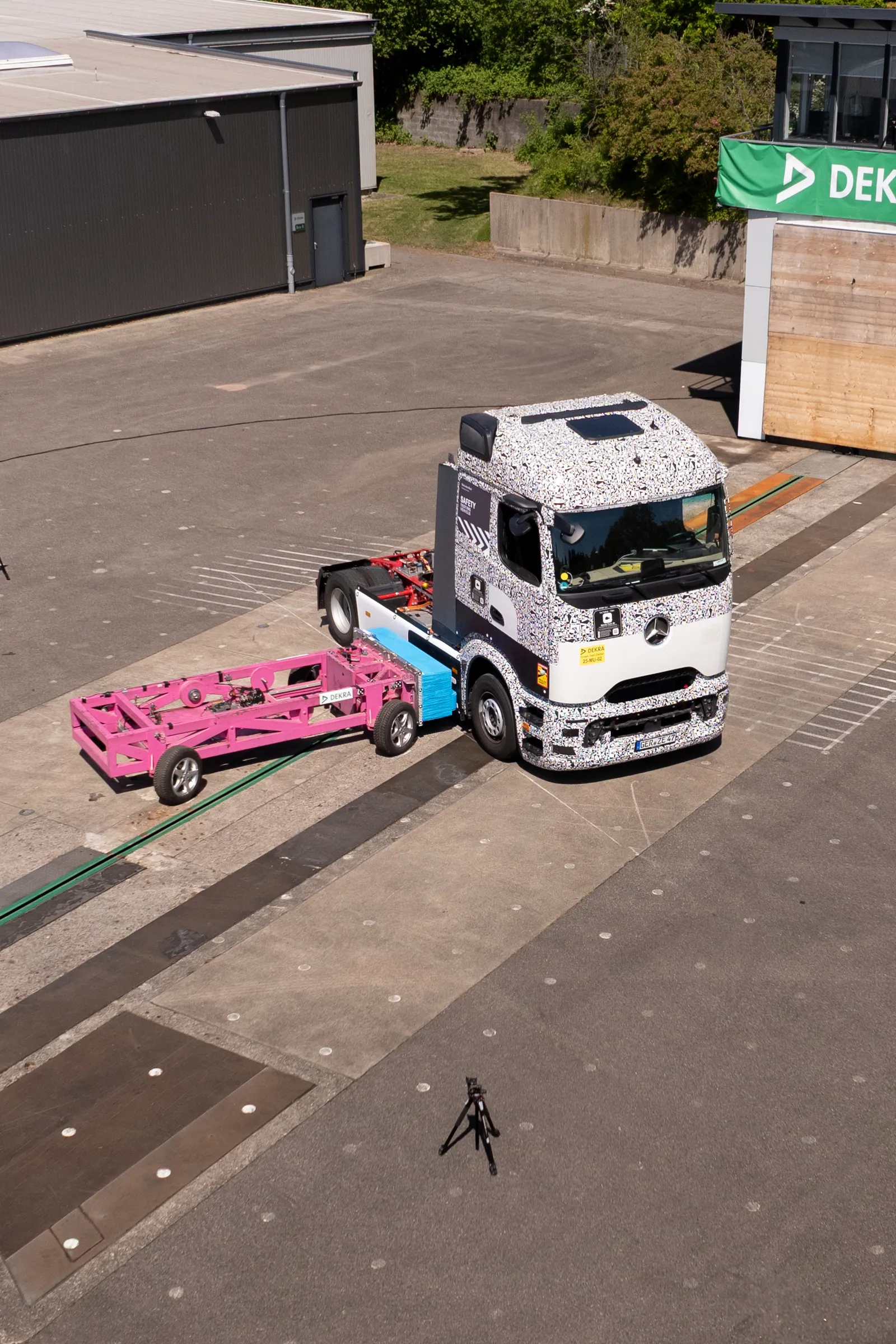
A behind-the-scenes look at a special test
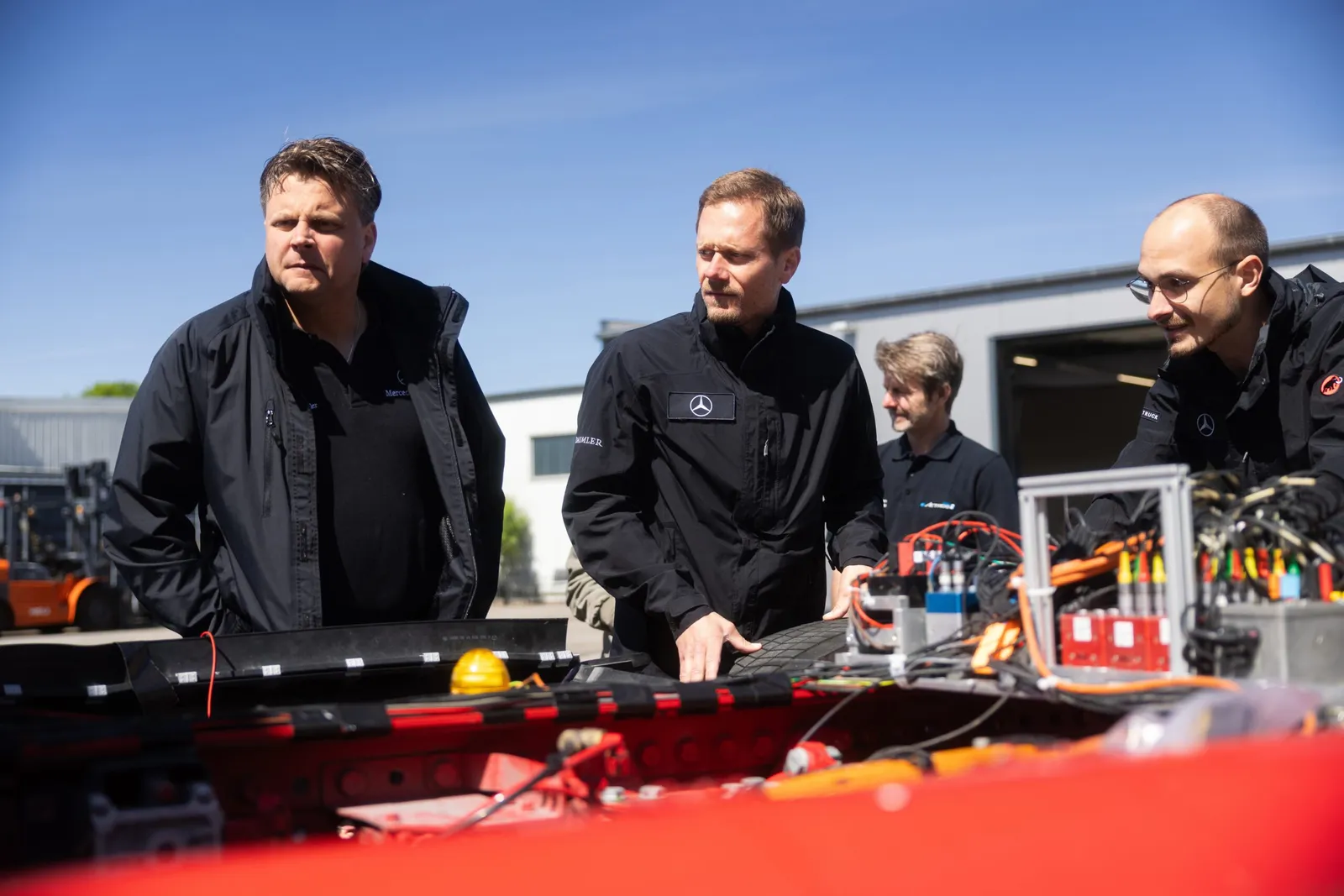
Before the test, simulation-based analyses were carried out, and sensors were installed and precisely calibrated. Each component was carefully adapted to the test scenario.
“For me, the last two or three minutes before the collision are particularly fascinating,” says Christoph Berger, a member of the Passive Safety team, describing the moment before the test sequence is triggered. “Everything becomes quieter than before, and there is a sense of focused tension in the air.” On impact, more than a tonne of mass strikes the side of the truck at a speed of over 50 km/h.
High-voltage system designed with safety in mind
The high-voltage (HV) system, including the batteries, meets strict in-house requirements for insulation technology, mechanical protection and fire-protection components, helping to reduce potential risks following major damage. Production vehicles therefore meet all applicable statutory standards, as well as make-specific test criteria that go well beyond regulatory requirements.
After each physical test, specialised emergency services first carry out a safety clearance. Only then does the detailed dismantling of the core components begin, so that damage can be analysed against the simulation data. Müller concludes: “The results clearly confirm our expectations. There would have been no danger in a real-world situation.”
Why do testing continue even after series production has begun?
Mercedes-Benz Trucks regularly carries out physical tests, even when a model is already in production, to make continuous improvements. New findings from data gathered in the field are continually fed back into the product range. This ensures that technological developments can be implemented quickly, legislative changes are met and new customer requirements are taken into account.
With this approach, Mercedes-Benz Trucks continues to pursue its Vision Zero goals relentlessly, aiming for maximum road safety for both conventional heavy goods vehicles and battery-electric heavy goods vehicles in Europe.
Additional active assistance systems (1) :
The Mercedes-Benz eActros 600 not only marks a milestone in zero-emission long-haul transport, but also impresses with its modern safety and assistance systems. These include Active Brake Assist 6 with 270-degree environmental monitoring, which can detect potentially dangerous situations and bring the vehicle to a standstill autonomously if necessary, and Active Sideguard Assist 2, which can effectively assist the driver, particularly when turning and changing lanes. Front Guard Assist monitors the area directly in front of the truck, providing additional protection for pedestrians and cyclists. Active Drive Assist 3 enables semi-automated driving on motorways, easing the driver’s workload on long journeys, while Attention Assist 2 can issue warnings if the driver is inattentive or tired.
The Mercedes-Benz eActros 600 is very quiet on the road, benefiting both drivers and the environment. To ensure that vulnerable road users, such as pedestrians and cyclists, can still hear the electric truck when it is nearby, it is equipped with an external acoustic vehicle alerting system (AVAS) that complies with legal requirements. Depending on the driving conditions, sounds are emitted when travelling forwards or in reverse. The sound also varies according to driving speed and accelerator pedal position, ensuring good acoustic awareness in urban traffic. The futuristic sound profile of the AVAS fitted to the eActros 600 is designed to reflect the appearance of a heavy goods vehicle and help make it more recognisable in urban traffic.
About the eActros 600
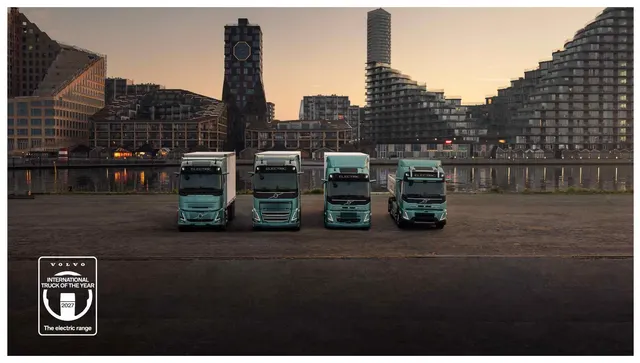
Mercedes-Benz Trucks began series production of the eActros 600 at the Mercedes-Benz plant in Wörth at the end of November last year. Customer deliveries began in December 2024. Mercedes-Benz Trucks’ electric flagship has already demonstrated its capabilities several times in real-world conditions: in customer operations, during the “eActros 600 European Testing Tour 2024”, a fully electric development tour covering 15 000 kilometres across 22 countries, and on the “European Testing Tour Winter 2025”, a journey of around 6 500 kilometres through Northern Europe. Each tour was completed with a gross combination weight of 40 tonnes. The electric truck was also named “International Truck of the Year 2025”. This is the industry’s most important award and is presented each year by the International Truck of the Year (IToY) organisation, which is made up of 24 commercial vehicle journalists from across Europe.
With its high-capacity battery of more than 600 kilowatt-hours, which gives the 600 model its designation, and a particularly efficient new electric drive axle developed in-house, the eActros 600 has a range of 500 kilometres (2) without intermediate charging. This range is achieved under very realistic, practical conditions with a gross combination weight of 40 tonnes, and can be significantly exceeded depending on driving style and route. The eActros 600 can even cover well over 1 000 kilometres a day. Intermediate charging during the driver’s statutory breaks makes this possible, provided charging options are available.
The eActros 600 has three battery packs, each with a capacity of 207 kWh (3). Together, these provide a total installed capacity of 621 kWh. The batteries use lithium iron phosphate (LFP) cell technology and are characterised by a long service life. Mercedes-Benz Trucks’ development engineers designed the eActros 600 to meet the same durability requirements for vehicles and components as a comparable conventional Actros for long-haul transport. This means up to 1.2 million kilometres over ten years of operation. After this period of use, the battery is expected to retain a state of health of more than 80 %. Unlike other battery cell technologies, more than 95 % of the installed capacity can also be used with LFP technology. This delivers a longer range with the same installed battery capacity. The vehicle is technically designed for a maximum gross vehicle weight of 44 tonnes. With a standard semi-trailer, the eActros 600 has a payload of around 22 tonnes in the EU. In some cases, national legislation may allow higher payloads.
To better meet its customers’ needs, Mercedes-Benz Trucks has recently expanded its range of battery-electric trucks with new variants based on the Mercedes-Benz eActros 600. Depending on their requirements for range, payload and comfort, customers will be able to choose between two cab variants, two or three battery packs (2 on eActros 400 versions, 3 on eActros 600 versions), a range of wheelbases and new axle configurations. The second-generation eActros model therefore offers more than 40 variants of the basic vehicle. The new vehicle versions feature key characteristics of the eActros 600, such as LFP battery technology and the specially developed electric axle.
Question about this story? Ask your question
Keep following this
Get an email when a new story is published. No account needed.
- ThemeLow-carbon transport and mobility
- SubjectEquipment and machinery