Group-GTS takes delivery of six Volvo Trucks running on LNG
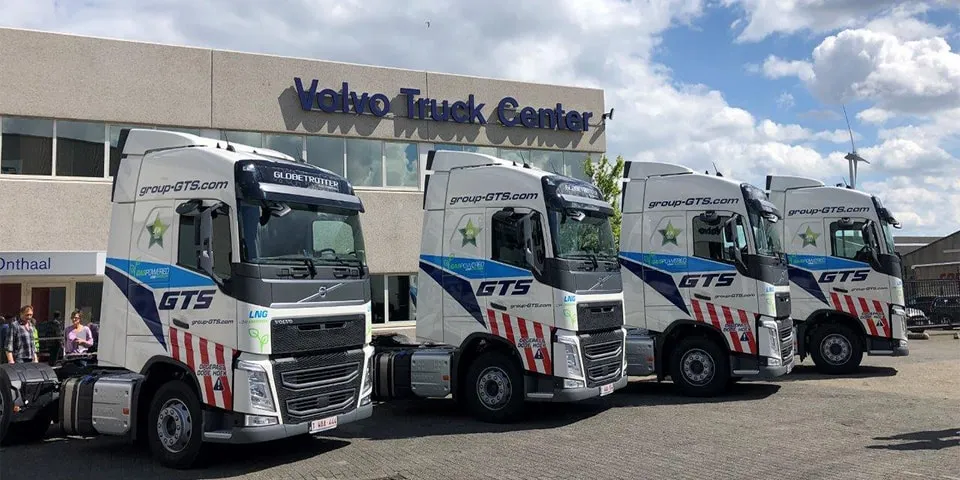
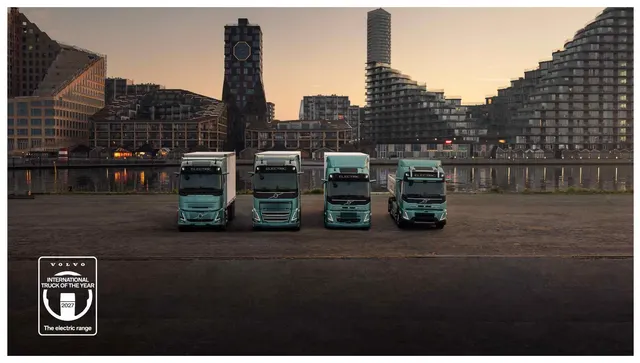
GTS Group is also convinced of the environmental and economic potential of Volvo natural gas trucks. The Tessenderlo-based group has just taken delivery of six FH LNGs. They will be used on domestic and international shuttle routes. Ben Geybels, head of Group-GTS, expects to place another order by the end of the year.
The keys to the six 460 hp FH LNGs were handed over at the end of April by Stijn Van den Bulck, account manager at Volvo Trucks Center in Olen. “This purchase by Group-GTS is a considered decision. Diesel is becoming increasingly expensive, the FH LNGs consume significantly less fuel, and more and more customers are asking their transport providers to reduce their carbon footprint. But it was above all the favourable TCO that convinced them,” he says.
Ben Geybels confirms this: “We carried out extensive tests and, together with our fleet manager, calculated that there is a genuine ‘business case’. However, a number of conditions have to be met. The trucks need to cover 130,000 kilometres a year and must be used on fixed shuttle routes, as the LNG filling station network is still too limited.”
Four of the six FH LNGs will be used for distribution in Belgium. “They will mainly transport construction materials and products for the mechanical engineering industry. The other two will mainly shuttle between Belgium and the Ruhr region,” explains Ben Geybels. He points out that the benefit of the Maut exemption in Germany is a bonus, but was not a decisive factor. “We don’t want this investment to depend on subsidies. Nor on marketing arguments, for that matter. We believe that, under current conditions, LNG is the best alternative to diesel for long-distance transport.”
Reducing CO2 emissions
“More and more customers have a climate policy and are asking us to reduce CO2 emissions. However, most of them are not prepared to pay more for their transport. We know that if we cover the planned distances, LNG will be cheaper than diesel. It also has a significantly lower environmental impact, both in terms of CO2 and noise, while delivering the same driving performance. The tests confirmed this,” says Ben Geybels.
Taking things step by step
That is why he is considering placing another order at the end of this year. “But we won’t rush into this. We don’t want to skip any steps. First, we want to collect more data and identify which transport operations are suitable. This decision will be based, among other things, on the LNG stations available along the planned routes,” he adds.
Group-GTS is headquartered in Tessenderlo and has another site in Kallo. An LNG refuelling point is already available in Kallo, and another will open in Tessenderlo in June. In both cases, the cost of detours will therefore be almost zero.
Appropriate signage
To highlight that the FH LNGs emit less CO2, the striping on the tractor units’ cabs has been supplemented with the words ‘Gas Powered, Low Emission’. “And because Group-GTS also attaches great importance to safety, we took the opportunity to add stickers warning vulnerable road users about blind spots,” concludes Ben Geybels.
Question about this story? Ask your question
Keep following this
Get an email when a new story is published. No account needed.
- ThemeLow-carbon transport and mobility
- SubjectEquipment and machinery