Forty years of the ‘Light Class’: the Mercedes-Benz Ecoliner
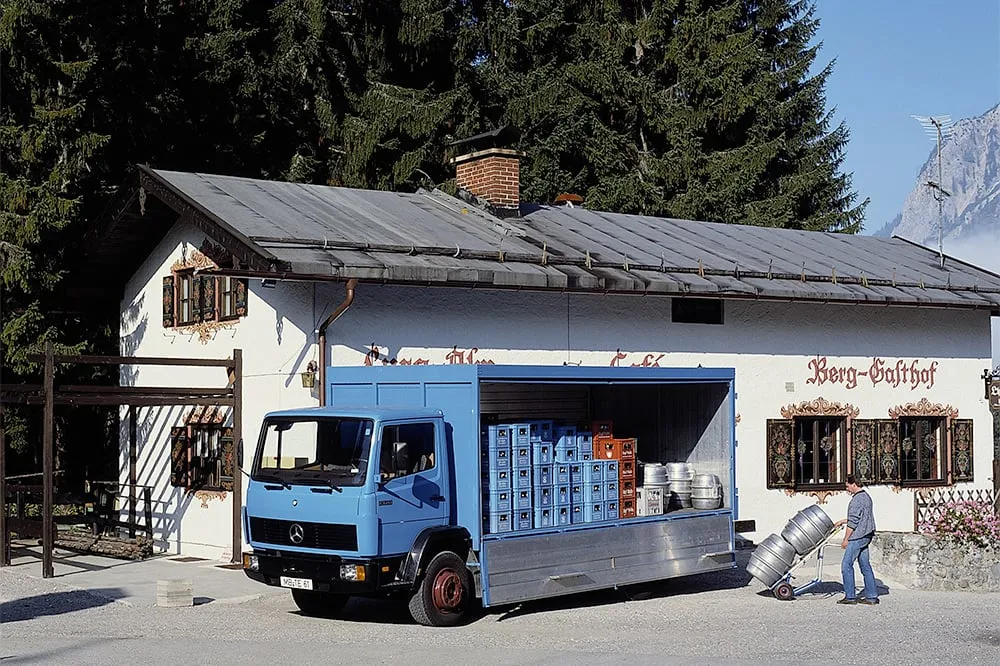
Forty years ago, following an international press launch in Rome, Mercedes-Benz LN2 trucks, better known as the Ecoliner, began to conquer the light truck segment. The trucks do not have an official name as such. Built between 1984 and 1998, they replaced the light LP, which had been the segment leader for almost 20 years. With the introduction of the LN2, light trucks also gained a bright, timeless tilting cab. They also anticipated some of the design of the heavy-duty range, the SK, introduced in 1988.
The ‘Light Class’ covered a wider range than its predecessors. With gross vehicle weights of 6.5 to 13 tonnes (models 709 to 1320, later even up to 1524), it overlapped at the lower end with the Düsseldorf Van/T2 segment and at the upper end with the Mercedes-Benz NG/SK. In addition to distribution and construction-site transport, the Mercedes-Benz LN2, with power outputs from 90 to 204 hp and, for the first time, a long-distance cab with a sleeper, met the growing demand for this class of vehicle in long-haul transport. From then on, Daimler-Benz’s truck range covered every application and weight category.
The Mercedes-Benz LN2 trucks were developed from the ground up. They offered greater active safety and a high level of driving comfort. The vehicles had body lengths comparable to those of the LP trucks, a shorter wheelbase and power steering as standard, making them more manoeuvrable. Technical progress was evident in every vehicle component, from the cab and powertrain to the chassis and brakes. For the first time, production trucks with a gross vehicle weight of 6.5 tonnes or more were equipped with full air brakes; Daimler-Benz’s anti-lock braking system could now also be fitted to light trucks. The four- and six-cylinder OM 364 and OM 366 engines in the light range were extensively developed to achieve high transport speeds as part of the powertrain optimisation process. Their origins can be traced to the OM 312, the forerunner of the 300 engine series dating back to 1949. Another innovation: for the first time in the design of commercial vehicles in the light class, Daimler-Benz opted for low-profile tyres, which were intended to contribute to safe handling in all conditions. The improved road behaviour included neutral cornering characteristics regardless of load, virtually no steering movements under braking or while steering, precise directional stability and minimal body roll.
When the new ‘Light Class’ trucks replaced the old light LP models in 1984, after almost 20 years of production, it marked a major step forward. Ranging from the 709 to the 1320 (later up to the 1524), the line-up included finely graduated weight and engine power variants. Four-wheel drive was also available. Despite comprehensive standard equipment, state-of-the-art technology down to the smallest detail and tilting cabs, the new models managed to improve on the proven high cost-effectiveness of the previous LP range: load volume and payload were increased, while fuel consumption and maintenance and repair costs were each reduced by 10%.
The most popular model in the LN2 series, a 7.5-tonne, 136 hp truck, the 814, is part of the Mercedes-Benz Trucks Classic Collection. Its tarpaulin bears the advertising slogan used when it was launched on the market. The vehicle will be on display in front of the Daimler Truck Campus in Leinfelden-Echterdingen until 15 May 2024.
Technical specifications of the truck on display: Mercedes-Benz LN2
| Year of manufacture | 1991 |
| Displacement | 5,958 cc |
| Power | 136 hp/100 kW |
| Speed | 90 km/h |
| Engine | OM366 six-cylinder diesel engine |
Question about this story? Ask your question
Keep following this
Get an email when a new story is published. No account needed.
- ThemeLow-carbon transport and mobility
- SubjectEquipment and machinery