Daimler Truck unveils the Mercedes-Benz NextGenH2 Truck, with limited-series production due to start in late 2026
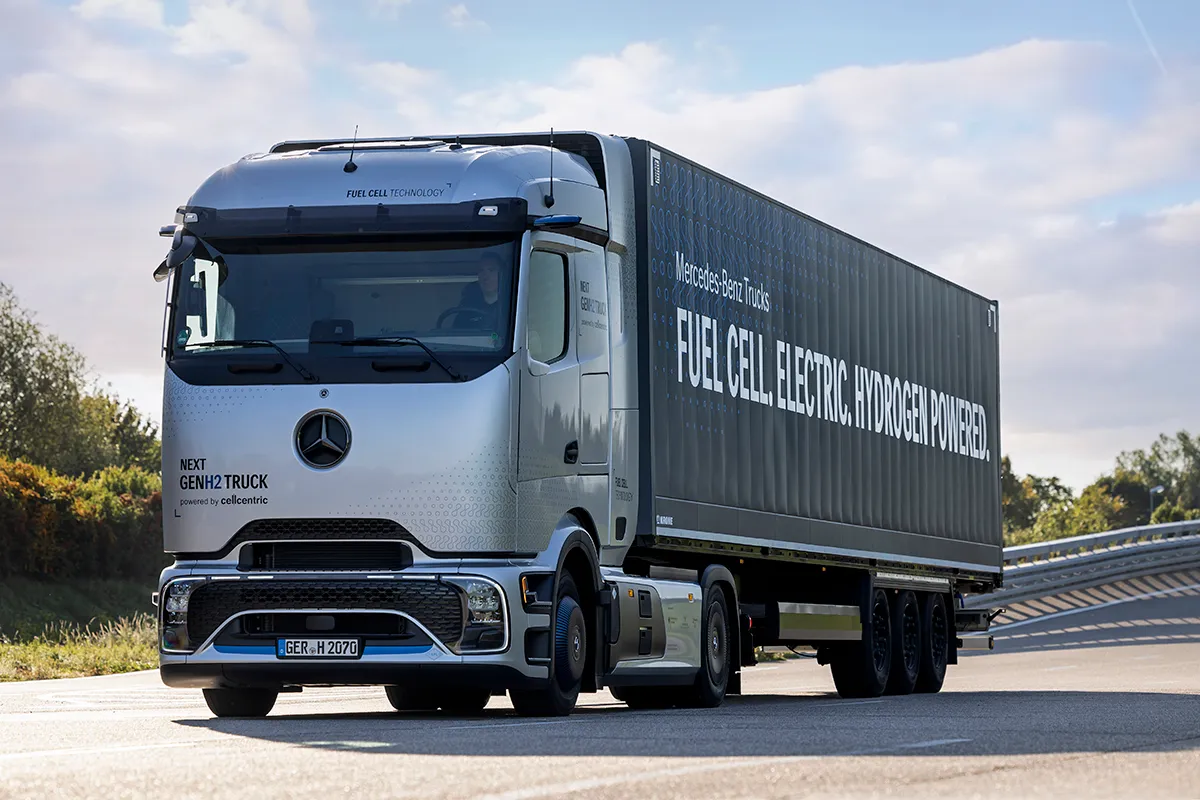
Following the successful development and testing programme for first-generation fuel-cell truck prototypes, Daimler Truck is unveiling the Mercedes-Benz NextGenH2 Truck. This fuel-cell truck marks another important step for Daimler Truck towards sustainable, hydrogen-powered transport. As part of a limited production run at the Mercedes-Benz plant in Wörth, 100 units of these advanced tractor units will be built and enter customer operations from late 2026.
- The Mercedes-Benz NextGenH2 marks the next step in developing hydrogen-powered road transport.
- A limited production run of 100 vehicles is expected to enter customer operations from late 2026
- Proven components, including the cellcentric fuel-cell system and liquid hydrogen technology, have been carried over from the first-generation Mercedes-Benz GenH2 Truck and further developed, alongside innovative safety solutions and a more compact layout that delivers greater customer value through improved trailer compatibility
- New to the NextGenH2 Truck: production-ready key components from the battery-electric Mercedes-Benz eActros 600, including the integrated e-axle, aerodynamically optimised ProCabin, Multimedia Cockpit Interactive 2 and the latest driver assistance systems.
- Achim Puchert, CEO of Mercedes-Benz Trucks: “Alongside battery-electric solutions, hydrogen powertrains are essential to the sustainable transformation of our industry. With the NextGenH2 Truck, we are taking another technological step forward in fuel-cell trucks. Together with our customers, we aim to put a limited series of long-range trucks featuring near-production technology into everyday transport operations from late 2026.”
Achim Puchert, CEO of Mercedes-Benz Trucks: “Alongside battery-electric solutions, hydrogen powertrains are essential to the sustainable transformation of our industry. With the NextGenH2 Truck, we are taking another technological step forward in fuel-cell trucks. Together with our customers, we aim to put a limited series of long-range trucks featuring near-production technology into everyday transport operations from late 2026.”
In developing the new model, the engineering team retained the proven strengths of the first-generation Mercedes-Benz GenH2 Truck. Liquid hydrogen enables a range well in excess of 1,000 kilometres on a single fill, even at full load. The proven cellcentric BZA150 fuel-cell system converts hydrogen into electrical energy on board.
Key improvements include proven components from the battery-electric Mercedes-Benz eActros 600 range, such as the latest generation of integrated e-axle, the aerodynamically optimised ProCabin, the modern Multimedia Cockpit Interactive 2 and state-of-the-art safety and driver assistance systems based on the current E/E architecture. Like its predecessor, the Mercedes-Benz NextGenH2 Truck is particularly well suited to highly flexible and demanding long-haul applications.
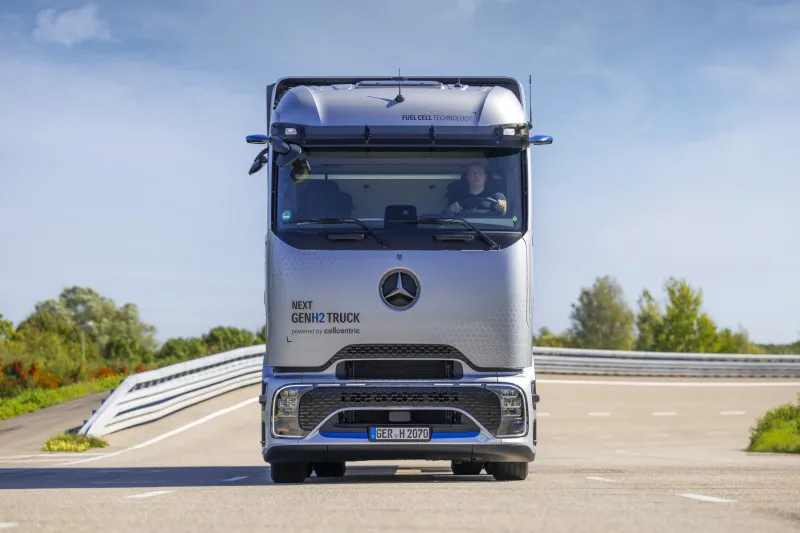
Liquid hydrogen enables ranges well in excess of 1,000 kilometres
Daimler Truck prioritises the use of liquid hydrogen in developing hydrogen powertrains. At, 253 °C, liquid hydrogen has a considerably higher energy density than gaseous hydrogen, making it possible to store more hydrogen, significantly extend the range and deliver performance comparable to conventional diesel trucks. The capacity of the two liquid hydrogen tanks has been increased compared with the first-generation Mercedes-Benz GenH2 Truck, allowing a total of up to 85 kg of hydrogen to be filled. Refuelling is possible from either side, as the two tanks are connected. Thanks to the sLH2 refuelling standard developed by Daimler Truck and Linde, the truck can be filled with liquid hydrogen in 10 to 15 minutes, as safely, quickly and easily as current diesel trucks.
Transporting liquid hydrogen requires less logistical effort, while liquid hydrogen tanks offer cost and weight advantages over high-pressure gas tanks. These benefits allow for higher payloads, making deployments comparable to those of today’s diesel trucks. Daimler Truck successfully demonstrated this at the end of 2023 during the #HydrogenRecordRun, when a Mercedes-Benz GenH2 truck with a gross vehicle weight of around 40 tonnes covered 1,047 km on a single fill of liquid hydrogen.
Reliable, efficient fuel-cell technology
The cellcentric BZA150 fuel-cell system, a joint venture between Daimler Truck and Volvo Group, remains at the heart of the NextGenH2 truck’s powertrain. Two fuel cells operate in tandem, delivering a total output of 300 kW (150 kW each), and are compactly integrated into the engine compartment beneath the cab. Years of intensive testing have shown the hydrogen powertrain concept to be reliable and efficient in real-world conditions. During the first customer trials with the Mercedes-Benz GenH2 Truck, for example, hydrogen consumption averaged between 5.6 kg/100 km and 8 kg/100 km, with gross combination weights ranging from 16 to 34 tonnes.
In operation, the fuel-cell system generates electrical energy through a reaction between hydrogen (H₂) and oxygen (O₂). Working with a buffer battery, it powers the electric motors integrated into the e-axle, providing strong propulsion. The only emission from this process is pure water vapour.
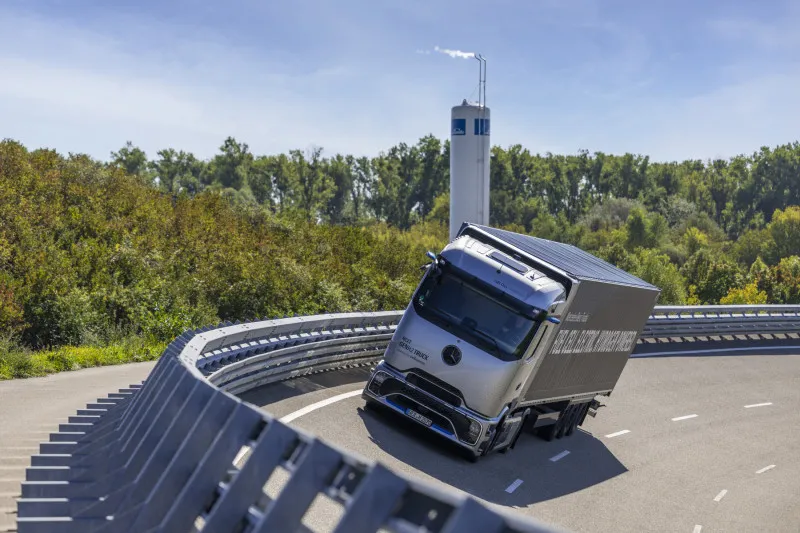
Production components deliver a major technological advance
The Mercedes-Benz NextGenH2 truck boasts a high level of technological maturity, thanks in part to the use of advanced components from Mercedes-Benz Trucks production vehicles. These include the ProCabin, already available on the Mercedes-Benz Actros L and battery-electric eActros 600, which is now being fitted to a fuel-cell truck for the first time. As a result, the NextGenH2 truck achieves a 9% (1) improvement in drag coefficient over the previous cab.
The NextGenH2 truck offers a high-quality driving experience comparable to that of its battery-electric counterpart, the eActros 600. Dynamic power from high torque available instantly, smooth and comfortable handling, and low noise levels inside and outside the cab are familiar benefits that the fuel-cell truck, as an electric vehicle using hydrogen as its energy source, can fully deliver. Even in challenging driving conditions, such as steep gradients or with heavy payloads, the truck delivers up to 340 kW in Economy mode and up to 370 kW in Power mode.
At the heart of the energy storage system is a high-voltage battery developed by Daimler Truck, with an installed capacity of 101 kWh (2). This lithium iron phosphate (LFP) battery acts as a buffer for the fuel-cell system and stores energy during recuperation. The NextGenH2 Truck uses the same efficient, in-house-developed electric drive axle as the eActros 600, with a 4-speed transmission (including two reverse gears) to provide optimum power at all times.
Together, these components enable highly efficient energy recuperation on downhill stretches and during braking, feeding the recovered electricity directly back into the buffer battery. This significantly increases the overall range and improves energy consumption.
The high-voltage components and latest E/E architecture are also carried over from the Mercedes-Benz eActros 600. The NextGenH2 Truck is therefore equipped with the latest advanced safety systems, including Active Brake Assist 6, Front Guard Assist and Active Sideguard Assist 2, and complies with current cybersecurity standards.
Innovative solutions improve customer usability
Customer trials of the Mercedes-Benz GenH2 truck provided Daimler Truck’s development team with valuable insights, directly informing improvements to the NextGenH2 truck and further increasing its benefits for customers.
An innovative, space-saving arrangement of components in the Tech Tower behind the cab has significantly reduced the space it occupies. As a result, the wheelbase has been shortened by 150 mm compared with the previous model, to 4,000 mm. This gives customers greater flexibility, allowing compatibility with various trailer combinations and a wide range of standard trailers that comply with European length regulations.
The Tech Tower also houses a new boil-off gas management system that meets all regulatory requirements for handling hydrogen, including parking the vehicle in enclosed spaces. An integrated cooling system ensures stable operating conditions, even in very high ambient temperatures or on challenging terrain.
A new sensor system that responds to a hydrogen leak, a highly unlikely event, now allows drivers to sleep overnight in the two standard bunks fitted in the truck cab. This improves comfort and operational flexibility, particularly for long-haul drivers on multi-day assignments.
In addition, a newly designed side panel with integrated crash elements provides better protection for the liquid hydrogen tanks in the event of an accident. The panel features improved aerodynamics and practical anti-slip plates, enhancing both safety and accessibility while reducing aerodynamic drag.
Testing and funding for the NextGenH2 truck
Last year, Daimler Truck tested Mercedes-Benz NextGenH2 Truck prototypes in extreme conditions in the Swiss Alps, during both winter and summer testing, to ensure their reliability in demanding operational scenarios. Lessons from these trials are being fed directly into further development.
Development, production and real-world deployment of the NextGenH2 trucks, planned from late 2026, are supported by the German Federal Ministry of Transport (BMV) and the states of Rhineland-Palatinate and Baden-Württemberg, with total funding of 226 million euros.
Series production of fuel-cell trucks is planned for the early 2030s.
[1] Customer-focused application in long-haul transport (motorway driving, standard semi-trailer, 40 tonnes), value determined by simulation.
[2] Nominal capacity of a new battery, based on internally defined parameters.
Question about this story? Ask your question
Keep following this
Get an email when a new story is published. No account needed.
- ThemeLow-carbon transport and mobility
- SubjectEquipment and machinery