2021: a year of multiple anniversaries for Daimler Trucks & Buses
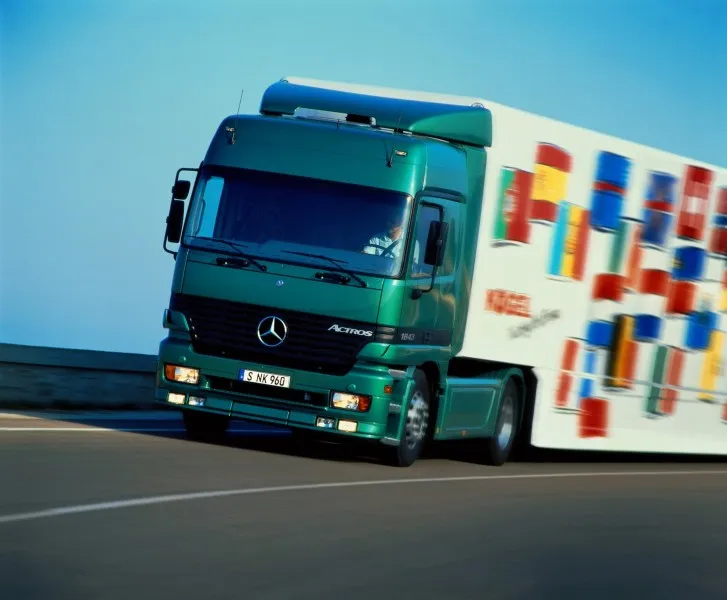
2021 is a very special year for Daimler Trucks & Buses, with four anniversaries to celebrate. In 1896, Gottlieb Daimler unveiled the first truck.
In 1951, Otto Kässbohrer did the same with the first bus featuring a self-supporting body, the Setra. Five years later, the first Unimog prototype tackled particularly challenging terrain. And finally, in 1996, the prototype for the quintessential modern truck, the Mercedes-Benz Actros, was unveiled.
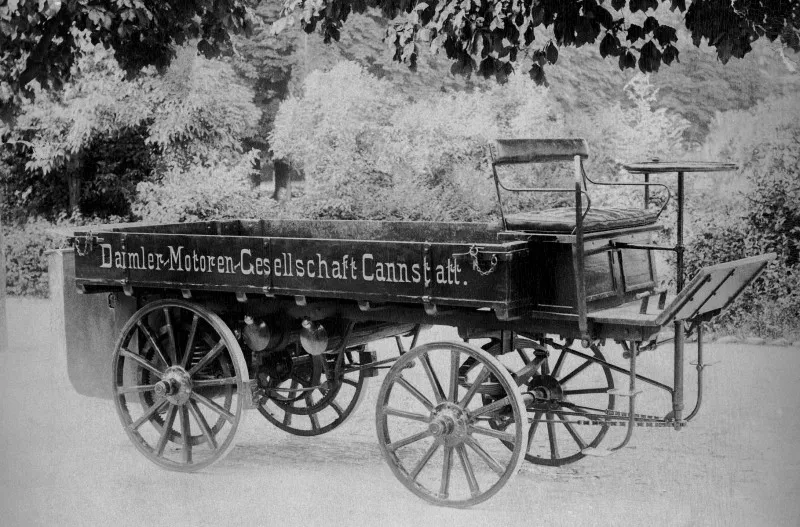
1896: The first truck
When Gottlieb Daimler unveiled his first truck in 1896, with wooden wheels clad in steel, the world was evidently not ready for this vehicle. It found no buyers in Germany. In England, where it was eventually sold, a flag-waving man had to walk in front of it to warn other road users. And yet this transport vehicle, powered by a 1.06-litre 2-cylinder engine developing 4 hp and known as the Phoenix, would go on to become the forerunner of an extraordinary success story in the world of goods transport.
Even so, the Phoenix had very little in common with a true truck. It was more like a converted cart, similar to those then pulled by horses. Its chassis had transversely mounted leaf springs at the front and coil springs at the rear. The suspension was essential not only because of the poor state of the roads, but also because the engine was particularly sensitive to vibration.
The final section of the transmission was modern: a belt transferred the engine’s power to a shaft mounted transversely to the vehicle’s longitudinal axis. A pinion, or small gear wheel, was fitted at each end of the shaft. Each pinion tooth meshed with a ring gear firmly attached to the driven wheel. Much later, this layout would become a hallmark of Mercedes-Benz truck design: planetary hub reduction axles, found on the “New Generation” vehicles, the SK heavy-duty range and, today, construction vehicles.
1946: The first Unimog prototype
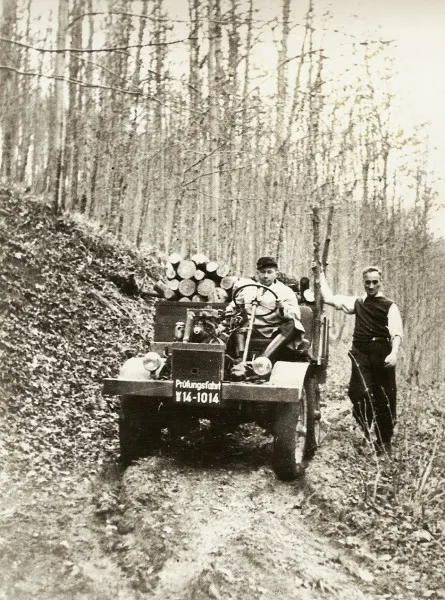
In 1946, the Unimog “Prototype 1” went on its first test run. Heinrich Rößler, who was responsible for the design, took the wheel himself. The prototype, with no cab and carrying a load of timber, was put through its paces on very challenging forest tracks near Schwäbisch Gmünd. The Unimog’s design was closely linked to the difficult circumstances of the post-war period, when Germany was suffering from supply shortages. In 1945 and 1946, food shortages were keenly felt. In response, Albert Friedrich, who had spent many years in charge of aircraft engine development at Daimler-Benz AG, came up with the idea of designing a motorised agricultural vehicle to boost productivity.
After the war, Friedrich re-established contact with Erhard & Söhne, a metalworking company that was also a Daimler-Benz supplier in Schwäbisch Gmünd. In December 1945, the department responsible for the agricultural sector began work. Albert Friedrich handed responsibility for the project to his former subordinate, designer Heinrich Rößler, who took up his post on 2 January 1946. In just a few weeks, a new vehicle layout had been developed, with the engine and gearbox positioned directly to the right of the vehicle’s centre. This layout enabled the torque tubes protecting the drive shafts to meet the axles at suitable angles. As a result, only four universal joints were needed. This ingenious design is still used 75 years later in the highly agile U 4023/U 5023 Unimog series. In March 1946, Hans Zabel, from Gaggenau and involved in the project from the outset, came up with the name “Unimog”, short for “Universal-Motor-Gerät”, meaning “universal motorised machine”. In October 1946, the vehicle went on its first test run.
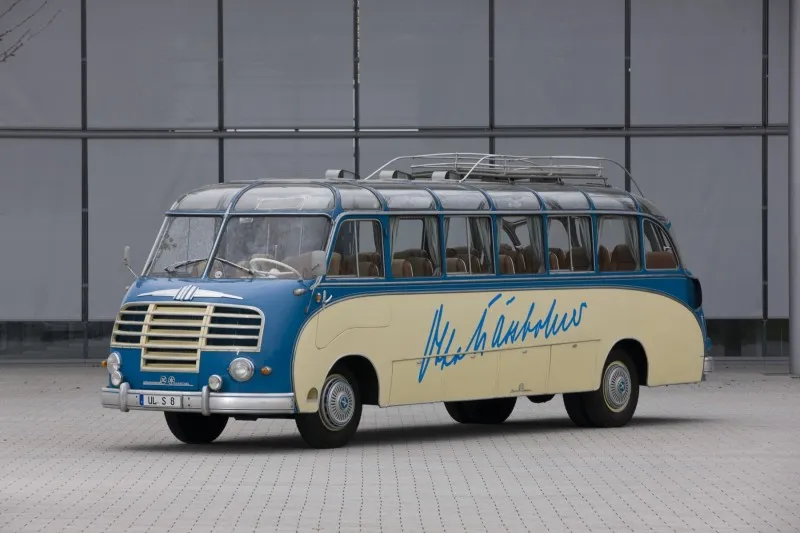
1951: The first Setra bus
The Setra brand is proud of its roots. In 1951, Ulm-based Kässbohrer Fahrzeugwerke unveiled the S 8, giving the brand its name, Setra (German for “self-supporting”). The first series-produced bus with a self-supporting body, rear-mounted engine and direct drive to the rear axle was presented at the IAA in Frankfurt. Over the past 70 years, with six model ranges, the brand has not only set the standard for coach design in Europe, but has also inspired, developed and advanced the sector in a unique way. The flagship of this historic brand, which has always stood for exclusivity, is the S 531 DT, a double-decker coach in the Setra TopClass 500 range.
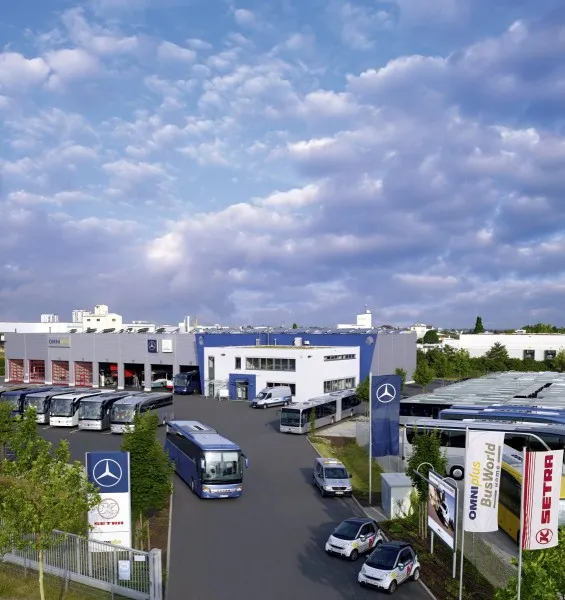
In 1996, just one year after Mercedes-Benz Buses and Setra merged to form EvoBus GmbH, Omniplus was established as the service brand responsible for the two coach brands’ after-sales activities. Omniplus built on the highly effective customer service divisions of both brands. Today, Omniplus has a very extensive service network, with more than 650 locations in 42 European countries, offering coach-specific services, genuine parts, eco-driving training and innovative centralised digital services.
1996: Mercedes-Benz Actros
At the end of September 1996, Mercedes-Benz unveiled a heavy-duty truck at the IAA Commercial Vehicles show that would revolutionise the industry: the Actros was the first truck to feature disc brakes and an electronic braking system (EBS). These technologies made the Actros the safest vehicle in its class. Other innovative technologies, such as the “Telligent” systems, also significantly improved efficiency. Service intervals more than doubled, fuel consumption fell by 3 to 7% depending on the type of operation, and payload increased by up to 400 kg. Safety and comfort also improved considerably. For example, thanks to the Telligent braking system with disc brakes, the braking distance of an Actros travelling at 85 km/h could be reduced by the length of a tractor-semitrailer combination. The engineers also paid close attention to the details, with a new type of wing trim that significantly reduced spray in wet weather.
Environmental considerations were not overlooked: more efficient new V-engines and various vehicle assembly optimisations, for example, reduced energy input by almost 50%. Designed to meet drivers’ specific needs, the new cabs also gave occupants up to 47% more interior space. They were safer, too, with every cab undergoing extensive crash testing both in simulations and in real-world conditions. Airbags and seats with integrated seat-belt tensioners were also new features.
Every newly unveiled Actros was named “Truck of the Year”. Even today, the Actros remains a pioneer in safety.
Question about this story? Ask your question
Keep following this
Get an email when a new story is published. No account needed.
- ThemeLow-carbon transport and mobility
- SubjectEquipment and machinery