Use of high-performance surface dressings (HPSDs) and large-area coloured road markings

Compliance and conditions of use
In 2023 and 2024, all technical data sheets and declarations of performance for HPSDs submitted for review by the Expertises unit of the Directorate of Road Engineering (DTR) at SPW « Mobility & Infrastructure » were found not to comply with the requirements of CCT Qualiroutes.
The DTR’s « Expertises » unit identified two main reasons for this situation:
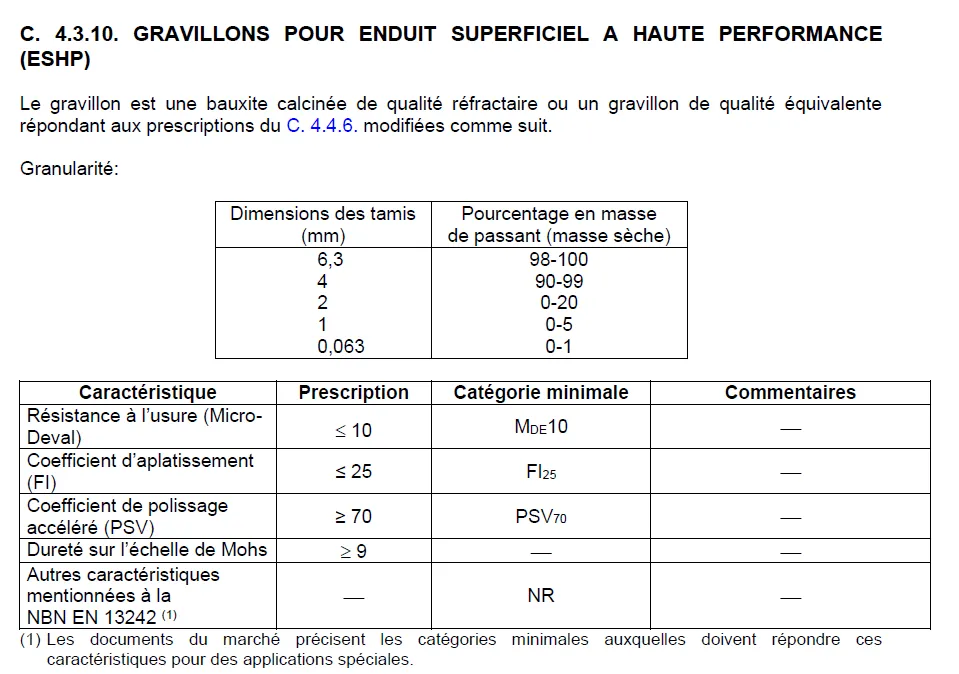
· first, the private sector’s reported difficulty in sourcing compliant aggregates, that is, aggregates meeting the grading and specifications in the table below (extract from CCT Qualiroutes):
· second, the fact that many project managers mistakenly use these HPSD items for installing anti-skid road markings, presumably reasoning that « if it can do more, it can do less ».
The areas to be treated are relatively small, whether they are used for suggested road or cycle-track crossings and junction crossings covering a few dozen m², or along a section of road (as with suggested cycle lanes). This is likely to affect the purchase price of the aggregates.
This situation creates a risk of a degree of price speculation when tenders are submitted.
In view of these findings, the Directorate of Road Engineering at SPW-MI wishes to make the following points:
- An HPSD with a transverse friction coefficient specification of more than 0.75, instead of 0.48 under normal conditions, must be reserved solely for hazardous areas requiring greater surface texture than a standard road surface.
- Its use should therefore remain exceptional. HPSDs are not recommended for markings in cycle zones.
- Large-area marking products, which can be coloured and combined with anti-skid aggregates (chapter L. 4 of CCT Qualiroutes), are much better suited to active travel.
Greater surface texture increases rolling resistance and makes the surface more abrasive, which can be harmful to road users if they fall.
A road marking is considered « large-area » when it is both more than 50 cm wide and more than 10 metres long.
HPSDs should therefore be reserved specifically for high-accident areas, to increase the texture of the road surface where it needs to be greater than that of a standard surface.
To this end, the requirements in CCT Qualiroutes specify the use of an extremely hard constituent aggregate, such as bauxite (or equivalent-quality chippings), with a MOHS hardness value >9 and an accelerated polishing value PSV =70.
For comparison, porphyry aggregate has a MOHS hardness of around 7, while standard aggregates for wearing courses must meet a PSV value of = 50 or 56.
Example of correct use of an HPSD:
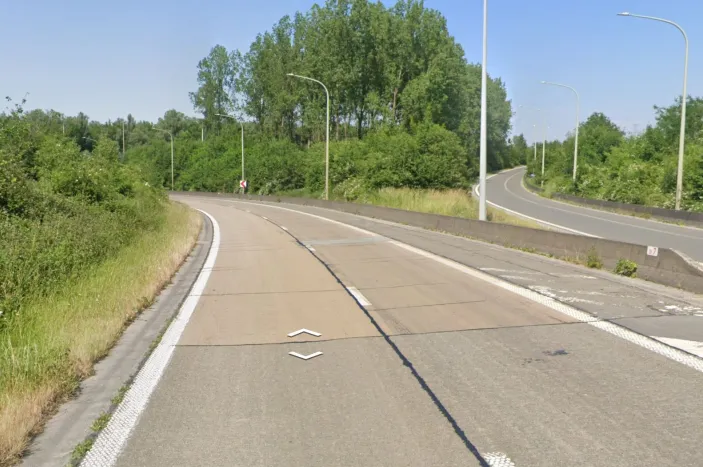
And of large-area road markings used for a suggested cycle lane (BCS) and a local safety measure:
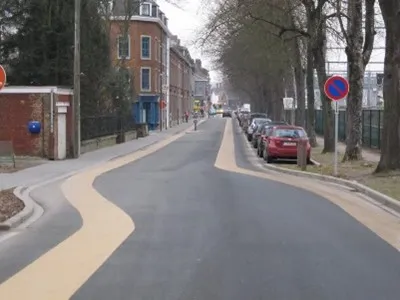
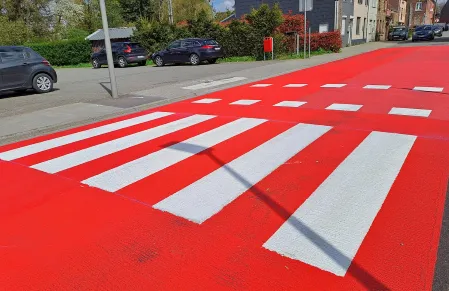
· As their name suggests, HPSDs are subject to very stringent requirements, meaning that compliant products are very expensive, particularly as the aggregates are sourced mainly from abroad.
If the product meets the certification level required by the CCT (CE2+ marking), it must be accompanied by a declaration of performance (DoP) stating the characteristics defined in standards NBN EN 13242 and NBN EN 13043.
To the best of our knowledge, at present, the applied price per m² for compliant products used to install large-area coloured markings (under chapter L. 4), without bauxite chippings, is around half that of an HPSD.
· There are also other ways to colour road surfaces, such as laying coloured asphalt, using poured hydraulic mortar, or applying a surface dressing based on methacrylate.
In all cases, it is essential to check surface texture performance after application:
- acceptance of the surface texture of coloured asphalt is carried out using SCRIM, against a specified SFC value of 0.48 or higher, as set out in G. 1.3.2.3.2
- acceptance of the surface texture of an HPSD is carried out using SCRIM, against a specified SFC value of 0.75 or higher, as set out in G. 3.5.3.4
- acceptance of a surface dressing based on poured hydraulic mortar is carried out using a pendulum, against a specified SRT surface texture value of 70 or higher, as set out in chapter G. 3.6.3.3
- acceptance of a surface dressing based on methacrylate resin is carried out using a pendulum, against a specified SRT surface texture value of 65 or higher, as set out in chapter G. 3.7.3.2
- acceptance of a large-area road marking is carried out using a pendulum, against a specified SRT surface texture value ranging from S0 (no requirement) to S5 (=65), as set out in chapter L. 4.3.2.5 of the CCT.
Unfortunately, there is no direct correlation between surface texture measurements taken using SCRIM and those taken using a pendulum. However, it is reasonable to assume that, since large-area coloured markings as defined in chapter L. 4.3.2.5 must have a minimum rating of S3 (SRT = 55), they should logically be at least as rough as concrete or asphalt road surfaces.
An SRT value of 55 is therefore considered equivalent to an SFC value of 0.48 (this was confirmed by an in-house test campaign correlating the two values over this short range of compliant acceptance values).
In conclusion, the Directorate of Road Engineering at SPW-MI recommends using « the right product in the right place », according to the requirements to be met.
A large-area coloured road marking (cold-applied surface dressing) is recommended to draw attention to specific areas (coloured road surfaces, junctions, raised tables, BCS)
whereas HPSDs should only be specified in specific cases where increased texture across the entire road surface is required.
For large-area road marking applications, priority should be given to item S6500 in the CPN, « thick-film cold-applied surface dressing per m² ».
If the required pendulum surface texture value differs from SRT = 55 (class S3 / minimum value specified by default in CCT Qualiroutes), it must be stated in the project’s special specifications.
Question about this story? Ask your question
Keep following this
Get an email when a new story is published. No account needed.
- ThemeTransforming infrastructure and territories
- SubjectInfrastructure