











What happens to extractive and processing waste?
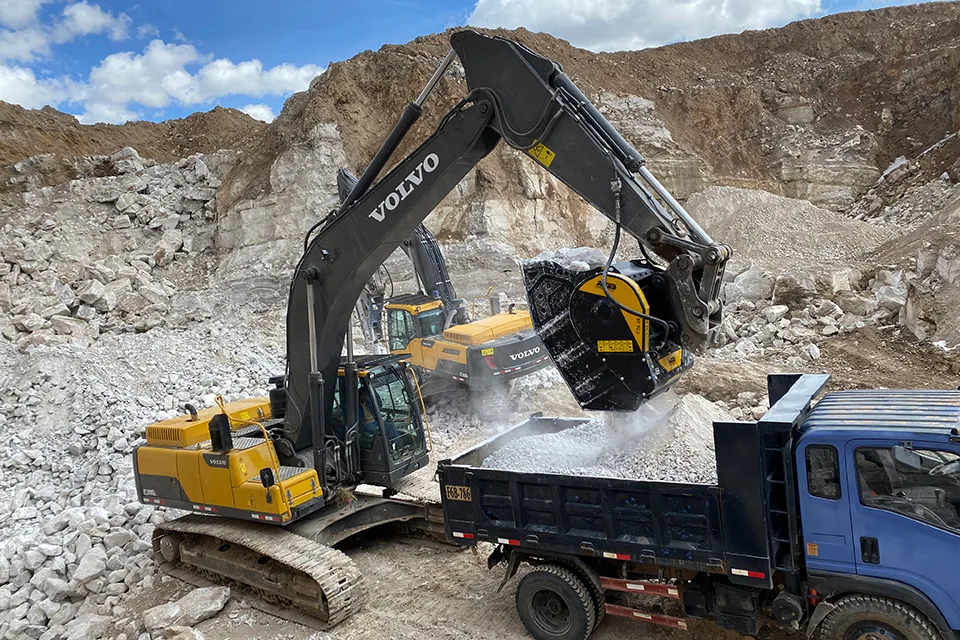
Reusing and recycling waste as effectively as possible, in line with the principles of the circular economy, and turning it into products for the construction sector and beyond is easier with MB Crusher equipment.
What are the main challenges shared by all mining sites? Managing extracted material and processing waste, and ensuring the material itself is economically viable. With MB Crusher equipment fitted to machinery already working at the quarry, systematically recovering waste becomes a source of revenue for the business. And with demand for raw materials recently rising, along with prices, many companies have realised they were sitting on a mountain of profit.
In particular, growing market interest in “recycled” aggregates has led many companies to recover quarry waste and process it appropriately. Reusing these materials brings economic benefits to industry operators as well as significant environmental benefits, since it reduces the need to exploit quarry deposits and therefore conserves non-renewable natural resources.

Waste can be given a new lease of life in a range of applications: aggregates for concrete, granular mixes for embankments and fill, aggregates for railway ballast, rock blocks, sealing materials for landfill foundations, stabilisers, bituminous mixes and high-density concrete for structures such as wind turbine bases and other strategic infrastructure.
All this becomes easier and more profitable when the material is processed on site using MB Crusher equipment, with only the carrier already available at the quarry.
Puerto Rico: extracted material is used to produce gravel for other projects
Using a combination of two MB Crusher units, an BF80.3 crusher bucket and an MB-S10 screening bucket, a Puerto Rican company has managed to produce its own gravel for reuse on its construction sites. The two units process quarry waste from extraction, producing material mainly for sub-base: the crusher bucket crushes the larger stones, then the material is cleaned with the screening bucket to achieve a higher quality. This saves considerable time and money, as the company can produce the material independently rather than having to buy it from other suppliers.
India: excavated soil will become concrete
Using an MB-S18 screening bucket mounted on a Kobelco excavator, an Indian company has optimised processing times and obtained material for cement production. The screening bucket sorts the material directly on the truck, without the need for additional equipment. It is a quick and straightforward operation that can be carried out directly on site.
Peru: gypsum crushed with a crusher bucket is worth more on the market
The higher the quality of the material, the more valuable it becomes and the more the company earns. However, to make a real profit, the material needs to be processed while optimising time and resources. This was also the case for a Peruvian mining company at its vast gypsum quarry. It fitted an MB Crusher crusher bucket to its excavator and crushed the material to the particle size requested by the customer.
Question about this story? Ask your question
Companies in this story
Keep following this
Get an email when a new story is published. No account needed.
- ThemeBuilding with less carbon
- SubjectNews
- CompanyMB Crusher







