











Upgrading the Ampsin-Neuville lock site: medium-sized lock enters testing phase and welcomes its 1st vessel
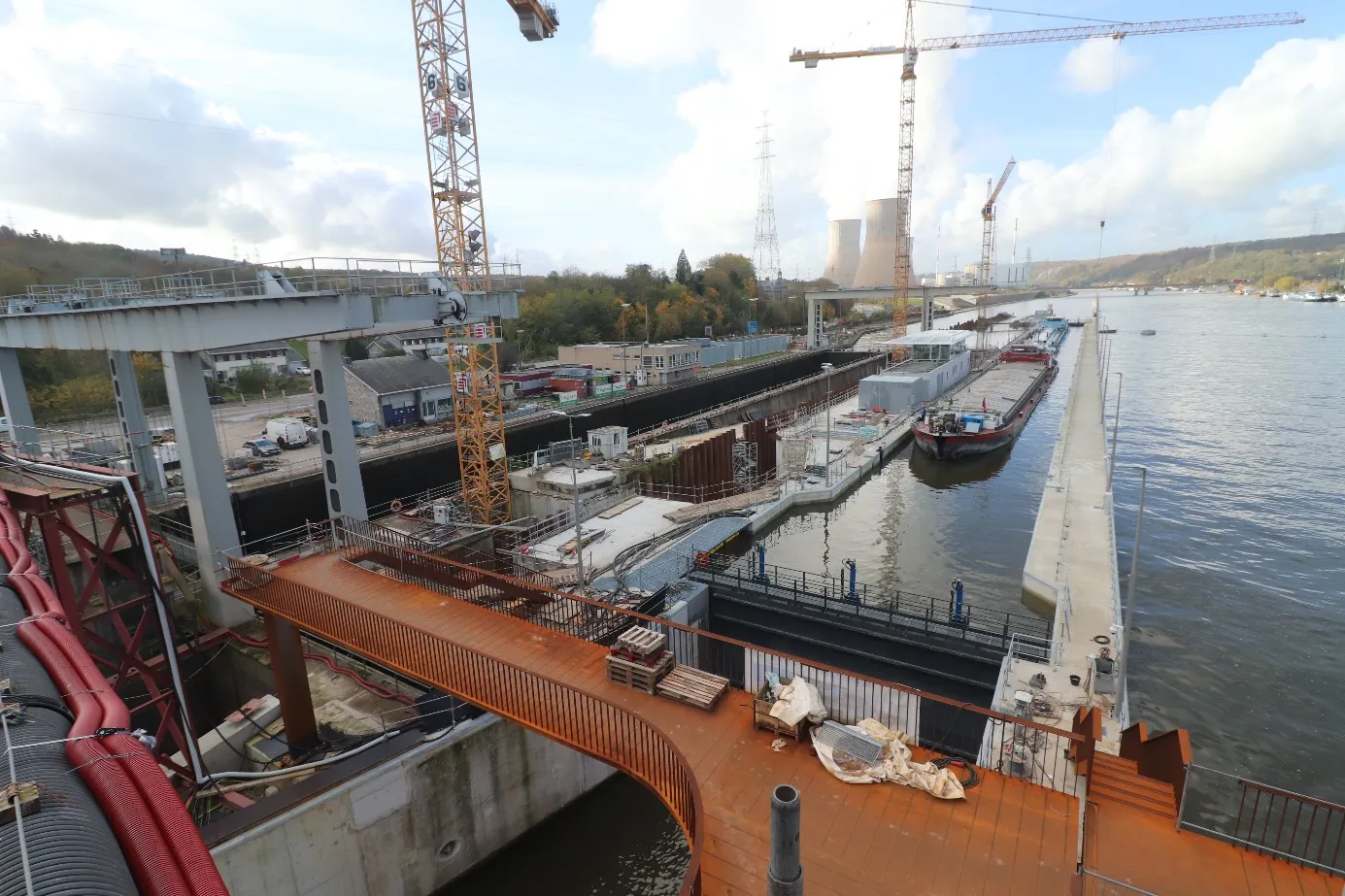
On 8 November, the brand-new medium-sized lock (225X12.5 metres, with a capacity of 4,500 tonnes) built at the Ampsin-Neuville lock site entered its so-called “probationary” phase, welcoming its first vessel. It is expected to officially open to navigation in around two months.
This probationary phase is needed to ensure that the new lock is working properly. It involves carrying out a series of tests while vessels are using it. During this period of around two months, 100 consecutive cycles must be completed without incident before the lock can officially open to navigation. The probationary phase is expected to end sometime in January, when the competent authorities and the parties involved in the project will inaugurate the lock at a press conference. The event will include a full update on the entire project and a detailed presentation of the facility.
Work will then continue with the dismantling of the 136×16-metre lock, which has been in service since 1958. It will be replaced by a large 225×25-metre lock (with a capacity of 9,000 tonnes). The new 225X12.5-metre lock will keep navigation moving during the two years needed to build this large-capacity infrastructure.
Background
Ampsin-Neuville is Wallonia’s 3rd busiest lock site in terms of freight volumes. Thanks to navigation being maintained during the works, 7.73 million tonnes of freight passed through the Ampsin-Neuville lock in 2020.
Located on the Meuse, in the municipalities of Huy and Amay, the Ampsin-Neuville lock site is the last bottleneck on the navigable waterway linking Namur to the seaports of Antwerp and northern Europe.
The site originally had two locks, commissioned in 1958: a medium-sized lock (136 x 16 m) and a small lock (55 x 7.5 m).
Both locks were smaller than those at sites upstream and downstream. They therefore needed to be replaced by two new large-capacity locks (225X12.5 metres and 225X25 metres) to reduce waiting times for boat operators and allow larger vessels to pass.
Work began in summer 2018 and is being carried out in two phases to ensure vessels can continue to pass:
- Replacing the 55 x 7.5 m lock with a 225 x 12.5 m lock (capacity of 4,500 tonnes = 225 20-tonne lorries).
This is the phase now nearing completion.
- Replacing the 136 x 16 m lock with a 225 x 25 m lock (capacity of 9,000 tonnes = 450 20-tonne lorries).
This is the project’s ultimate goal. It is scheduled to enter service at the end of 2023. A small amount of electromechanical finishing work will then remain, to be carried out in early 2024.
In the longer term, these works will also improve the surroundings for users, cyclists and walkers:
- The N90 will be made safer and its route altered to accommodate the upgrade of the lock site;
- The footbridge linking the municipalities of Amay and Huy will be replaced and extended to cross the national road. It will have access ramps connecting to the existing cycle paths;
- The left bank downstream of the site will be landscaped to give it a more natural character;
- A new fish pass, in the form of an artificial river, will enable various species to cross the weir and provide some of them with breeding grounds.
Question about this story? Ask your question
Keep following this
Get an email when a new story is published. No account needed.
- ThemeTransforming infrastructure and territories
- SubjectNews







