











The main span of the Suzan Daniel Bridge is positioned above the Antwerp-Brussels-Charleroi Canal
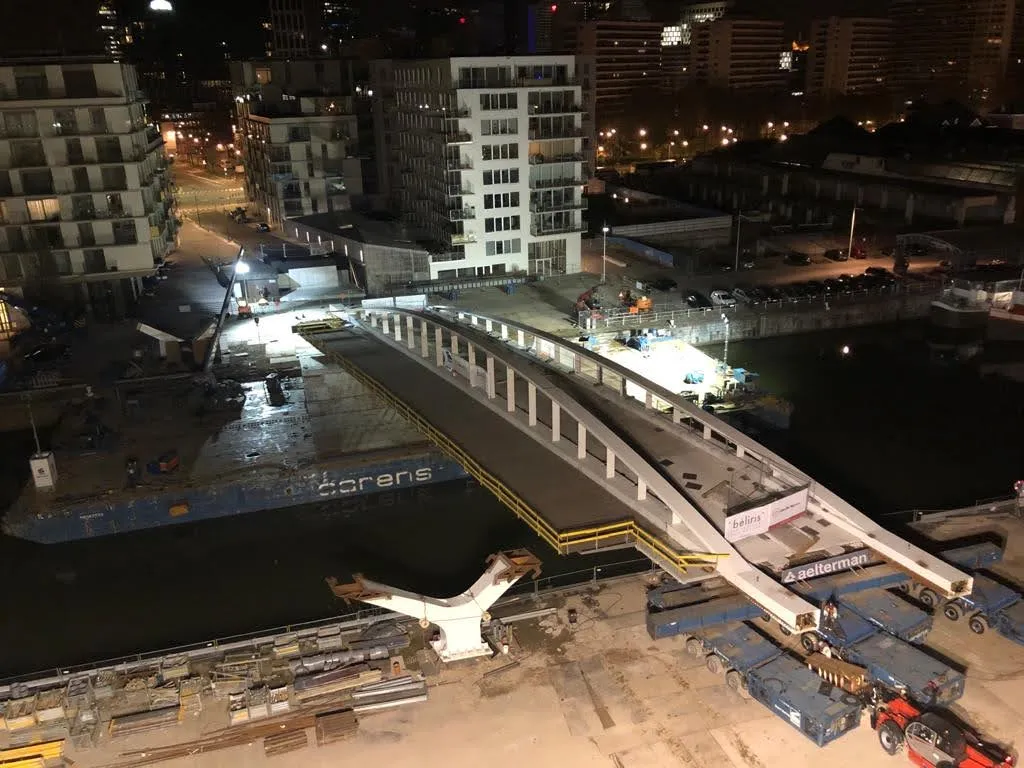
The main section of the Suzan Daniel Bridge has been positioned above the Brussels Canal. This is reported by Beliris, the public construction expert for Brussels.
This latest milestone brings us closer to the opening of the bridge and the new connection between the Northern Quarter and Tour & Taxis.
The move began on Wednesday evening and was successfully completed at 5am this morning. In the coming days, the bridge will be placed on its permanent supports.
It will give pedestrians and cyclists a shorter, more pleasant route across the canal. It will also enable public transport to connect Simon Bolivar Avenue with Avenue du Port and Rue Picard, creating a more logical route between the Gare du Nord and the districts around Tour & Taxis. The bridge is a major technical achievement and promotes sustainable mobility.
MADE IN BELGIUM BRIDGE
For the past 6 months, this 60 m-long, 1,200-tonne section of the bridge has been assembled on the quay. Its steel arches were manufactured at the Aelterman workshop near Ghent and transported by barge while the main girders and bridge deck were reinforced and concreted. The steel structure of the cycling and pedestrian section was built in a workshop near Kortrijk and then assembled onto the structure.
This section was installed above the canal using transporters and barges, drawing on the expertise of contractors De Nul and Aelterman and their subcontractor Sarens, and with the cooperation of the Port of Brussels and the project designers at Greisch.
The secondary decks, each 30 m long, will then be built. They will span the quays on either side of the canal, connecting to Avenue du Port and Quai de Willebroeck. The bridge will then be completed with surfacing, safety barriers and lighting. The work is scheduled for completion by the end of 2021. A sum of €9.4 million, including studies, has been allocated to the project. River traffic, which has been closed since Thursday evening, will reopen on Monday morning.
FIGURES
- 1 main section 60 m long and weighing 1,200 tonnes, 2 secondary sections each 30 m long and an 80 m ramp, making a total length of 200 m
- 2 traffic zones: a 7 m-wide asphalt public transport lane and a 6 m-wide cycling and pedestrian lane
- 8 remote-controlled transporters and 2 barges for the operation
- 4 days of work to float the structure
- A gradient of less than 4% to make access easier for people with reduced mobility
Question about this story? Ask your question
Keep following this
Get an email when a new story is published. No account needed.
- ThemeTransforming infrastructure and territories
- SubjectNews







