











Specialist in quick couplers and other equipment
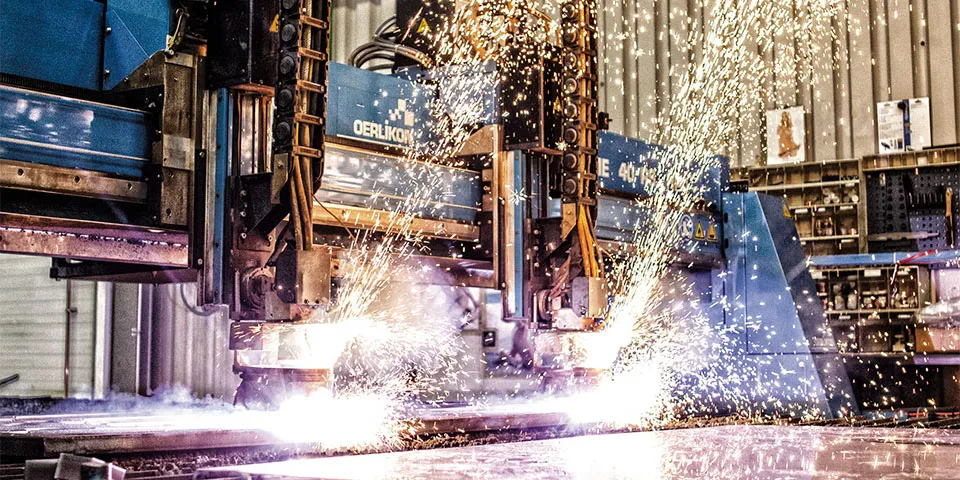
In 1985, Eurosteel set out to develop and manufacture equipment for excavators and wheeled loaders. 35 years later, specialising in this equipment has become the company’s core business.
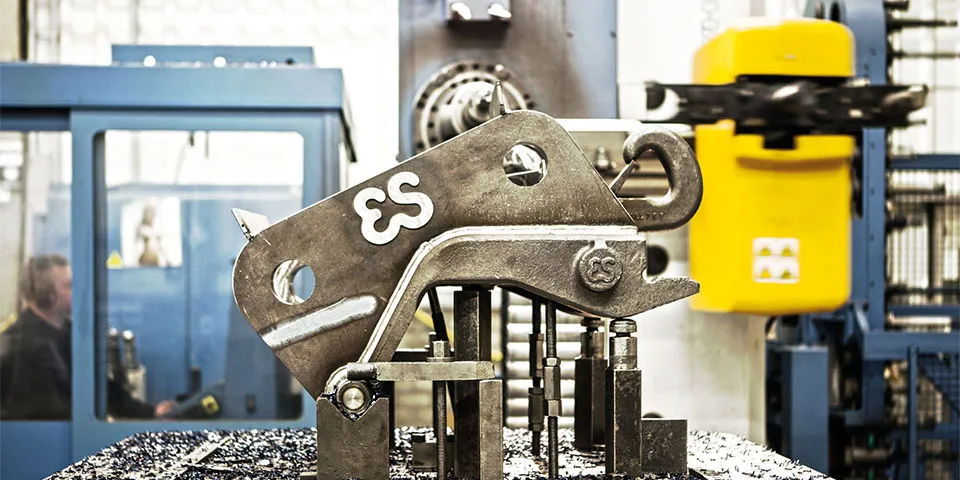
Eurosteel has a total of 4 CNC milling machines.
Based in Venlo, in the Dutch province of Limburg, Eurosteel is an independent company with no links to any machine brand. A dedicated team of more than 50 employees works every day to develop and manufacture equipment for all types and makes of excavators and wheeled loaders, up to an operating weight of 90 tonnes. Its products consist mainly of quick couplers, buckets and various types of forks, as well as specialist equipment for a wide range of applications, from composting to infrastructure works.
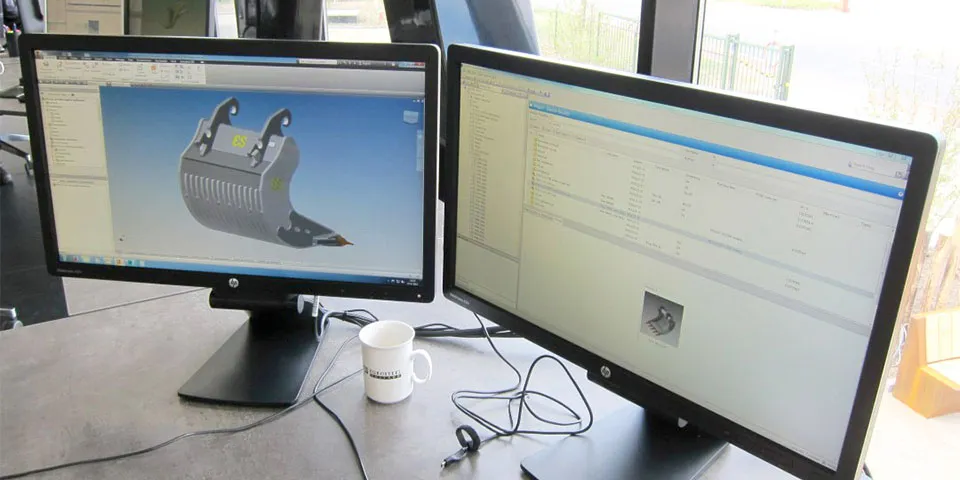
This wide variety of machines and applications has given rise to a huge range, comprising around 650 standard-type quick couplers and more than 2500 standard attachments. Combined with numerous options and the specific requirements of individual customers, the range fully meets the demands and wishes of project owners.
90 % of Eurosteel’s products are sold in the Benelux, primarily through importers and distributors of new machinery. End users can also contact Eurosteel directly to purchase equipment.
Over the years, Eurosteel has built excellent customer relationships by focusing on quality. “Quality alone is not enough for Eurosteel. Commitment, professionalism, flexibility, service and meeting delivery deadlines are also among the company’s strengths,” the company says. In Eurosteel’s view, sales, development and production are inseparable: “This is the only way we can respond flexibly to customers’ specific requirements while maintaining control over quality and delivery times.”
In-house production
To put this vision into practice, Eurosteel continually invests in its facilities. The company now operates from a modern building. One important detail: since 2013, Eurosteel has no longer used gas, instead heating and cooling its offices and workshops with a ground-air heat exchanger.
The 1000 m² of office space includes five engineers, who work full time on developing equipment and fulfilling customers’ specific requirements.
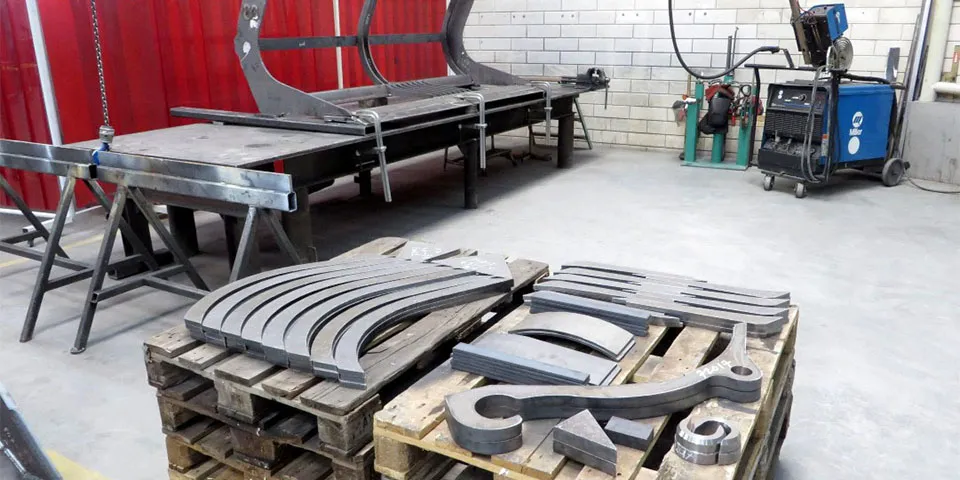
The equipment is then manufactured in Eurosteel’s production halls (5500 m²) by 36 employees, from raw material to finished product. Around 200 tonnes of steel are delivered to Eurosteel every week, including rolled, abrasion-resistant, profiled and cast steel. This raw steel then undergoes various processes, including cutting, turning and milling, to produce the components that make up each item of equipment.
Skilled workers then assemble the equipment. Although they use jigs, this is still precision work. Once assembled, the products are welded, still by hand. Manual welding remains the most effective and flexible method given the wide range of products. After welding, the products are checked for straightness. The holes, used in particular to fit the machine pins, are milled and bored immediately after welding to ensure that all surfaces are properly aligned and dimensional tolerances are met. “For this purpose, we have a total of 4 CNC milling machines, extremely expensive machines that are nevertheless essential to achieving the level of quality Eurosteel demands. ◊
As a finishing touch, the equipment is painted in our own paint shop, while the ES logos are given their distinctive yellow colour,” Eurosteel explains.
Rototilt importation
As well as manufacturing equipment, Eurosteel has also been the Benelux importer of Rototilt tiltrotators since 2003. Rototilt supplies a wide range of tiltrotators for excavators from 1.5 to 40 (!) tonnes. These tiltrotators can be fitted with a variety of coupling systems, options and controls.
For the past few years, connection to 3D GPS systems has also been possible. Eurosteel also responds to market demand for tiltrotators. The compact, removable models for the CW system are a good example.
Plans for the future
Since 2010, substantial investments have been made in the production process, as well as in ERP and 3D drawing systems. During this period, the workforce has grown from 40 to more than 50. This steady growth is needed to keep up with demand, which is also increasing. In 2010, Eurosteel more than doubled the size of its production facilities. Turnover has also doubled since then, meaning that the current production facilities have once again become too small. Eurosteel is therefore actively preparing new growth plans. In short, Eurosteel is moving forward “at lightning speed”.
EUROSTEEL INVESTS
• 2010/2011: production area doubled from 2500 to 5500 m2 with the addition of 2 new halls
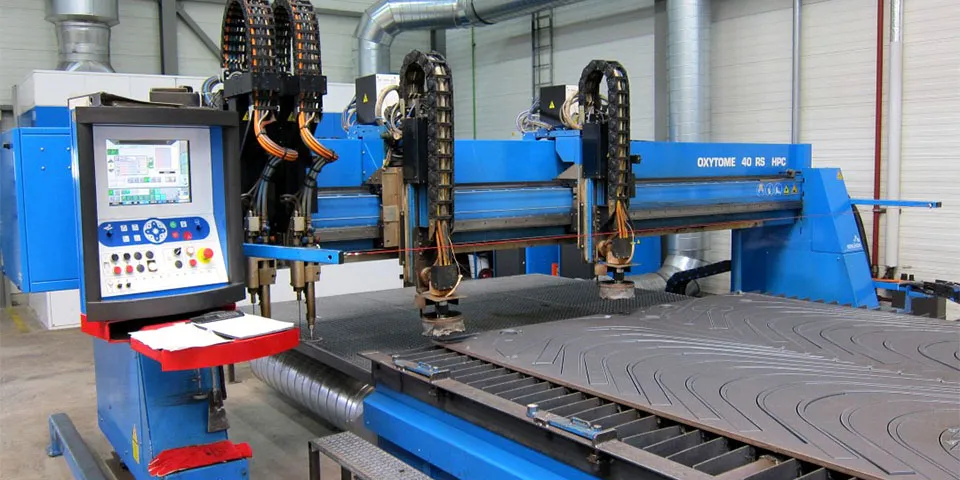
• 2011: cutting capacity doubled with a new SAF plasma
cutting unit featuring a 2 x 300 amp plasma system and 2 x oxy-fuel
• 2011/2012: 6 new assembly/welding stations installed, with cranes and fume extraction
• 2012: new Tos CNC boring mill
• 2013: natural gas phased out thanks to a completely in-house-built ground-air heat exchanger
• 2015: office space doubled from 500 to 1000 m2 and existing offices modernised
• 2015: new Darley 320 t CNC press brake
• 2016: new MTE CNC milling machine, the 4th largest, to increase
machining capacity in response to growing demand for quick couplers
• 2017: cutting capacity doubled again with a new
machine identical to the one acquired in 2011
• 2018: new CMZ CNC lathe and extension of the paint shop
Question about this story? Ask your question
Keep following this
Get an email when a new story is published. No account needed.
- ThemeConstruction machinery and equipment
- SubjectNews







