











Reinforcement and rebar processing plants keep working…
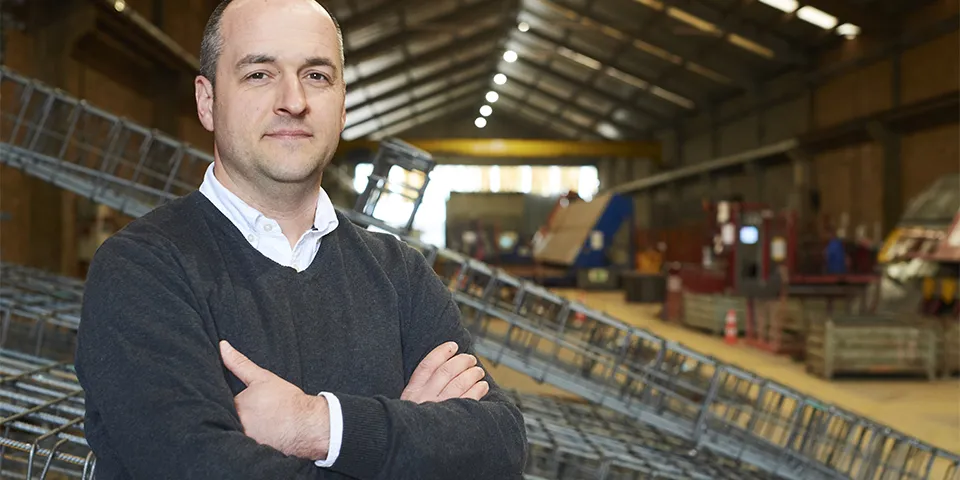
Reinforcement plants cut and bend the reinforcing bars used in our concrete structures, and install them on site. United under their federation, Cobesta, the sector faces numerous challenges in the current climate. We speak to Pierre Henri Lesens, Head of Reinforcement and Prefabrication at CIT Blaton.
CIT Blaton’s roots go back more than 150 years, shaped by a constant commitment to combining quality and innovation. Looking to the future, the company sees itself as modern and is clear about its ambition to build strong client relationships. Despite the coronavirus crisis, CIT Blaton remains optimistic and is prepared to make sacrifices to make up for delays on construction sites.
Concrete reinforcement: a technical trade undergoing rapid change?
Pierre-Henri Lesens: Indeed, reinforcement is a major part of construction. As the construction sector continues to evolve, reinforcement work must evolve too. Steel quality and standards must advance in the same way as concrete.
The BENOR system applies to the entire production and distribution chain for reinforcing steel. Is it an additional quality guarantee?
P. H. Lesens: I firmly believe the BENOR mark is an unquestionable guarantee of quality. It is a quality label for reinforcing steel, which offers an advantage. Our reinforcement plants are inspected regularly, ensuring the primary quality of the steel, whose origin is BENOR-certified. The quality of our cutting and bending is also inspected.
Has the coronavirus crisis had a major impact on the sector? Do you think you can make up for the weeks lost?
P.-H. Lesens: The crisis affected us directly, as we stopped all our activities from 18 March until 17 April. We resumed work on a partial basis on that date, but the series of safety and social distancing measures were very restrictive for us. Our activities resumed at 70% in the week of 27 April and reached 100% in the week of 4 May.
That said, we have not really fallen behind, because construction sites were also at a standstill. We now guarantee delivery times to site, and we will meet them.
Do site scheduling and coordination from a delivery perspective sometimes cause difficulties with contractors?
P.-H. Lesens: Indeed, the sector is increasingly tied to tight schedules, and several difficulties can arise.
First, there are design offices. When a design takes longer, the project does too, information reaches us late and we are left under pressure. The steel then needs to be delivered quickly.
Then, as I said, construction sites are increasingly working to tight schedules, leaving no margin for error. If something goes wrong on site or a failure occurs, we fall behind and deliveries are delayed.
Are reinforcement drawings standardised?
Who is adopting digitalisation through a BIM approach?
P.-H. Lesens: Neither drawings nor schedules are standardised at present, which I personally find a great shame. We are in discussions within Cobesta to standardise everything, but no agreement has yet been reached. It is very difficult to get everyone on the same page. The design and inspection bodies need to agree… I think this would be a positive step for reinforcement plants, design offices and contractors alike. I believe BIM will help formalise the process (it is not yet used on most construction sites). I appreciated the occasions when I worked with this system: everything is carefully calculated and planned in advance.
Question about this story? Ask your question
Keep following this
Get an email when a new story is published. No account needed.
- SubjectNews







