











Productivity without waste: a call to action from mb crusher
Connectivity is an essential feature of the modern economy. MB crushing equipment is at the forefront of connecting communities, economies and countries.
The economy increasingly needs infrastructure to link supply chains across countries and connect communities of people across metropolitan areas. However, building housing, road and sewer networks, gas pipelines and water mains, public facilities and other infrastructure is becoming increasingly costly. Today, it is also more complex than ever due to the huge delays caused by global shortages of materials.
Without adequate infrastructure, the economy cannot prosper. Without materials, connections cannot be built. This may seem like a vicious circle, but the solution is simple and can be summed up in one sentence: infrastructure means doing more with less.
How did we reach this conclusion? By looking at what our customers did to overcome difficulties sourcing materials. We saw how they used resources efficiently and avoided waste.
The results are remarkable: by simply using their existing construction machinery and fitting MB Crusher attachments, they cut costs overall and eliminated delivery delays.
Digging trenches without buying backfill material
At the Cerro Negro mine in Chile’s Atacama region, a company dug 80 km of trench in the desert without having to buy and transport the sand needed to backfill it. The customer fitted an MB-S18 screening bucket to its Doosan DX225LC to screen the material directly over the trench. This delivered huge savings and faster turnaround times, while also preserving the land. Processing the material on site reduces the number of lorries and prevents local material from being contaminated by imported aggregates.
Building aqueducts safely in urban areas
In Agadir, a port city in Morocco, a new aqueduct was built across the entire city. The Saharan climate meant that the work had to be carried out quickly and with maximum safety for workers. Manually separating the excavated material would have taken too long, could not guarantee complete safety and, in particular, would not have produced the uniform clods required on site. Using an MB-S18 screening bucket mounted on a Doosan 240 excavator, the excavated material was screened directly on site. The result: homogeneous, uniform material for use as backfill, work completed on schedule and complete safety on site.
Cutting the cost of preparing railway ballast
Investing in rail network development improves and facilitates economic exchange, speeds up freight transport, makes commuting easier and boosts tourism. Huge quantities of ballast are needed to build railway links. Ballast is essential for the proper functioning of the railway itself, helping to minimise the thermal expansion of the rails, absorb noise, drain water and prevent vegetation growth.
Two interesting examples come from India and Italy, with one thing in common: large quantities of ballast were prepared by reusing material that was already available, simply cleaning and screening it. This makes the process highly cost-effective.
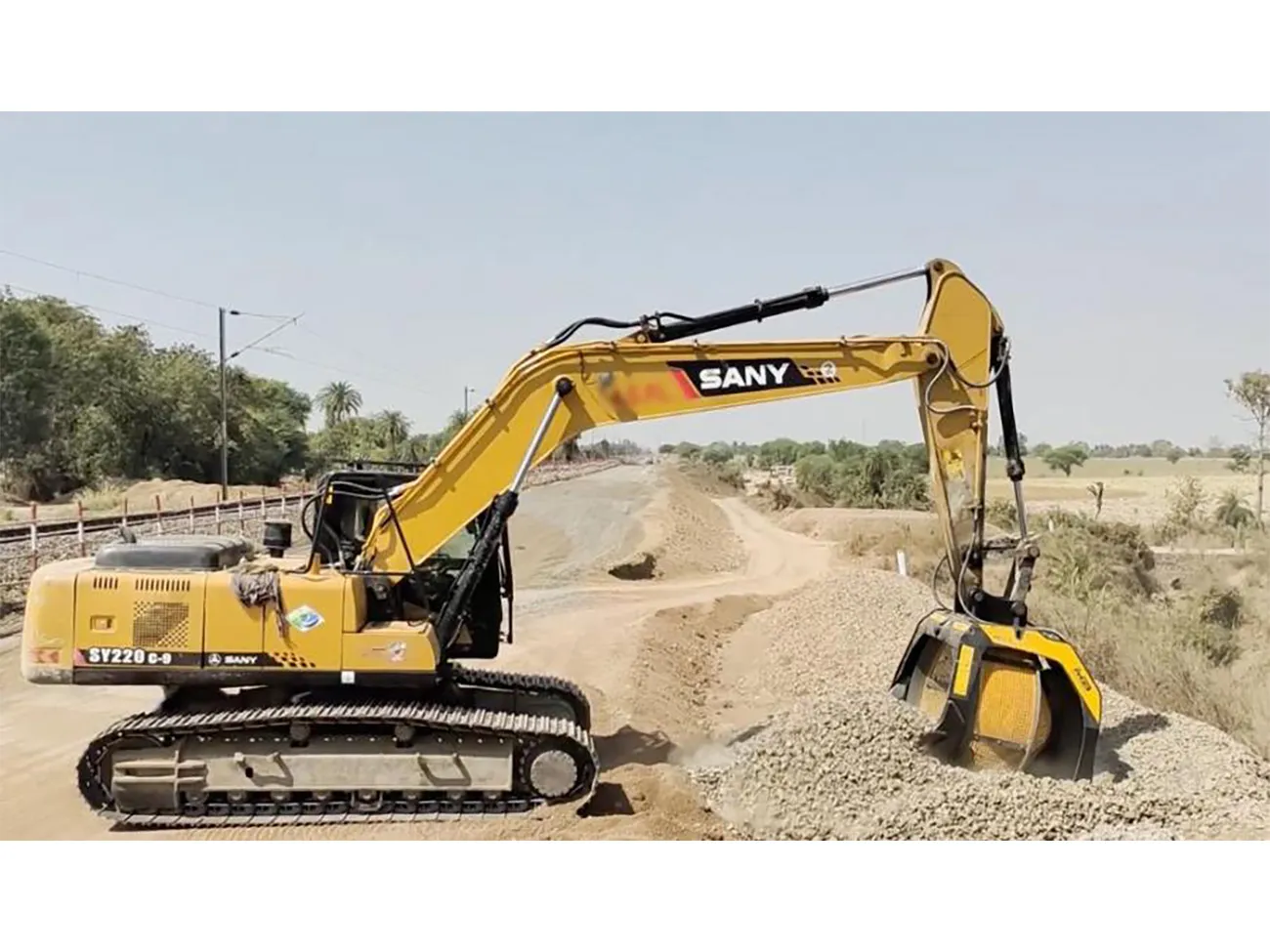
In India, an MB-S18 screening bucket was used on a Sany SY220 excavator to screen material directly alongside the railway line. In Italy, the same screening bucket model was mounted on a Hitachi EX215 to clean material in the quarry and load it straight onto the lorry.
Materials were also reused during maintenance of the railway network linking Warsaw with outlying areas: old, unused sleepers were crushed with a BF70.2 crusher bucket mounted on an Atlas 1604 excavator. The crushed material was then reused as a sub-base layer ahead of the subsequent ballast installation.
Wasting nothing is the key to success. Connectivity brings prosperity. Let’s make it easier, faster and more sustainable.
Een zakelijke vraag aan MB Crusher? Get in touch
Companies in this story
Keep following this
Get an email when a new story is published. No account needed.
- SubjectNews
- CompanyMB Crusher







