











Performance in every detail: Keestrack delivers lasting performance at the lowest cost per tonne.
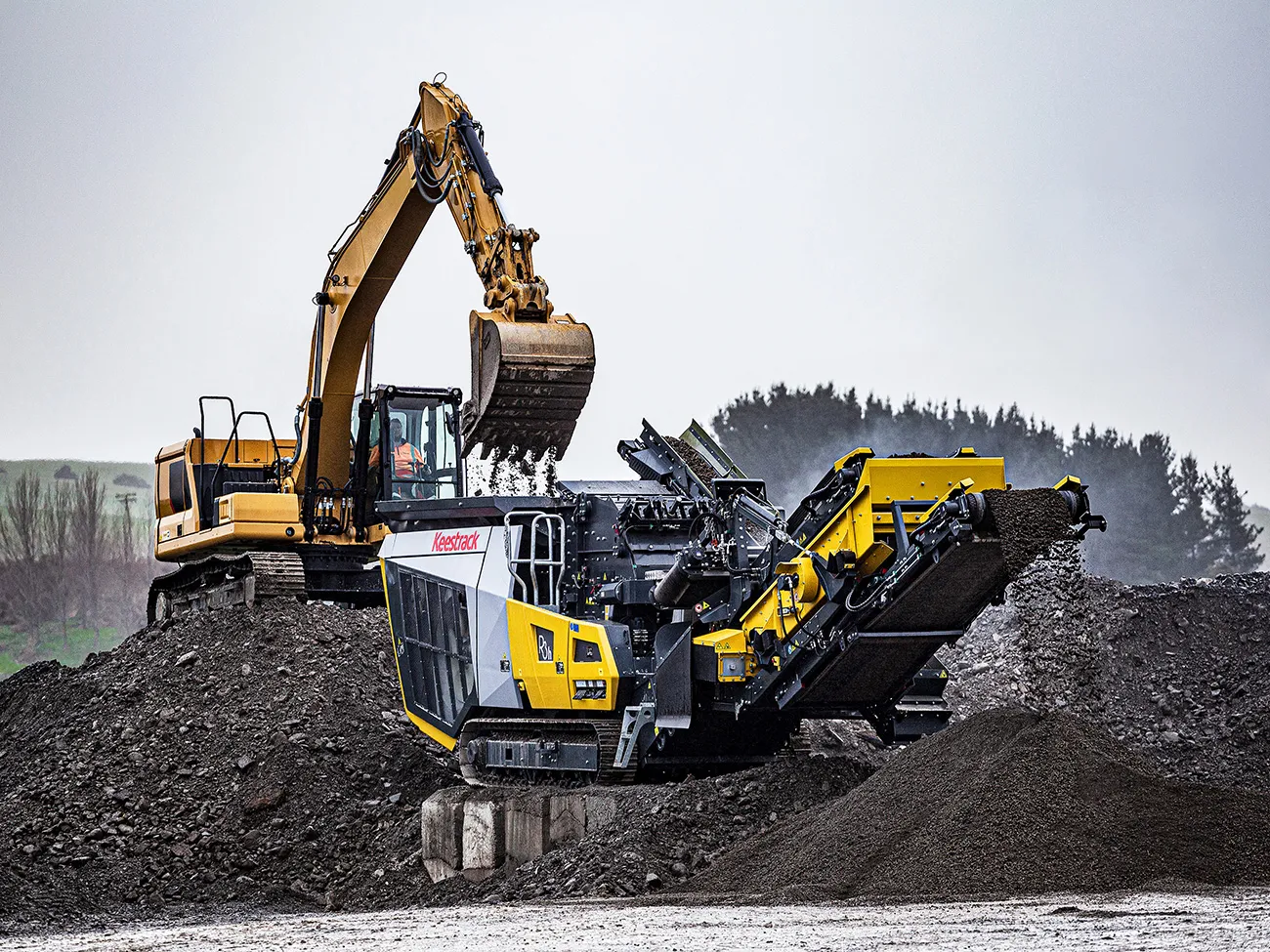
Keestrack has built a strong reputation for innovative, cost-effective equipment, constantly striving for the best performance at the lowest cost per tonne. At Conexpo, the manufacturer of mobile crushing and screening equipment will showcase its extensive product range. Keestrack, whose US headquarters are in Texas, will be at Conexpo alongside its distributors from the US, Canada and Latin America to present its latest developments.
Keestrack America at Conexpo
Machines on display at the Keestrack stand, C-31386 in the Central Hall
The R5e impact crusher
The newly designed R5e impact crusher is a fully electric plug-in machine. It also has a plug-out connection to power additional equipment. Used in aggregate production, recycling, quarrying and mining, the impact crusher can be powered by a mains connection or by a generator if no mains connection is available.
The R5e weighs 55t (61 sT) and has a capacity of up to 400 t/h (440 sT/h). It is highly mobile and can be transported as a single unit, even when fitted with a closed circuit. The double-deck pre-screen (2.200 mm x 1.000 mm) (7’x3′) ensures effective screening, with material either stockpiled by the side conveyors or directed through the crusher bypass. The impact crusher has an inlet opening of 800 mm x 1.050 mm (31″x41″) (H x W) and is driven by a 200 kW electric motor. This drives a rotor 1.000 mm (39″) wide and 1.260 mm (50″) in diameter, with extremely high mass inertia, delivering high productivity and stability. The precision two-deck screen measures 4.760 mm x 1.500 mm (15’7″ x 5’) and can be configured in a closed circuit. The mid-size and fine fractions can be stockpiled as an option. The swivelling oversize conveyor can easily be converted into a stockpiling conveyor when required.
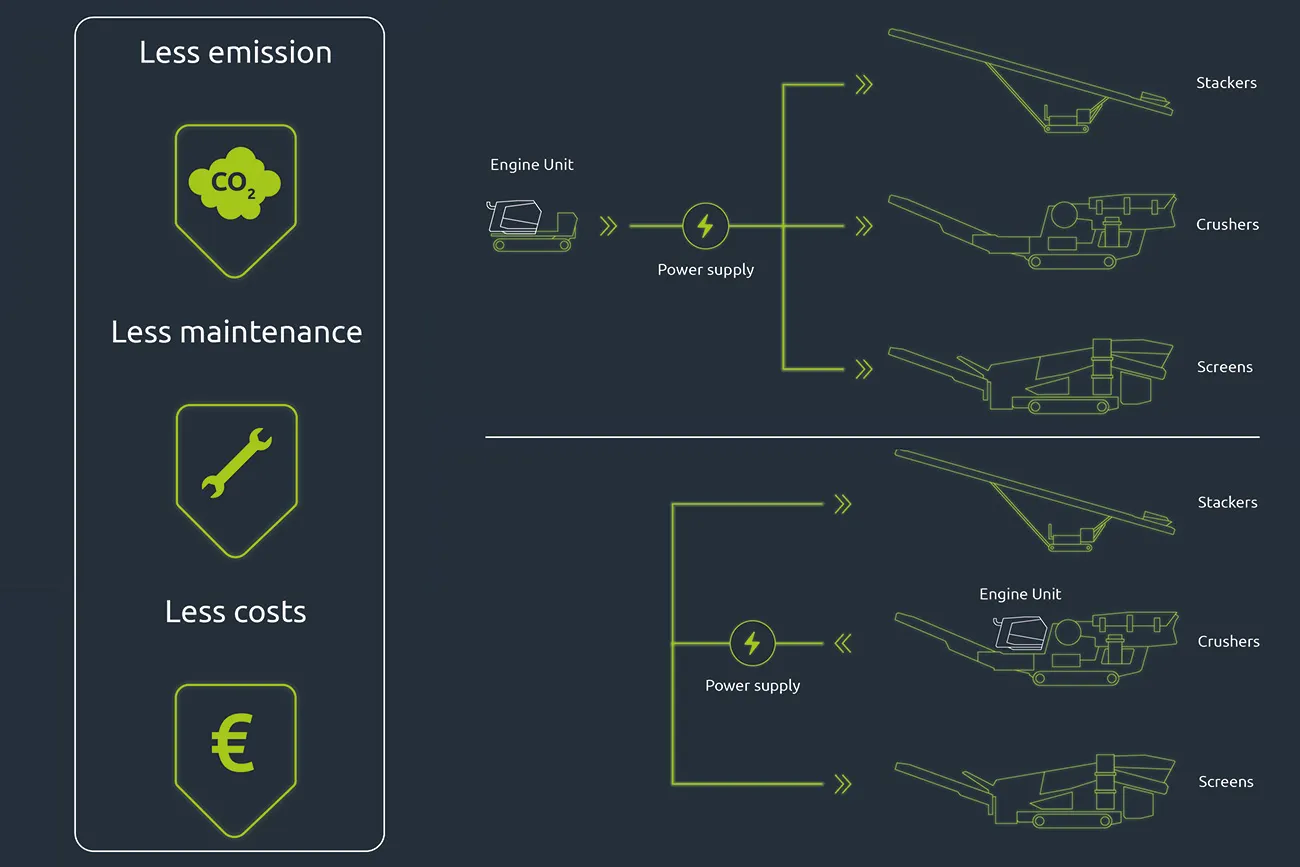
The R5e on display at Conexpo is fitted with a removable 4,5t (5sT) engine/generator unit, which can be positioned either on the machine chassis or beside the machine, connected by a power cable. Located in a less dusty, lower-vibration environment, it serves as a backup when no mains connection is available. Maintenance is also safer and easier when the engine is at ground level. Connecting several machines to a single removable engine/generator unit can deliver substantial savings, as only one engine/generator needs to be operated and maintained.
The R5e consumes an average of 173 kW when powered entirely by electricity, or around 40l/h (10 gal/hour) when powered by the removable diesel engine/generator.
Key figures for drive systems
Compared with traditional diesel-hydraulic machines, diesel-electric installations can deliver direct fuel savings of up to 40%.
When incorporated into production trains, attributable fuel consumption can fall by as much as 70% when hybrid screens and stockpiling conveyors are powered directly via the plug-out connection of an electric crusher upstream or downstream.
When connected to the mains, savings are even greater, depending on local electricity prices, as operating and maintenance costs fall significantly.
The H4e cone crusher
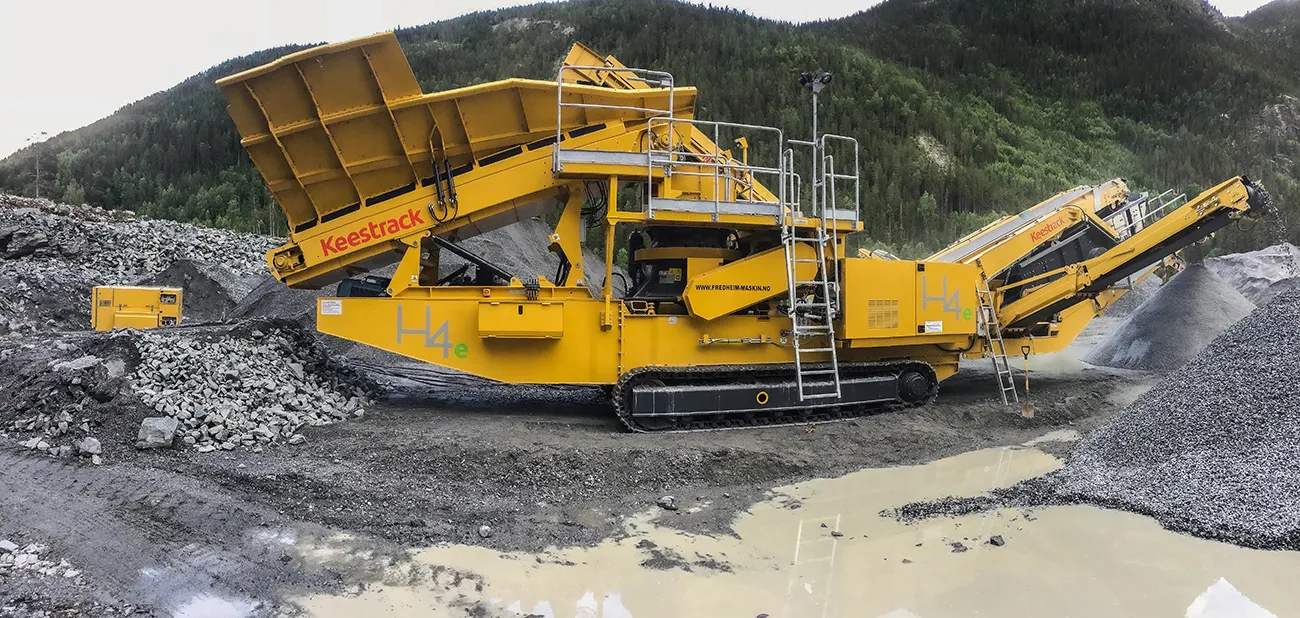
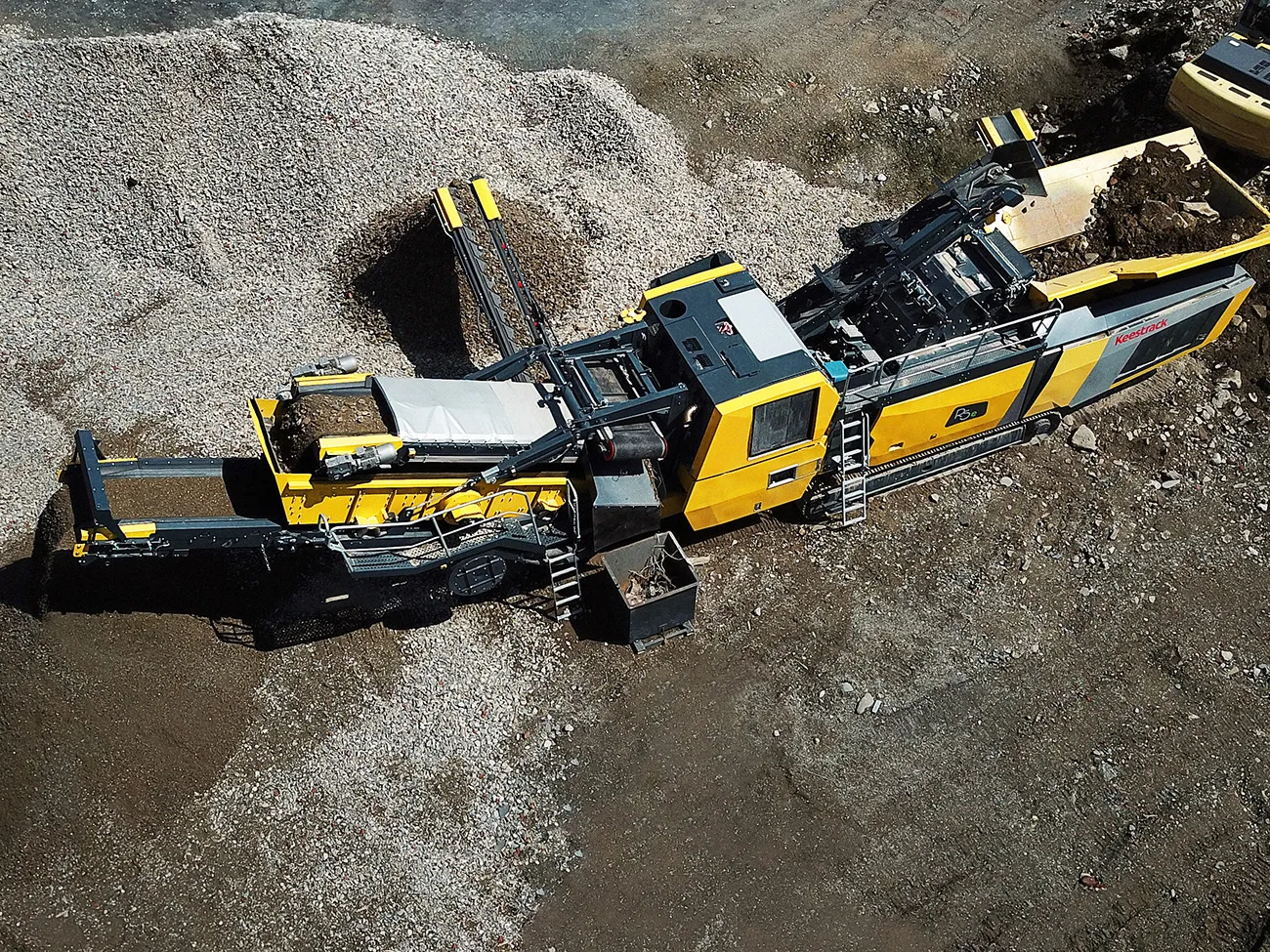
The H4e cone crusher is another electric machine in the Keestrack range. The H4e is designed to crush the hardest rocks and ores, stone, gravel and aggregates.
The proven cone technology alone weighs 9t (10sT). The H4e weighs 45t (50sT) fully equipped, including options such as the 3.600 mm x 1.500 mm (12’x5′) three-deck after-screen. Like all Keestrack electric machines, the H4e has an electric plug-in connection for fully electric operation, as well as a plug-out connection for linking to other electric equipment.
The H4e has its own onboard diesel engine/generator to power the equipment in diesel-electric mode. The H4e cone accepts feed sizes of up to 185 mm (7”), with a min.–max. C.S.S. of 6 mm, 38 mm (¾”-1½”), depending on the crushing chamber configuration. Its capacity is up to 208t/h (230sT/h), and it is powered by a 251 kW electric motor.
The H4e consumes an average of 130 kW when powered by electricity, or around 33l/h (8 gal/hour) when driven by its onboard diesel engine/generator.
The K6 scalping screen
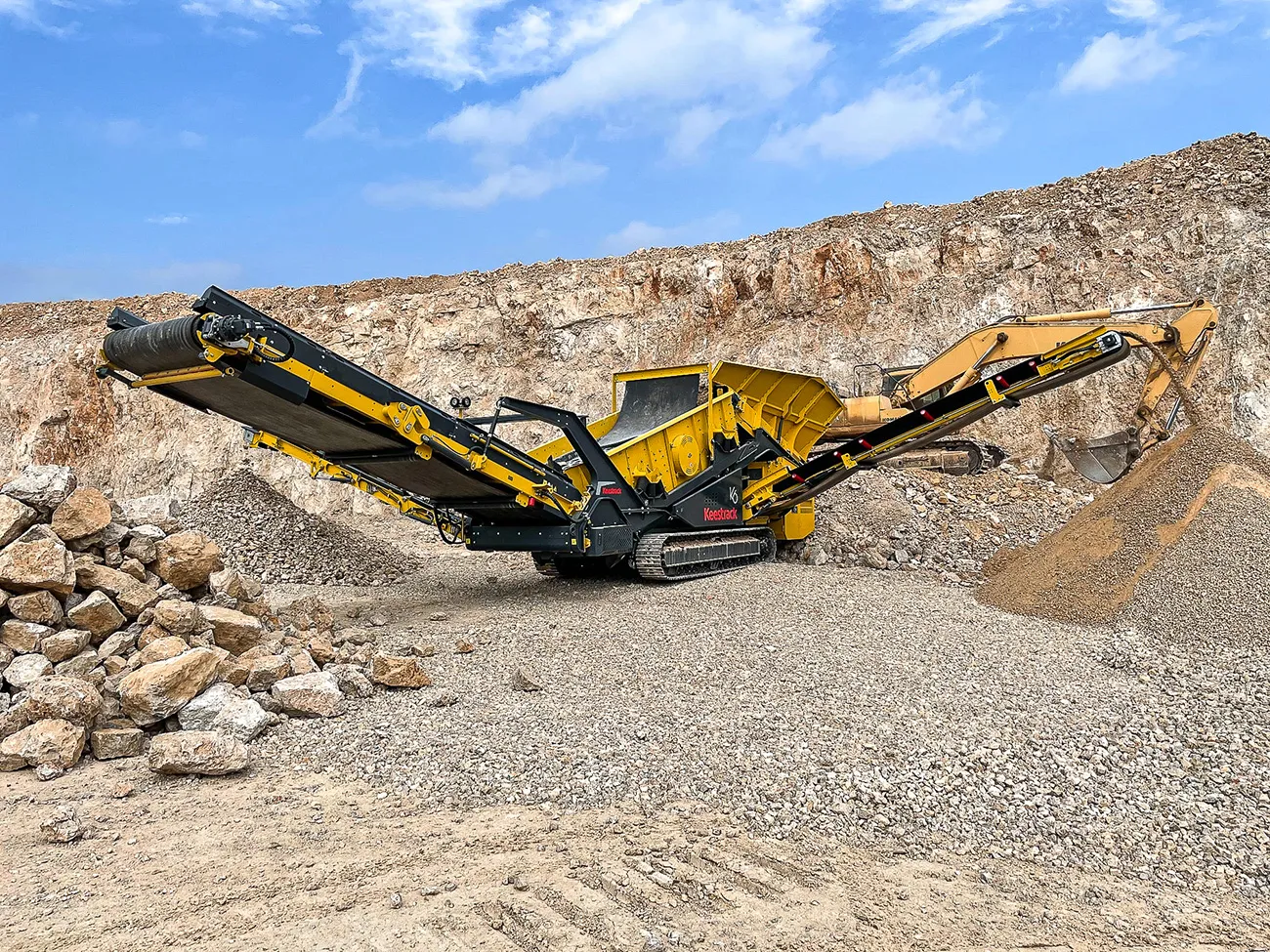
The most established and productive scalping screen on the market is the machine that started it all at Keestrack. Launched in 1996, the K6 remains at the cutting edge thanks to continuous R&D and a capacity of up to 700t/h (770 sT/h). Its long 4.500 mm x 1.800 mm (15′ x 6′) screen deck, heavy-duty standard apron feeder and hydraulically adjustable screening angle deliver unrivalled performance at the lowest cost per tonne. The wide range of options and screening decks available makes the K6 suitable for every screening application, from scalping the largest rocks to fine screening. Every Keestrack machine is designed for easy service access, to minimise maintenance and repair downtime. The K6 is fitted with a hydraulically raised screen, providing easy access to the screening decks and making them easier to replace.
The K6 is available in diesel-hydraulic, diesel-electric and ZERO versions. The ZERO version has no onboard combustion engine and is powered solely by electric motors. The K6 on display at Conexpo is the standard load-sensing diesel-hydraulic version, which consumes just over 11 l/h (3 gal/h).
The R3 impact crusher
The R3 impact crusher’s innovative technology, safety features and design have won several European design awards, including the Red Dot Award. This highly compact, easy-to-transport impact crusher has a capacity of up to 250t/h (275 sT/h). It is equipped with a vibrating feeder with a 1.200 mm x 920 mm (4’x3′) pre-screen, a 770 mm x 960 mm (30″ x 38 ») inlet opening (H x W), a rotor 1.100 mm (44″) in diameter and 920 mm (3′) wide, and a 3.100 mm x 1.400 mm (9’x4′) two-deck precision screen. It weighs just 32t (36 sT). The Keestrack is also available with a diesel-electric drive and plug-in functionality. The diesel-hydraulic version will be on display at Conexpo.
The B7 jaw crusher
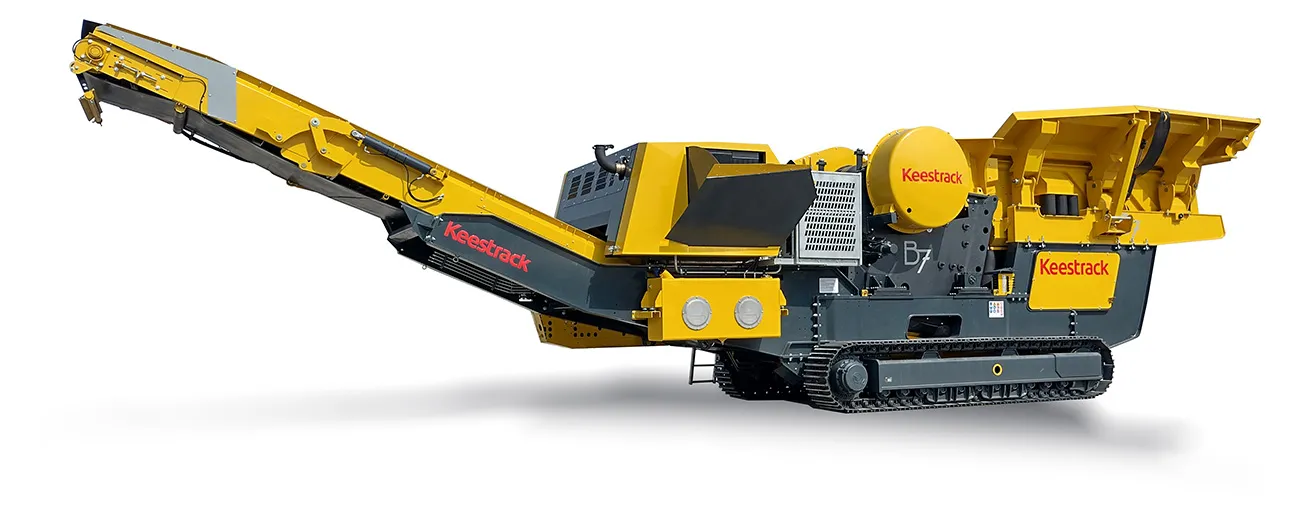
Keestrack designed the heavy-duty B7 jaw crusher specifically for the hardest rocks found in quarries and mines. The B7 jaw crusher is equipped with a vibrating feeder with a 2.200 mm x 1.080 mm (L x W) two-deck grizzly and a 1.450 mm x 870 mm (L x W) wire mesh bottom deck to optimise crushing results and reduce wear.
The material feed size can be up to 700 mm (28″), the feed opening measures 1.200 mm x 830 mm (47″ x 33″), and the C.S.S. discharge setting ranges from min. to max. 75 mm, 250 mm (3″, 10″). The jaw crusher features the patented N.S.S. non-stop system, which protects the crusher from uncrushable material and automatically resets the C.S.S. during operation. The jaw crusher itself weighs 28t (31 sT), while the easy-to-transport B7 jaw crusher weighs 70t (77sT) in total.
Keestrack’s vision for sustainability
“Our focus on sustainability is at the heart of our business, as it is the reason our company exists.
Producing and recycling valuable raw materials is the reason mobile crushing and screening exists.”, says Frederik Hoogendoorn, Vice President Sales & Marketing, “and our efforts are having a positive impact on our environmental footprint.” Over the years, alongside recycling, Keestrack has also become active in quarrying, mining and aggregates. “As these heavy industries require very powerful drive systems, Keestrack has continued to look for alternative drive systems. From load-sensing hydraulic systems to electric drives, including ZERO drives, meaning equipment with no onboard combustion engine and electric motors only. Demand for this has been driven by the Northern European market. We want to protect the planet and save money at the same time,” continues Mr Hoogendoorn.
Electric drive and removable engine
Keestrack introduced electric drives as early as 2012 with its e-drives, plug-in electric equipment with an onboard diesel engine/generator for use when no plug-in power connection is available. Electric-drive machines have evolved to feature a removable engine/generator unit that can be positioned beside the equipment, in a less dusty, lower-vibration environment, or on the machine chassis. These machines can be connected to one another, further reducing energy costs.
ZERO drive
Keestrack presented its ZERO-drive machines at Bauma Germany 2022 in response to growing demand from Northern European countries. This equipment has no onboard combustion engine at all. Electric motors drive most mobile crushing and screening equipment and power some of the necessary hydraulic systems. Most of the Keestrack product range is already available with ZERO drive: cone crushers, impact crushers, scalping and classifying screens, stockpiling conveyors, jaw crushers and the new A6 tracked apron feeder.
“Electric drive systems are currently the most environmentally friendly and efficient options on the market, as they outperform conventional hydraulic systems. They also make the end user less dependent on a specific engine supplier. If no plug-in connection is available, the end user can choose their own generator or select one of Keestrack’s (tracked) engine/generator units.”, explains Kees Hoogendoorn, President and founder of the Keestrack Group.
Dust suppression
Dust management is becoming increasingly important as environmental regulations evolve and multiply. Since crushing and screening often generate dust, Keestrack has added a dust suppression system to its product range, as the standard dust-control systems currently available for fitting to crushers and screens are not always effective.
The mobile W7 dust suppression cannon, with integrated water filter and pressure valve, is the largest in the Keestrack range. It weighs 675 kg (1490 lbs) and can be lifted using a standard forklift. It can also be fitted with a lifting eye.
How it works
The water is supplied at a pressure of 1 to 5 bar. It passes through a water treatment unit that filters out minerals and dust particles. The high-pressure pump forces the water through the nozzles at a pressure of 20 bar. The quick-connect nozzles create a mist of microdroplets, which the balanced, quiet fan propels into the air. Thanks to the cone’s aerodynamic shape, it creates a 70 m (230 ft) jet when the W7 is positioned correctly, in line with the wind. The mist of microdroplets captures dust particles, which combine and fall to the ground.
By controlling the size and quantity of the microdroplets, which can be done by adjusting the spray nozzles, the W7 can provide the best solution for your challenge.
The jet, water volume, angle and oscillation can be adjusted to suit the specific requirements of the process.
Question about this story? Ask your question
Keep following this
Get an email when a new story is published. No account needed.
- SubjectNews







